Applied Materials’ Besi Investment Puts Chip Packaging in Focus
A proposed minority investment puts chip connections in focus. Production reliability, customer adoption and costs determine the commercial value.
By The Strategic Newb Editorial Team
Event: · Published:
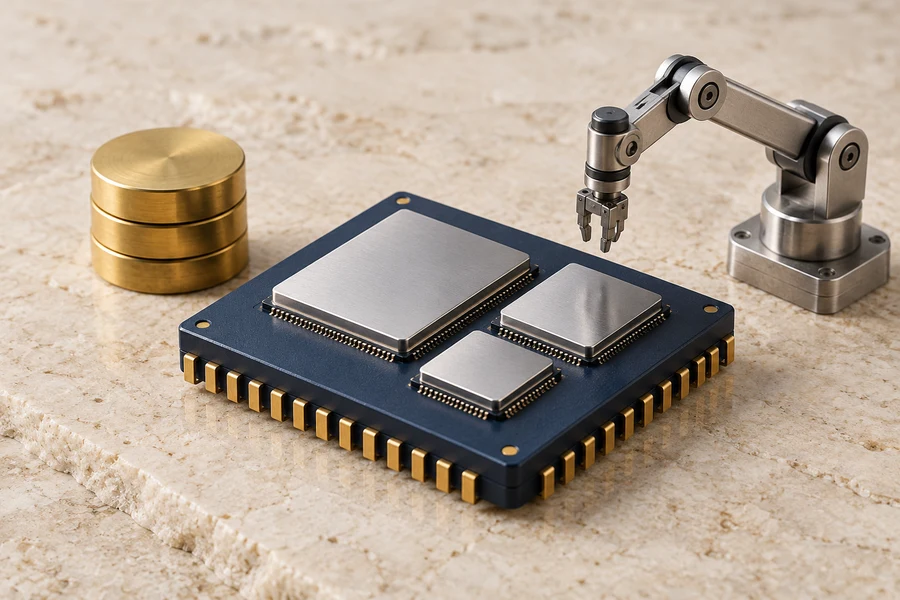
AI-generated with OpenAI image generation for The Strategic Newb
Applied Materials announced on 26 October that it has agreed to increase its investment in Dutch semiconductor equipment maker Besi to approximately 20%. Delivery of the shares remains conditional on the applicable US antitrust waiting period. This is an investment agreement, not evidence that the transaction has already completed. Applied Materials, 26 October 2026
For a new investor, the useful question is why the way chips are connected can matter economically. Faster individual components are only part of a computing system. Connecting them reliably, producing enough working units and keeping manufacturing costs manageable can determine whether technical progress becomes a commercially useful product.
- A larger minority holding is different from buying an entire company.
- Better connections can create value, but manufacturing reliability and customer spending determine the business outcome.
- The announcement is firm evidence of a strategic commitment; future cost savings and investment returns remain uncertain.
What changes in the relationship
Reuters reports that the proposed holding would rise from 9% to about 20%. The companies have collaborated since 2020. Applied says it does not intend to seek board representation or move beyond approximately 20%. Those limits matter when interpreting the announcement as a partnership investment. Reuters, 26 October 2026
An equity stake gives its holder a financial interest in a business. It does not automatically give that holder ownership of every product, factory or customer relationship. Likewise, a buyer purchasing shares should not be confused with customers ordering new equipment. These are different transactions, with different implications for revenue and cash flow.
The announcement therefore raises two separate questions. One concerns ownership and completion of the share transaction. The other concerns whether cooperation leads to equipment that customers can deploy profitably. Progress on the first question does not answer the second.
Why packaging belongs in the economics of computing
In this context, packaging means assembling and connecting semiconductor components into a usable system. It is more than the protective material around a chip. The connections have to carry information between components, while the finished assembly must operate reliably and be practical to manufacture.
Consider the underlying economic problem without assuming a particular performance improvement. A designer may have strong processing and memory components, yet still face costs in connecting, testing and cooling the whole system. Improving one component helps less if another part of the system remains the limiting factor. Spending can therefore shift toward the technologies that remove the next constraint.
Applied identifies advanced packaging, including hybrid bonding and new interconnect approaches, as areas of collaboration. These are development priorities in the company's announcement, not proof of completed improvements across customers' factories. Applied Materials announcement
The cost of a working unit matters most
For a manufacturer, the relevant cost is not simply the price of a machine. It includes installation, staff training, maintenance, materials, testing and the number of usable products the process produces. Yield is the share of production that meets the required standard. A difficult process can look impressive in a demonstration while remaining expensive if too many finished units fail testing.
A more capable machine could justify a higher purchase price if it produces enough additional usable output. Conversely, an expensive machine that spends too much time idle spreads its cost over fewer units. Reliability, production speed and demand need to fit together. This is an economic framework, not a reported calculation for Besi or Applied.
Customer qualification also matters. Before relying on a process for large volumes, a customer needs confidence that it works consistently within its own production system. That can make adoption slower than a technology headline suggests. Engineering progress and a customer's willingness to commit spending may arrive at different times.
Who could gain, and who faces pressure
Equipment suppliers could benefit if customers invest in more demanding assembly processes. Materials providers, testing specialists and skilled production workers may also find opportunities. The benefit depends on actual orders, delivery schedules and the cost of supporting customers, rather than the size of an announced shareholding alone.
Chipmakers face a different calculation. Additional capability can improve their product offering, but equipment purchases require cash before the resulting production generates income. If demand disappoints, capacity can become underused. A technology that is attractive strategically can still create financial pressure during an expensive transition.
For competing suppliers, closer coordination between established partners may raise the standard customers expect. It does not establish that alternatives will disappear. Customers can value multiple suppliers, compatibility and the ability to avoid dependence on a single production route. Competition and bargaining power remain questions to assess as commercial evidence develops.
Evidence and time horizon
Now, the observable development is the investment agreement. The evidence is strong for the existence of that announcement, supported by Reuters reporting. There is no completed-transaction confirmation in the sources used here, nor independently demonstrated savings attributable to this larger holding.
Over one to three years, useful evidence would include customer adoption, repeat equipment orders and how operating costs evolve alongside sales. That is an analytical observation period, not a promised company delivery schedule. Over a longer horizon, broader adoption would depend on whether new processes remain practical as product requirements change.
Technical success, commercial deployment and attractive profitability are separate milestones. Even an economically useful technology can disappoint shareholders if its expected success was already reflected in the price paid for the shares.
What to watch next
Watch for confirmation that the share-delivery conditions have been met, then for customer evidence that connects engineering work to production. Orders, utilisation, service requirements and cash generation would help distinguish a strategic ambition from a durable business result. No transaction completion date is assumed here.
For a beginning investor, a semiconductor equipment share is exposure to a company's earnings, spending cycle and valuation. It is not direct ownership of the computing gains a future technology might enable. This announcement helps identify an important industrial question: how much value can better chip connections create, and how much of that value can suppliers retain?
Sources
- Applied Materials: investment announcement, 26 October 2026, 4:30 p.m. EDT; linked above.
- Reuters via Investing.com: “Applied Materials to raise BESI stake to about 20%”, 26 October 2026; linked above.