Australia's 1 GW Project Ares AI Data Centre Drops Its 2028 Start Target
Australia's 1 GW Project Ares dropped its June 2028 target. See how regulation, power and water could slow the global AI infrastructure race.
By The Strategic Newb Editorial Team
Event: · Published:
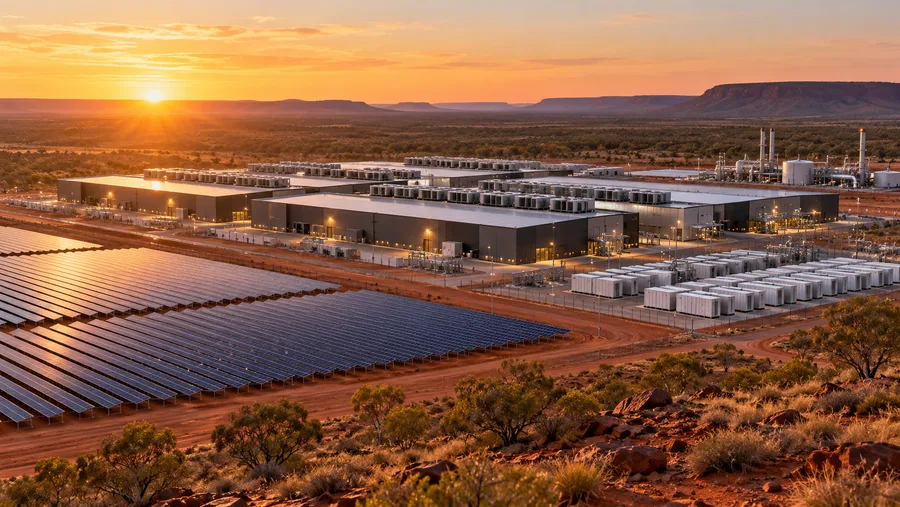
The Strategic Newb / AI-generated editorial illustration
Australia's proposed Project Ares AI data centre is no longer working toward its June 2028 first-power target. The delay shows why the next stage of the artificial intelligence boom may depend as much on permits, electricity, water and public acceptance as it does on advanced computer chips.
Energy North has dropped the original start target for Project Ares, a proposed one-gigawatt hyperscale data centre in Australia's Northern Territory. The developer confirmed that it is no longer working toward a first-power date of June 28, 2028, after the regional environmental regulator paused part of the assessment process.
The project has not been cancelled. However, it no longer has a fixed commissioning date. That distinction matters. Project Ares is a large test of whether remote locations with abundant land and energy resources can become competitive centres for artificial intelligence infrastructure.
The delay also exposes a wider economic constraint. Companies can order AI processors and raise billions of dollars, but a data centre cannot operate without dependable electricity, cooling, water, network connections and regulatory approval.
What changed with Project Ares?
On November 2, 2026, Reuters reported that Energy North had stopped using June 28, 2028 as the target date for the project's first electricity supply.
The developer had included that date in regulatory documents submitted several months earlier. Energy North now says that it cannot provide fixed approval dates. Construction would begin only after all required approvals are in place. A new operating schedule will therefore depend on the environmental review and the project's final investment decision.
The Northern Territory Environment Protection Authority decided that Project Ares requires a full environmental impact statement. This is the highest level of assessment under the territory's environmental law.
The regulator also suspended its deadline for finalising the assessment requirements while it consults the National Environmental Protection Agency. According to the regulator, the project could affect ten environmental factors. These include water, biodiversity, land use and sites with cultural importance.
This regulatory decision was published on October 7, 2026. The new development is that Energy North has now confirmed that the original 2028 timetable is no longer valid.
What is Project Ares?
Project Ares is a proposed hyperscale campus designed for artificial intelligence, cloud services and high-performance computing. Its planned information-technology capacity is one gigawatt.
A gigawatt is one billion watts. The number refers to the computing facility's proposed electrical scale, not the amount of computing performance it would deliver. For comparison, this is an exceptionally large power requirement for a single digital-infrastructure project.
The proposal includes more than server buildings. Energy North plans an integrated energy system with:
- Up to three gigawatts of solar-generation capacity
- Battery storage of up to 16 gigawatt-hours
- Gas-fired power for dependable and backup supply
- Roads, an airstrip and accommodation for construction workers
- Water infrastructure and as much as four gigalitres of groundwater use per year
The campus is intended to operate behind the meter and independently of the Northern Territory's public electricity grid. Energy North says the system would gradually move toward renewable-powered operation.
These plans are not completed assets. They remain part of a proposed project that still needs regulatory approval, detailed engineering and a final investment decision.
Why the Project Ares delay matters economically
The Australian government lists Project Ares as a major project with approximately A$11.9 billion in projected capital expenditure. The developer estimates that it could support about 4,400 construction jobs and up to 300 permanent jobs.
Those figures are projections rather than realised investment or employment. Nevertheless, losing the original timetable can affect economic decisions before construction starts.
1. Delays can increase financing costs
Large infrastructure projects normally require years of planning and several layers of financing. When the approval schedule becomes uncertain, investors may demand more protection or wait before committing capital.
Engineering teams, advisers and project developers must continue operating while the review proceeds. This can raise development costs even if construction eventually begins.
2. AI customers need predictable capacity
Cloud companies and AI developers plan computing capacity years in advance. They need to know when electricity, buildings and network connections will be available.
If a project cannot provide a reliable commissioning date, potential customers may reserve capacity in another region. That does not mean customers have already abandoned Project Ares. It is a commercial risk created by the delay.
3. Regional jobs and infrastructure may arrive later
The Northern Territory could benefit from construction spending, transport upgrades, energy development and demand for specialist workers. A postponed final investment decision would delay those potential benefits.
The same delay could also give local communities and environmental authorities more time to examine risks involving groundwater, ecosystems and culturally important land.
4. Power is becoming a competitive advantage in the AI economy
The AI industry is often described as a competition for advanced semiconductors. The Project Ares case shows that access to large quantities of dependable electricity can be equally important.
AI processors consume power continuously and generate substantial heat. A hyperscale campus therefore needs generation, storage, cooling and backup capacity. Regions that can approve and build this infrastructure efficiently may attract more AI investment. Regions with slow or unpredictable processes could lose projects to competing locations.
This is an economic inference, not a confirmed outcome of the Project Ares review.
Why Australia wants more AI data centres
Australia has several advantages as a potential data-centre market. It offers political stability, large areas of land, renewable-energy resources and submarine cable connections to Asian markets.
The Northern Territory wants to use its land, solar resources and proximity to regional network routes to attract investment outside Australia's established metropolitan data-centre markets.
However, remote projects also face disadvantages. They need new energy infrastructure, reliable water access, skilled labour, transport connections and community consent. Project Ares demonstrates how the same location can offer abundant physical space while creating complex approval and construction challenges.
Who could gain and who could lose?
Potential losers
- Energy North and its financial partners: A longer development period could increase costs and delay revenue.
- Construction and energy suppliers: Contracts and employment may begin later than expected.
- The Northern Territory: The region risks postponing a large investment and its associated economic activity.
- Prospective customers: AI companies may have to find alternative computing capacity.
- Australia's data-centre strategy: Competing locations could present themselves as faster or more predictable.
Potential gainers
- Competing Asia-Pacific data-centre locations: They could attract customers that require capacity before Project Ares is ready.
- Environmental and engineering specialists: A full impact assessment requires detailed technical work.
- Local communities and water users: A longer review can provide more scrutiny of environmental and cultural risks.
- Projects with simpler approval requirements: Developers with access to existing grids, industrial land or established water systems could gain an advantage.
Has Project Ares been cancelled?
No. Energy North says the project is continuing and that preparatory work for the environmental studies remains underway.
The company will establish a new schedule after regulators define the assessment requirements and the necessary approvals are obtained. Its current development plan links the final investment decision to regulatory approval. Commercial operation is targeted for 12 to 18 months after that investment decision, although all milestones remain indicative.
The most accurate description is therefore delayed and without a fixed start date, not cancelled.
What happens next?
The next important development will be the publication of the final terms of reference for the environmental impact statement. These terms will specify the studies and evidence Energy North must provide.
After that, investors should watch for four milestones:
- Completion and publication of the environmental impact statement
- Decisions from Northern Territory and federal regulators
- A final investment decision and confirmed financing
- A revised construction and commissioning schedule
Until those milestones are reached, the project's A$11.9 billion expenditure and employment estimates should be treated as projections.
The Strategic Newb view
The central lesson from Project Ares is that the AI infrastructure race is becoming a competition for physical permission.
Advanced processors remain essential, but they are only one part of the system. The winning regions will also need generation capacity, battery storage, water, land, network connections, qualified workers and credible approval processes.
Project Ares could still become a major Australian AI hub. Its missing 2028 target nevertheless provides a warning for the wider market: announced data-centre capacity is not the same as operating capacity.
Frequently asked questions
What is the Project Ares AI data centre?
Project Ares is a proposed one-gigawatt hyperscale data-centre campus in Australia's Northern Territory. It is intended to support artificial intelligence, cloud computing and high-performance computing.
Why has Project Ares been delayed?
The developer removed its June 2028 first-power target after the Northern Territory environmental regulator required a full environmental impact statement and suspended part of the assessment timetable while consulting the national regulator.
How much could Project Ares cost?
The Australian government's major-project listing gives an estimated capital expenditure of approximately A$11.9 billion. This is a project estimate, not money already invested.
How much energy would Project Ares use?
The proposed campus has an information-technology capacity of one gigawatt. Its supporting plans include up to three gigawatts of solar generation, as much as 16 gigawatt-hours of battery storage and gas-fired backup power.
Is Project Ares cancelled?
No. The project remains under development and environmental assessment. It currently has no fixed first-power date.
Sources
- Reuters, "Australian outback data centre pulls timeline after regulator stalls," November 2, 2026.
- Northern Territory Environment Protection Authority, "Project Ares — method of assessment," October 7, 2026.
- Northern Territory Environment Protection Authority, Project Ares consultation and assessment register.
- Australian Government EPBC Act Public Portal, Project Ares referral summary.
- Australian Government, Current Major Projects register.
This article explains technology and economic developments for general information. It does not provide personal investment advice.
More news →