Bedrock’s funding puts autonomous construction through the cost test
Funding supports expansion. Completed work, supervision and support costs determine whether autonomous construction can create lasting economic value.
By The Strategic Newb Editorial Team
Event: · Published:
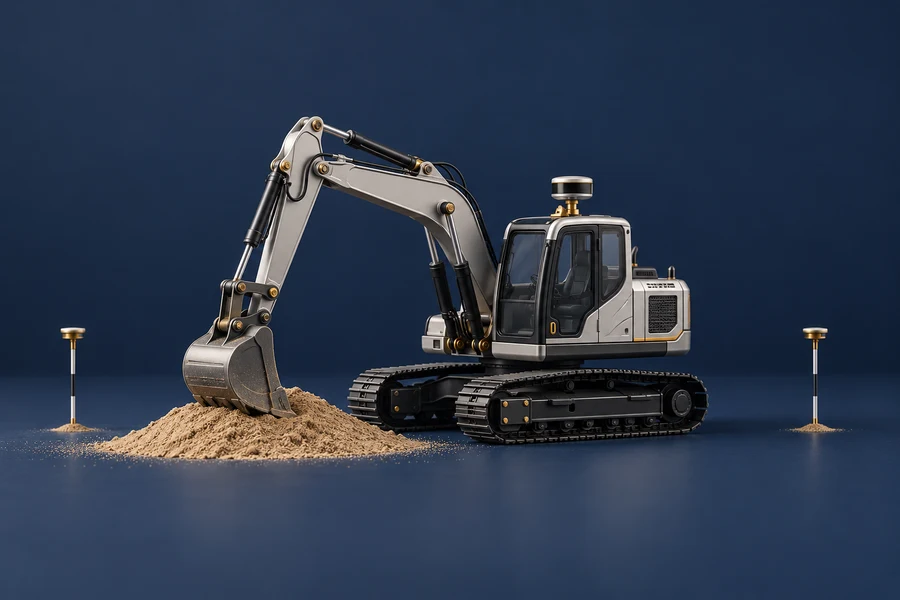
The Strategic Newb / AI-generated editorial illustration
A construction robot creates economic value only when it helps finish useful work at an acceptable total cost. Bedrock Robotics’ financing offers a recent example of that challenge. The company announced a $600 million Series C on 26 October 2026, co-led by CapitalG and Emergence Capital. This is an analysis of that announcement, not a claim of a new funding event on 2 November.
- New capital can support deployment, but a funding round does not establish profitable operation.
- Contractors need reliable completed work, including supervision, maintenance and integration costs.
- The potential benefits extend to infrastructure capacity; evidence must come from repeated customer use.
From a demonstration to a working business
Bedrock’s company announcement says autonomous excavators have performed paid work on commercial sites since August. CapitalG confirms its participation; it is an investor, not an independent evaluator. TechCrunch also reported the financing. The financing and the company’s commercial-use claim are meaningful developments, but neither establishes independently measured safety or profitability.
Series C names a stage of private-company fundraising. Investors provide capital under negotiated terms; this does not create an ordinary publicly traded share that a reader can buy on a stock exchange. More funding may give a company resources to hire, develop equipment and support customers. It also creates expectations about future growth that operating results must eventually justify.
There are three separate milestones. A technical demonstration shows that a task can be performed under specified conditions. Commercial deployment means a customer is using the system in a business setting. Profitable deployment requires the value of the work to exceed the full cost of delivering it. Progress through one milestone does not automatically complete the next.
Measure completed earthwork, not impressive motion
For an excavator, moving a bucket repeatedly is not the same as completing an acceptable job. The ground must end up in the right place and condition, within the project’s specifications. Work that needs correcting consumes equipment time, fuel and labour. A fast machine can still be expensive if its mistakes interrupt the rest of the site.
A useful comparison therefore begins with the cost per accepted unit of work. The calculation should include the machine, any automation equipment, software, installation, maintenance, fuel and human support. It should also include the cost of downtime and rework. Leaving those items out can make an attractive demonstration look more economical than the service customers actually receive.
Utilisation means how much of the available time equipment spends doing useful work. Higher utilisation can spread fixed costs over more completed tasks. Yet an excavator does not operate in isolation. If trucks cannot remove material quickly enough, or the next work area is not ready, faster digging may only create a queue. Improving the bottleneck matters more than maximising one machine’s activity.
Existing equipment still needs integration
Adding autonomy to a worksite involves connecting a machine’s behaviour with plans, boundaries and other people’s work. Instructions must be current, and the system needs a reliable way to handle unusual situations. Changing ground conditions, weather, access restrictions and maintenance needs can all alter the operating environment. These are general engineering and business considerations, not reported failures of Bedrock’s system.
A contractor also needs clear responsibilities. Who stops the machine when conditions change? Who diagnoses a fault, supplies replacement parts and checks that a repaired system can return to service? Those arrangements have costs, even if nobody sits continuously in the cab. The relevant comparison is the complete operating model, including the people supporting it.
Safety cannot be inferred from a funding figure or a single incident-free demonstration. Useful evidence would describe the operating conditions, exposure time, interventions and reporting methods. Comparing systems requires comparable definitions. A claim about performance on one type of site should not be silently extended to every terrain, task or machine.
Who could benefit, and who bears the costs?
Contractors could benefit if automation helps them finish more work with their available crews and equipment. Infrastructure owners could benefit from more predictable schedules. Suppliers of sensors, controls and maintenance services could gain demand. These are possible economic channels, not forecasts of revenue for specific companies.
Workers may face changes in the mix of tasks: less routine operation in some settings and more planning, supervision or maintenance. Training and the distribution of those roles matter. It is too early to turn one financing announcement into a confident estimate of jobs created or lost across construction.
The automation provider must fund development and customer support before a large installed base generates recurring income. Expanding too quickly can increase service demands faster than revenue. Customers, meanwhile, may prefer flexible contracts until they understand reliability and total costs. The financial interests of the supplier and contractor therefore overlap without being identical.
The time horizon and strength of evidence
Now, the strongest evidence concerns the announced financing and the companies’ descriptions of deployment. Over the next one to three years, repeat orders, independently documented operating results and support costs would help assess scalability. That is an analytical horizon, not a promised timetable. Coordinating many different machines across entire sites is a longer-term possibility whose economics still need demonstration.
For a new investor, the broader lesson is that a technological advance and an attractive investment return are separate questions. Even useful technology can face strong competition, high support expenses or a purchase price that already assumes substantial success. This article identifies the business questions without recommending an investment.
What to watch next
Look for customer evidence covering repeated projects rather than one selected trial. The most informative disclosures would connect completed work, operating hours, human interventions and total costs. Contract renewals and expansion by existing customers would be useful signals, although they would still not reveal every cost. The commercial test is whether dependable work can be delivered repeatedly at terms that make sense for both contractor and supplier.
Sources
- Bedrock Robotics Raises $600 Million Series C — Bedrock Robotics via GlobeNewswire, 2026-10-26T09:35:00-04:00.
- Doubling Down on Bedrock — CapitalG, 2026-10-26.
- This startup’s self-driving excavators help dig up $600M in new funding — TechCrunch, 2026-10-26T10:45:00-07:00.