Britain’s Titania Satellite Shows Why Space Security Is Economic Infrastructure
Titania and Project Inaros combine a British military satellite with a three-country sensor trial. The economic story is the growing value of sovereign space infrastructure.
By The Strategic Newb Editorial Team
Event: · Published:
The Strategic Newb image library
Modern economies depend on satellites even when most people never see the systems involved.
Navigation, communications, weather forecasts, military coordination and the precise timing used by financial and industrial networks all rely on services delivered from orbit.
Britain’s latest defence-space announcement shows how protecting those systems is becoming part of industrial and economic policy.
On November 7, 2026, the UK Ministry of Defence confirmed that the British-built Titania satellite was in orbit. It also announced the establishment of Project Inaros, a trial network of ground-based sensors designed to detect unusual activity close to UK satellites.
The development combines two capabilities: observing Earth from orbit and monitoring what is happening around important spacecraft.
What changed on November 7?
Titania is the second satellite in the UK’s growing ISTARI military constellation. It follows Tyche and is expected to be joined by Juno and Oberon.
The satellite itself launched during October 2026. The new development on November 7 was the official confirmation that Titania was in orbit together with the announcement that Project Inaros was being established.
Titania weighs approximately 100 kilograms and circles Earth about once every 90 minutes. It was designed and built in Hampshire through cooperation between the Defence Science and Technology Laboratory and BAE Systems under a £9.5 million contract.
Project Inaros will test three ground-based neuromorphic sensors. They will be positioned in the UK, Australia and at British facilities in Cyprus.
The sensors were developed by British-Australian company Optera with the National Security Strategic Investment Fund.
What does Titania do?
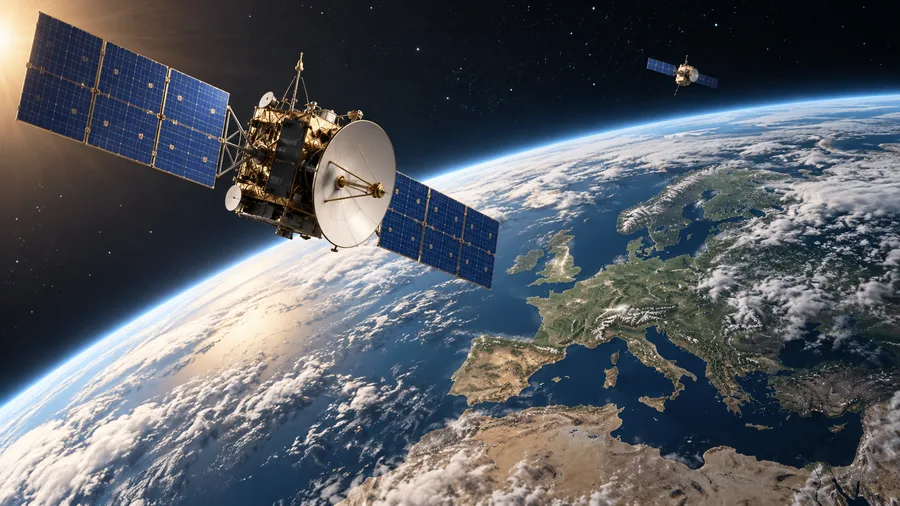
Titania is a small military observation satellite operated by UK Space Command.
Its role is to gather information that can support intelligence, surveillance and reconnaissance. Data from space can help armed forces understand activity across large geographic areas without relying only on aircraft or ground-based systems.
Small satellites can be cheaper and faster to develop than large traditional platforms. A group of smaller spacecraft can also provide more frequent coverage and reduce dependence on one expensive asset.
However, Titania is part of a developing constellation rather than evidence that the UK already has a complete independent surveillance network.
How does Project Inaros work?
Titania looks down toward Earth. Project Inaros looks upward into space.
The Inaros sensors use neuromorphic technology. A conventional camera repeatedly captures complete images, including areas where nothing has changed. A neuromorphic sensor responds primarily when it detects a change in light.
This approach is inspired by biological vision. It can reduce unnecessary data processing and help identify small moving objects against a dark or complex background.
For space monitoring, that could make it easier to detect an object approaching a satellite or moving in an unexpected way.
The UK government says the technology could become an early-warning system for threatening activity near British spacecraft. That capability remains an intended outcome. No public trial results were available when the announcement was made.
Why satellite security has an economic impact
Space infrastructure supports ordinary economic activity.
Navigation satellites guide transport and logistics. Communications satellites connect remote locations. Weather observations affect agriculture, aviation and energy planning. Precise satellite timing helps synchronize communications and financial systems.
Disruption to these services could create costs far beyond the space industry itself.
This means investment in space security can have two economic functions. It can protect services on which companies depend, and it can support a domestic industrial base capable of building and maintaining the required technology.
The UK has committed more than £3 billion to defence-space capabilities over four years. This is a broad program budget, not the individual cost of Titania or Inaros.
If the wider pipeline produces regular orders, it can support companies working in spacecraft manufacturing, electronics, sensors, secure communications, software and ground-control systems.
Who could gain?
BAE Systems benefits from its involvement in Titania and from future demand for sovereign space capabilities.
Optera could gain if the Inaros trials demonstrate that neuromorphic sensors are useful for operational space monitoring.
SSTL and Airbus are connected to the planned Juno and Oberon satellites. Their participation shows how the program may distribute work across several established suppliers.
Smaller businesses could benefit as subcontractors providing components, software, testing and specialist engineering.
Workers with experience in electronics, optical systems, space software and data analysis may also see stronger demand for their skills.
Who could lose or face disruption?
Foreign suppliers may face reduced opportunities if Britain prioritizes domestically controlled technology and supply chains.
Traditional optical-sensor providers could face competition if neuromorphic systems prove more efficient for certain monitoring tasks.
Taxpayers carry the risk that experimental technology does not produce a useful operational capability.
Commercial satellite operators could also face higher insurance and security costs if growing military competition makes orbit more contested.
The impact horizon
Titania’s deployment has an Immediate effect because the satellite is already in orbit and can begin contributing to the ISTARI program.
The industrial effect is more likely Within 1–3 years. Project Inaros must complete trials, while Juno, Oberon and other planned capabilities create potential future orders for suppliers.
The wider economic benefit of improved satellite resilience is Longer term and difficult to measure. Avoided disruption is valuable, but it does not appear as direct revenue in the same way as a manufacturing contract.
Evidence and confidence
The evidence is Moderate and confidence is Medium.
The UK government confirmed Titania’s status, the £9.5 million development contract and the Inaros trial. Established British news organizations reported the announcement.
However, most detailed capability claims originate with the Ministry of Defence. No independent performance data for Titania or Inaros was released.
Statements about jobs, security and industrial strength are policy expectations. They should not be presented as measured results.
The wider £3 billion investment figure covers multiple defence-space capabilities. It is not the cost of Titania and Project Inaros alone.
The Strategic Newb angle
The strongest angle is that space sovereignty is becoming economic infrastructure policy.
Britain is trying to maintain the ability to build satellites, monitor orbit and protect services that support civilian and military activity. That requires domestic engineering knowledge, specialist suppliers and a long-term procurement pipeline.
The important question is whether small government programs such as Titania and Inaros can anchor a wider, commercially competitive space industry—or whether suppliers will remain dependent on defence spending.
Key takeaways
- Britain confirmed on November 7 that Titania was in orbit following an October launch.
- Titania is the second satellite in the UK’s developing ISTARI constellation.
- Project Inaros will test three neuromorphic sensors in the UK, Australia and Cyprus.
- Titania was developed under a £9.5 million contract.
- The wider £3 billion figure applies to the UK’s broader four-year defence-space investment program.
- Inaros is an experimental trial, and no performance results have been released.
Frequently asked questions
Did Titania launch on November 7, 2026?
No. The Ministry of Defence said the launch occurred in October. The November 7 announcement confirmed that Titania was in orbit and introduced the new Project Inaros trial.
What is a neuromorphic sensor?
It is a sensor inspired by biological vision. Instead of recording complete images continuously, it focuses on changes in light, which can reduce data processing and help track movement.
Is the £3 billion budget for Titania alone?
No. Titania was developed under a £9.5 million contract. The £3 billion commitment covers a much broader range of UK defence-space capabilities over four years.
Has Project Inaros proved that it can protect satellites?
No. It is entering a trial phase. Its effectiveness must still be demonstrated through testing and operational evidence.
Sources
- UK Ministry of Defence: Titania and Project Inaros announcement
- Sky News: Titania enters orbit
- Defence Industry Europe: Titania and Inaros overview
- UK government: Original £9.5 million Titania contract
This article provides economic and technology analysis, not personal investment advice.
More news →