Bull Doubles French Supercomputer Factory Capacity as Europe Builds AI Infrastructure
A physical expansion in Angers brings assembly capacity to 12 racks a month, while Europe's dependence on imported processors remains.
By The Strategic Newb Editorial Team
Event: · Published:
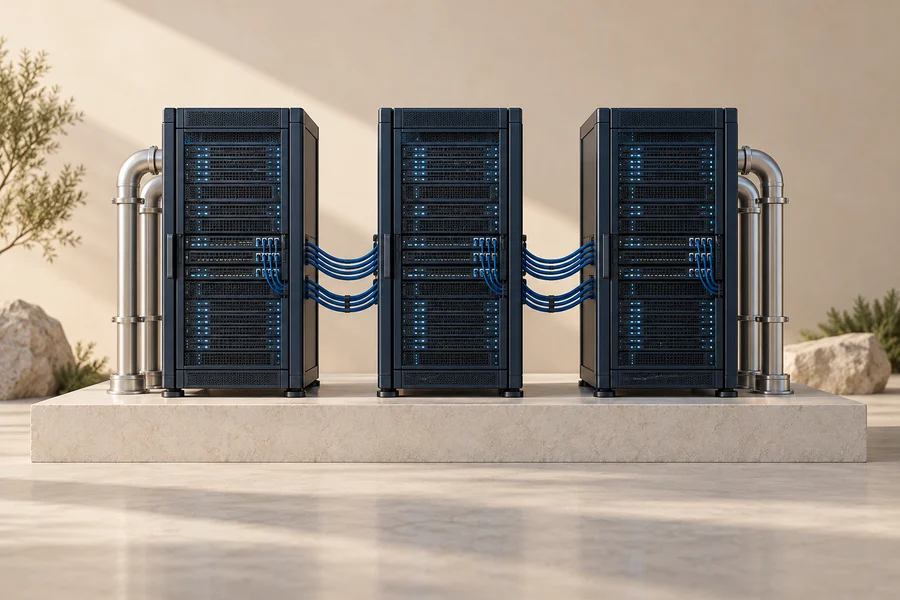
AI-generated with OpenAI image generation for The Strategic Newb
Europe's AI ambitions need more than research grants and cloud contracts. They need factories that can put large computing systems together. On October 1, 2026, Reuters reported on French supercomputer maker Bull’s expanded plant in Angers. Its executives told Reuters, which reported from the facility, that an €80 million expansion has raised assembly capacity from six to 12 supercomputer racks a month.
Date clarification, October 2, 2026: Bull’s own announcement dates the opening of the new production building to October 2. The Reuters report was published on October 1. Bull says the wider reconstruction project is due for completion in 2028; opening this building does not mean the entire modernization is complete.
Bull says the factory could reach 24 racks a month in 2027 if demand warrants it. That second increase is an option, not current output. The difference is central to the economic story: Europe has added real assembly capacity now, while the larger scale still depends on orders and execution.
What does a supercomputer factory actually make?
A supercomputer is built from many linked machines that work on a problem together. Those machines sit in racks with processors, memory, networking, power distribution and cooling. Some systems help scientists simulate weather or materials; others can train or run large AI models. Increasing rack assembly capacity makes it possible to manufacture and test more of these interconnected systems at the same time.
According to Reuters, the larger Angers plant allows Bull to work in parallel on two major orders that could not previously have been built together: France's Alice Recoque system, involving 94 racks, and Finland's LUMI-AI. The EuroHPC Joint Undertaking has signed a contract for LUMI-AI, giving independent institutional support for the existence of that order. Those contracts show demand for systems, but a rack-capacity figure alone does not tell us delivered computing performance or utilization.
Why assembly capacity matters to Europe's economy
Building systems in Europe can capture engineering, integration and maintenance work closer to European customers. It may also reduce the time and complexity of delivering publicly funded computing projects and give local AI developers, researchers and industrial companies access to more capacity. For companies that depend on simulations or model training, compute availability can influence product-development speed and investment decisions.
There is a strategic trade dimension as well. Reuters reported that European-made components now account for about 70% of the machines under construction at Angers, up from 20% to 30% five years ago, according to Bull's account. Treat that percentage as a company-reported supply-chain measure, not an independently audited figure or a claim that 70% of all value is European. The plant still uses processors from Nvidia, AMD and Intel, depending on customer needs. Local assembly therefore strengthens one layer of Europe's capacity without eliminating dependence on non-European chip suppliers.
Bull also reports a strong order pipeline. Its chief executive told Reuters the company had won 15 of 18 EuroHPC tenders, a company claim that should not be confused with an independently calculated market share. Separate EuroHPC information on France's Alice Recoque contract and Finland's LUMI-AI order helps establish the tangible projects behind the expansion.
The potential winners and bottlenecks
Bull and its European equipment and services suppliers could benefit if more systems are ordered and delivered. Research institutes, AI developers, manufacturers and aerospace companies could gain from better access to powerful computing. European workers in system integration, cooling, power engineering and servicing may see more demand.
Competing supercomputer vendors face a stronger local manufacturer, while buyers could still encounter bottlenecks in advanced processors, memory or other imported parts. Public funders bear the risk that expensive hardware is delivered without sufficient access, software support or productive use. Factory throughput is an input to economic value, not the value itself.
The immediate change is the doubled assembly capacity at Angers. Its effect on delivery schedules and regional supply chains is most likely within one to three years as contracted systems are assembled and deployed. Any wider productivity or AI-industry benefit is longer term, depending on how researchers and businesses use those machines.
What will show whether the expansion worked?
Watch actual racks shipped, project completion dates, procurement of key components, the size and location of supplier contracts, and utilization of the finished systems. Those indicators will reveal whether the factory expansion improves Europe's effective compute access rather than only its nominal manufacturing capacity.
The Strategic Newb angle: Europe's compute sovereignty is being built in layers. Angers improves the ability to assemble and deliver supercomputers locally, while imported processors and the challenge of turning installed machines into economic output remain.
Sources and evidence
- Reuters, October 1, 2026: reporting from Bull's expanded Angers factory.
- EuroHPC Joint Undertaking, August 31, 2026: LUMI-AI contract.
- EuroHPC Joint Undertaking, November 18, 2025: Alice Recoque contract.
Evidence: Strong for the reported physical expansion and documented project orders; moderate for Bull's own output and component-share figures. Confidence: High that assembly capacity has expanded, medium on the eventual economic payoff.
More news →