Cisco’s New AI Network Chip Puts Data Costs in Focus
Faster connections may improve useful output. Deployment, reliability and total costs determine whether new networking hardware creates economic value.
By The Strategic Newb Editorial Team
Event: · Published: · Updated:
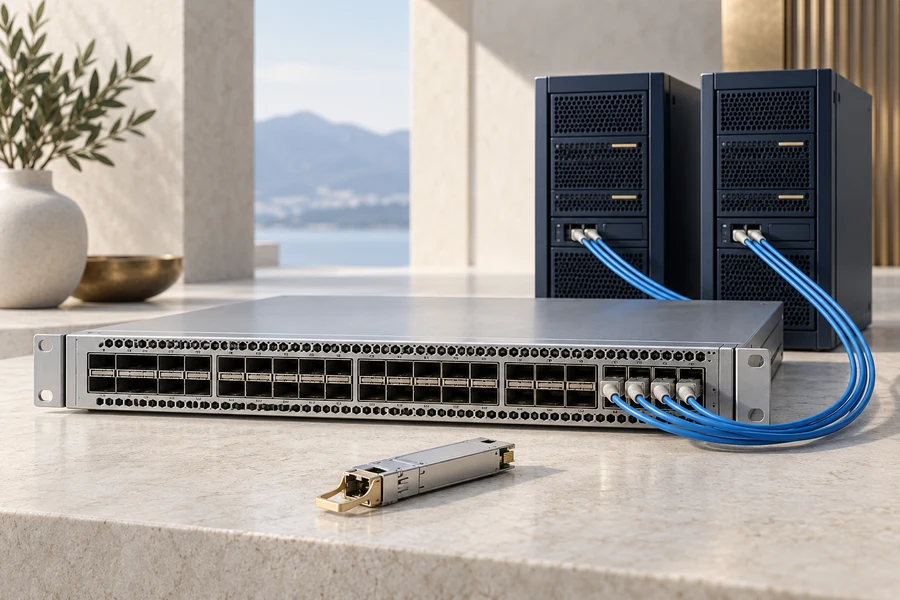
AI-generated with OpenAI image generation for The Strategic Newb
Cisco’s 12 October announcement at the Open Compute Project summit puts another part of the AI investment cycle in focus: the network connecting expensive computers. Its new G302 switch chip is planned to begin shipping before the end of 2026. For beginners, the important question is whether better connections help operators obtain more useful work from the equipment they already finance.
Three key points
- Network capacity can affect how efficiently a data centre uses its computing equipment.
- A product specification and a planned shipment are different from measured customer savings.
- Buying faster hardware only makes economic sense when useful output justifies the full cost.
What the new chip actually does
Cisco’s data sheet describes G302 as a 51.2-terabit-per-second switching processor. A switch directs data between connected machines; it is not the processor that trains an AI model. A terabit is a unit of data, so this capacity measures data movement rather than intelligence or the number of profitable customer orders. The document also lists support for different connection speeds.
Cisco separately announced plans with Nvidia for an open specification for a new pluggable optical module. Such modules connect equipment through optical signals. The company release presents this as development work. It should not be read as proof of a completed, widely deployed standard. SiliconANGLE independently reported the announcements, but its coverage is not an independent test of cost savings.
The economic cost of waiting for data
A data centre pays for more than computer chips. It needs buildings, electricity, cooling, network equipment, software and skilled staff. Some costs continue even when a machine is waiting. If a computing task repeatedly pauses for information to arrive, expensive processing capacity may produce less useful output during the same operating period. This is the economic reason a connection can matter as much as a headline processor specification.
A bottleneck is the part of a process that limits the whole process. Removing one can help, but only when it is the actual constraint. A faster network does little for a workload held back mainly by slow storage, unsuitable software or insufficient demand. Operators therefore need measurements from representative jobs, not just the maximum capacity of one component. The useful comparison is completed work at an acceptable quality and total cost.
Upfront spending versus recurring savings
Capital expenditure is money spent on assets intended to last, such as servers and network equipment. Operating expenditure covers recurring costs such as electricity and maintenance. An upgrade increases the first category immediately. It may reduce the second category per completed job, or allow more jobs to run on the same site. Neither outcome follows automatically from a higher connection speed.
Installation also has a cost. Staff must test compatibility, plan migrations and understand how to diagnose failures. Replacing a component may require changes elsewhere in the system. An operator can rationally keep older equipment if the additional output from a replacement does not cover these costs. Technological progress and the timing of a sensible purchase are separate questions.
Who could gain—and where competition enters
Equipment suppliers could gain revenue from upgrades. Optical-component makers and integration specialists could see additional work. Data-centre customers could benefit if operators pass lower costs through to service prices. These are possible channels, not announced financial results. Suppliers also face development costs, competing designs and customers that can postpone orders.
An open specification can make it easier for different manufacturers to build compatible equipment. That could broaden purchasing choices and reduce dependence on one supplier. However, a published specification is only a starting point. Buyers still need working implementations, support arrangements and evidence that parts operate reliably together. More choice may improve buyers’ bargaining power while putting pressure on suppliers’ margins.
Evidence and time horizon
Now: the announcement and data sheet establish what Cisco is offering and planning. They do not establish customer returns. Over one to three years, deployment decisions and operating results could reveal whether the approach delivers useful savings. That period is an analytical horizon, not a company delivery promise. Longer-term effects depend on demand for AI services and the competing ways to build them.
For a new investor, exposure can sit in a supplier’s sales, an operator’s investment budget or a customer’s cloud bill. These businesses do not benefit in the same way. Faster equipment may be commercially successful while a particular investment still disappoints because the purchase price already assumed strong growth. Product progress alone cannot establish an attractive investment return.
What to watch next
Watch for actual G302 shipments, customer deployments and comparisons of complete systems under similar workloads. For the optical initiative, look for the specification and participation by other suppliers. Useful evidence would connect speed with reliability, energy use and the cost of completed work. Avoid treating a laboratory result, commercial deployment and sustained profitability as the same milestone.