Crusoe’s $700 Million Facility Shows Why AI Power Needs Financing
Crusoe’s equipment-backed facility shows how AI power investment links early spending to future computing income, without proving lower costs or profits.
By The Strategic Newb Editorial Team
Event: · Published:
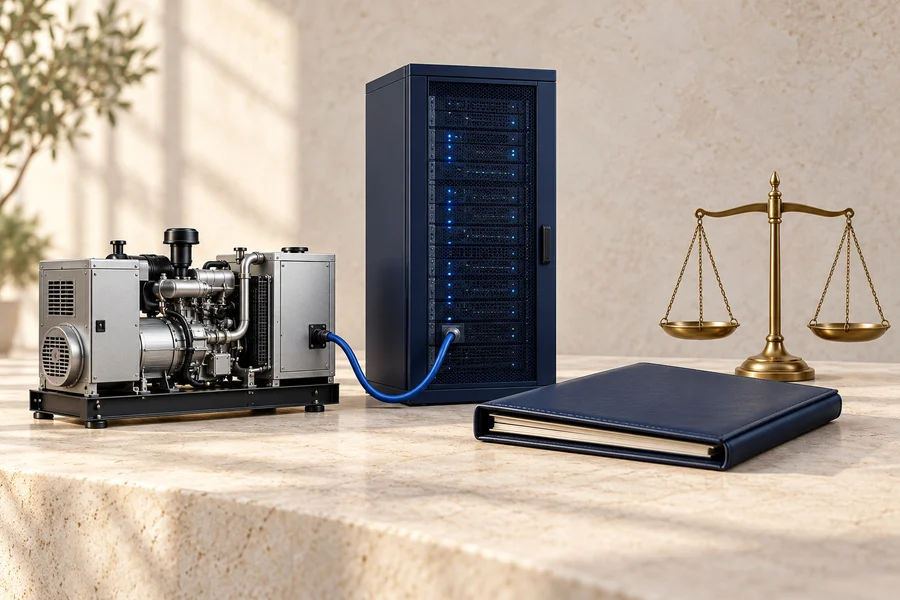
AI-generated with OpenAI image generation for The Strategic Newb
Crusoe and Neuberger Specialty Finance announced a $700 million financing facility on 22 October to purchase power infrastructure for AI data centres that Crusoe builds and owns. The facility is secured by recently ordered power-generation equipment, according to the companies’ announcement. For beginners, the important connection is between equipment ordered today and computing revenue that may arrive later. Funding the gap is part of building AI infrastructure.
This is an analysis of an announced financing arrangement. It is not evidence that $700 million has already been drawn, that generators are operating, or that the resulting data centres will earn a profit.
- The announced facility finances power infrastructure, with equipment serving as collateral.
- On-site generation can change how a data centre obtains electricity, while adding fuel, maintenance and financing obligations.
- The announcement establishes the financing plan; delivery, operating performance and investment returns remain separate questions.
What the announcement actually establishes
The primary release identifies gas generators and behind-the-meter power as the purpose of the arrangement. Behind-the-meter generation means electricity is produced on the customer’s side of the utility meter, rather than being obtained entirely through the public grid. That description does not establish whether a particular site will operate independently of the grid, nor how much backup it will require.
The release says the financing is secured by recently ordered equipment. Collateral is an asset pledged to support a loan: if a borrower cannot meet its obligations, the lender may have rights over that asset under the agreement. The precise enforcement rights and other terms are not supplied in this announcement.
A 23 October report from The Inference also describes the arrangement. Its interpretation does not independently establish future operating results. The factual core here remains the companies’ own disclosure. That disclosure does not provide the facility’s interest rate, maturity or associated megawatt capacity, so those details cannot be used to calculate a reliable cost of power or return.
Why the timing of cash matters
An AI data centre needs more than chips. Servers, electrical equipment, cooling and buildings must work together before the facility can reliably sell computing services. These components can have different ordering, delivery and installation schedules. An early equipment payment can therefore occur well before a customer starts paying for usable capacity.
A financing facility offers a way to bridge that timing gap. It does not remove the gap’s economic cost. Interest and repayment obligations still have to fit the project’s eventual cash flow. A facility’s announced size also differs from the amount actually borrowed: the release does not establish that the whole $700 million has been spent.
Debt differs from equity, the ownership capital supplied by shareholders. Borrowing can finance assets without issuing an equivalent amount of new ownership, but it creates contractual payment obligations. Whether that trade-off is attractive depends on terms and operating outcomes that this announcement does not settle.
Owning power equipment changes the cost structure
Purchasing generation equipment creates an upfront capital expense: money committed to a long-lived asset. Running it then creates operating expenses, including fuel, maintenance and staffing. Financing adds another layer of cost. A useful assessment must consider all of these, rather than treating an equipment purchase as a complete electricity solution.
On-site generation may give a developer another option when arranging electricity supply. However, machinery still needs to be delivered, installed, permitted and connected to the systems it serves. Fuel must be available, and equipment outages must be managed. The announcement does not demonstrate that these steps are complete for the financed assets.
Gas generation also exposes a project to fuel-price changes and emissions-related requirements. Local siting, noise and air-quality considerations can matter. These are general project risks, not a claim that a specific Crusoe installation has encountered a particular problem. The facility announcement supplies no measured evidence of lower electricity costs.
Who could benefit, and who carries the risk?
Equipment suppliers can gain business when data-centre developers place orders. Their economic benefit depends on delivery, payment and the profitability of those orders. A financing announcement alone does not establish a supplier’s realised earnings or identify which listed company will capture them.
For Crusoe, the potential benefit is better alignment between equipment procurement and data-centre development. The corresponding risk is committing capital and taking on obligations before the assets generate enough cash. Delays elsewhere in a project could leave otherwise useful equipment waiting for the rest of the facility.
For the lender, collateral offers a potential source of recovery, but it does not guarantee that a loan is safe. Equipment can lose value, take time to sell or require costly relocation. For computing customers, the relevant outcome is dependable capacity at an acceptable price. The existence of financing proves neither reliability nor a particular price advantage.
The timeline and strength of the evidence
Now, the verifiable development is an announced $700 million facility backed by equipment. Evidence for the announcement is direct and strong; evidence for its eventual economic success is not yet supplied. The two should not be combined into a claim that the financing has already solved a power constraint.
Over a one-to-three-year analytical horizon, the questions are whether equipment is delivered, infrastructure enters service and customer income supports operating and financing costs. This is a framework for monitoring development, not a company-provided completion timetable. Over longer periods, utilisation, maintenance and replacement needs help determine whether the assets remain economically useful.
What a new investor should watch next
Look for disclosed borrowing terms, actual amounts drawn, equipment delivery and commissioned capacity. Then separate technical operation from commercial performance: a functioning generator does not prove that the associated computing business is profitable. Customer commitments, revenue and costs need their own evidence.
The broader lesson is that AI expansion creates demand for physical infrastructure and capital at the same time. Owning an equipment supplier’s shares, lending to a developer and owning a computing business provide different exposures. This financing announcement explains one part of that chain; it does not establish an attractive investment return for any of them.
Sources
Neuberger and Crusoe announce $700 million facility, Crusoe newsroom, 22 October 2026: primary announcement. Neuberger’s $700 million Crusoe loan, The Inference, 23 October 2026: secondary reporting; not independent validation of projected effects.
More news →