Europe Selects 46 Raw Material Projects: From Policy to Production
Europe’s new project selection targets material supply chains. Financing, permits and dependable output will determine whether strategic ambitions become economic value.
By The Strategic Newb Editorial Team
Event: · Published: · Updated:
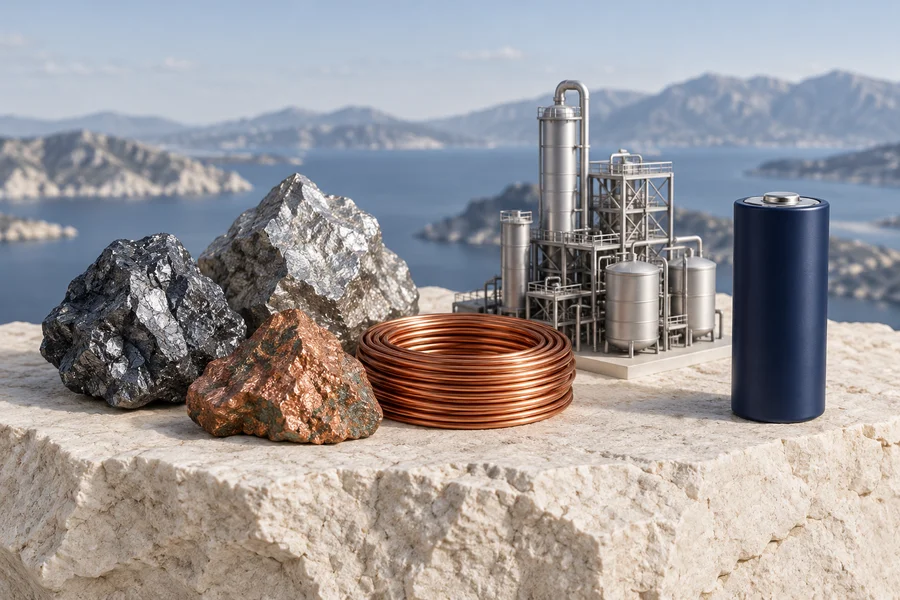
AI-generated with OpenAI image generation for The Strategic Newb
The European Commission selected 46 new strategic raw material projects on 9 October, spanning 16 EU countries. The announcement puts a practical question behind Europe’s industrial ambitions: how do minerals become a dependable supply of usable materials? Selection is a policy milestone. Financing, construction and commercially viable production still have to follow.
Three things to understand
- The new selection covers extraction, processing and recycling, including projects that combine stages.
- More possible suppliers can reduce disruption risk, but a project designation does not establish production costs or customer demand.
- For investors, the useful evidence is financing, permits, contracts and consistent output—not the strategic label alone.
Why the factory matters as much as the mine
A mineral deposit is a starting point. Extraction removes material from the ground. Processing turns it into a form that another manufacturer can use. Recycling recovers usable material from waste or products. These stages need different equipment, expertise and customers. Owning access to a resource does not automatically provide the chemical purity or reliable deliveries an industrial buyer requires.
The Commission’s wider framework links these supply chains to batteries, clean technology, defence and aerospace. Its 2030 benchmarks distinguish extraction, processing and recycling capacity. That distinction matters: a bottleneck at one stage can leave equipment elsewhere underused. More mining alone cannot solve a shortage of suitable refining capacity.
How a supply decision reaches company costs
The economic mechanism starts with reliability. A manufacturer that cannot obtain a small but essential input may have to slow an entire production line. Payroll, premises and some financing costs continue even when fewer finished products leave the factory. A second qualified supplier can therefore have value beyond a lower purchase price. It can help the buyer maintain deliveries to its own customers.
That resilience is not free. Maintaining alternative sources can require testing, additional inventories and contracts with minimum purchases. A nearer supplier might reduce transport complexity while charging more for production. The relevant comparison is the total cost of obtaining a dependable input, including the consequences of interruptions. It is not simply the cheapest quoted price for a tonne of metal.
For a new materials producer, the calculation runs the other way. It must pay for buildings and equipment before steady sales arrive. Borrowing creates interest obligations. Issuing new shares can spread future profits across more owners. A strategically useful plant can still be a difficult investment if construction costs rise or selling prices fall.
A designation is not a completed funding round
EFE’s independent report puts developers’ estimated investment needs for the selected projects at €21.1 billion, while noting that Brussels had not specified its public funding contribution. That is a capital requirement, not a statement that this sum has been paid out. This article does not assign a budget or completion date to an individual project.
A useful next document is an offtake agreement: a contract under which a customer commits to buying output. Such a contract can help a lender assess future income. But its price formula, duration and conditions matter. A non-binding expression of interest gives less certainty than an enforceable purchase commitment. Neither eliminates the need to produce the required quality at an acceptable cost.
Who could benefit—and what could delay progress
Equipment suppliers and engineering firms could receive work if projects reach construction. Industrial buyers could gain alternative sources if plants qualify and deliver. Existing producers could face more competition. These are possible channels, not measured effects of this announcement. The benefits would arrive at different times, and a construction order does not guarantee a profitable operating business for the project owner.
Feasibility also depends on electricity, water, transport, trained workers and environmental requirements. Recycling has a further constraint: enough suitable discarded material must be collected, sorted and processed. A recovery technology demonstrated on selected samples may behave differently with inconsistent commercial feedstock. Technical capability, industrial operation and profitability are separate tests.
Time horizon and strength of evidence
Now, the strong evidence is the official selection, corroborated by independent reporting. Over one to three years, the informative milestones would be permits, financing and construction progress, depending on each project’s stage. Over a longer horizon, consistent deliveries and cash generation would demonstrate economic usefulness. These are monitoring horizons, not promised opening dates. The designation itself cannot establish when every site will operate.
What to watch next
Watch for project-specific funding terms, final permits, binding customer contracts and published production results. For a new investor, distinguish a share in a developer from ownership of the underlying commodity: the share also carries construction, debt and management risks. A diversified supply chain can be valuable to the economy without making every participating company a successful investment.