Helion’s Chip Funding Plan Connects Fusion Ambitions to Factory Economics
Proposed funding supports power components. Reliable manufacturing, electrical losses and total system costs will determine whether research creates economic value.
By The Strategic Newb Editorial Team
Event: · Published: · Updated:
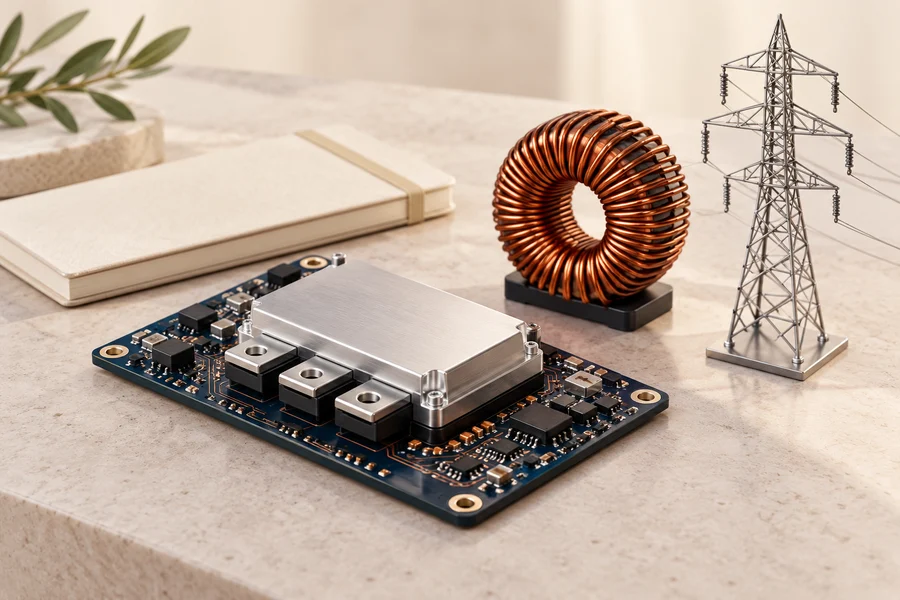
AI-generated with OpenAI image generation for The Strategic Newb
A future electricity technology can depend on a component that receives far less attention than the power plant itself. Helion’s new semiconductor funding announcement puts that connection in view: research into controlling electricity must eventually become equipment that works repeatedly, can be manufactured consistently and costs less to operate than the alternatives.
On 22 October, Helion announced a letter of intent for up to $175 million of US CHIPS research funding, alongside $50 million of private investment. A definitive award agreement remains a separate step. The announcement establishes a financing proposal, not delivered commercial fusion electricity.
Three points to understand
- Research finance can support component development before a power plant earns electricity revenue.
- Better electrical switching could reduce losses and equipment costs, but those benefits require measured operating results.
- Semiconductor manufacturing, a working fusion system and a profitable energy business are three different tests.
Why electrical switches matter to an energy project
A semiconductor is a material used in devices that control electrical current. In this context, the relevant devices are power components, rather than the processors that run an artificial-intelligence model. Their economic value depends on managing substantial electrical loads reliably.
GeekWire’s reporting and interview describe a three-year research programme and the role of high-voltage components in Helion’s pulsed system. That gives the announcement a concrete industrial focus. It does not independently establish future performance or a commercial return.
Think of switching equipment as part of the route electricity takes through a machine. Energy lost along that route cannot be sold to a customer. Heat also has to be managed. If improved components waste less energy, other parts of a system may require less cooling or experience less stress. These are potential engineering mechanisms, not savings demonstrated by this funding announcement.
The relevant question therefore extends beyond whether a component can survive a laboratory test. It includes how it behaves under repeated operation, how often it fails and whether its performance stays consistent as production expands.
From a good device to repeatable production
Manufacturing creates a second economic challenge. A design can work well while still being difficult to produce in large numbers. A factory pays for equipment, materials, skilled staff and testing before it knows how many finished components will meet the required specification.
The share of usable output is often called manufacturing yield. Poor yield means the cost of unsuccessful production has to be recovered from fewer saleable devices. Improving it can matter as much as increasing the theoretical performance of an individual component.
Packaging also matters. Here, packaging means arranging and connecting semiconductor devices so they can function as a module, rather than putting a finished product in a shipping box. Connections, heat management and testing affect the whole module’s usefulness. An inexpensive chip inside an unreliable assembly may be costly for the customer.
For suppliers, research spending can create demand for tools, materials and technical services. However, receiving a development order does not guarantee a long production contract. Customers may change specifications, qualify competing designs or delay investment while the broader system is still being tested.
What public funding changes—and what it leaves open
Public support can change who carries the early development cost. A company may be able to fund testing or production preparation earlier than it could using only customer revenue. That can expand the number of technical approaches being explored.
The financing terms also matter. Helion’s release says Commerce would receive a non-voting equity interest valued at $175 million upon a definitive agreement. An equity interest is an ownership claim. Its eventual economic value depends on the business; the stated amount is not a guaranteed cash repayment to taxpayers.
The broader policy trade-off is between creating domestic industrial capability and committing resources to uncertain technology. Local supply can reduce some transport and coordination difficulties, but location alone does not establish lower costs. Equipment, skills, consistent output and competitive suppliers still have to be available.
There is also an opportunity cost: money and specialist labour used on one development programme cannot simultaneously do another job. The case for support is stronger when useful knowledge or manufacturing capability can serve additional applications. Such wider benefits need evidence rather than being assumed from a large funding headline.
The timeline has several stages
Now, the main evidence concerns the announced funding arrangement and the proposed research effort. Over the next one to three years, meaningful signs would include completed testing, qualified components and repeatable manufacturing results. This is an analytical framework for judging progress, not a promised delivery schedule.
Commercial electricity production involves a broader system and may take longer. A component programme cannot establish that the entire plant will produce dependable output at a competitive lifetime cost. Even successful electricity generation would leave questions about construction expense, maintenance, financing and the price customers are willing to pay.
Evidence is therefore strong that an announcement was made, limited on the eventual manufacturing economics, and insufficient to infer future plant profitability. Technical demonstrations, commercial deployment and shareholder returns should be assessed separately.
What this means for a new investor
Exposure to an energy theme can take several forms. A supplier may earn revenue from building equipment, while a plant owner needs that equipment to generate enough income over many years. Their risks and timing can differ even when both benefit from the same investment programme.
A listed semiconductor company also serves many customers. A small research relationship may have little effect on its total profit. Neither the importance of fusion research nor a government funding proposal tells an investor what a security is worth.
What to watch next
Watch for the definitive agreement, clearly described performance tests, manufacturing quality and evidence of customer use. Compare claims about lower component losses with total system costs. The useful development is a measurable reduction in an economic constraint—not simply a larger announced budget.
Sources: Helion, funding announcement, 22 October 2026; GeekWire, reporting and CEO interview, 22 October 2026. Unlinked economic mechanisms are editorial analysis, not measured results of the programme.
Related analysis: how battery funding becomes useful storage.
More news →