IEA Oil Report: Why More Crude Does Not Fix Diesel Costs
More crude does not immediately rebuild diesel buffers. Refining, transport and inventories determine how fuel costs reach businesses.
By The Strategic Newb Editorial Team
Event: · Published: · Updated:
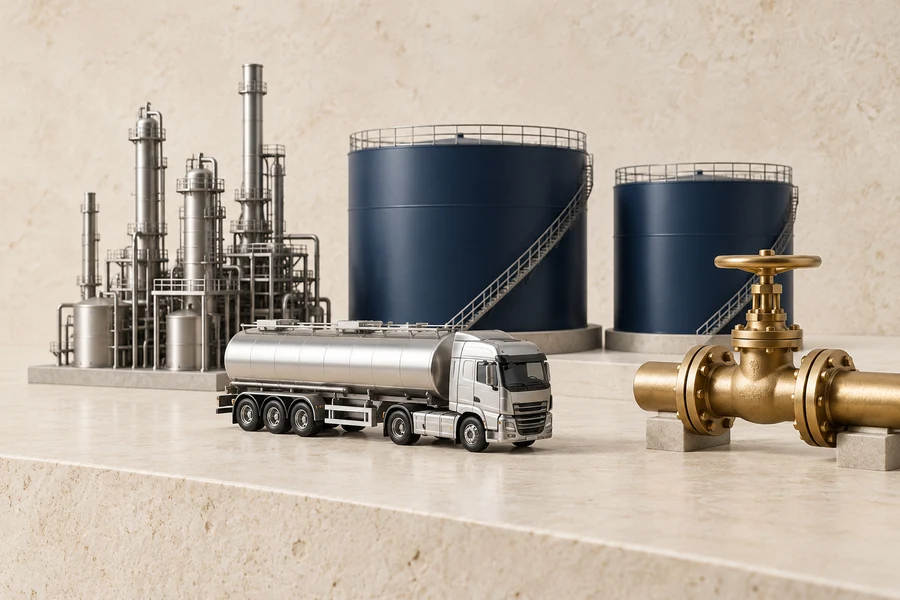
AI-generated with OpenAI image generation for The Strategic Newb
The International Energy Agency’s 14 October oil report presents an awkward combination: recovering oil supply and continuing pressure on diesel. That matters far beyond energy companies. Fuel moves goods between farms, factories, warehouses and shops. This analysis explains why more crude oil arriving in the system does not immediately translate into cheaper deliveries or a more comfortable household budget.
Three key points
- Crude oil, finished fuel and immediately available stocks are different things.
- A business can face higher delivery costs even when overall oil consumption falls.
- Forecasts describe a conditional outlook; they do not guarantee future prices.
The new evidence is in the balance
The IEA estimates global supply rose by 2.5 million barrels a day in September from August, reaching 102.3 million. Yet September diesel exports were 700,000 barrels a day below a year earlier. It expects tight diesel conditions to extend into 2027. These are the agency’s estimates and outlook, not our independent measurements. Separate Euronews reporting describes continuing shipping concerns; it does not independently verify the IEA’s balance calculations.
A barrel is the beginning of a process
Crude oil needs processing before it becomes usable fuel. Refineries separate and transform it into products with different purposes. Their equipment, maintenance needs and access to suitable inputs affect what they can produce. A shortage at this stage cannot always be solved by buying another barrel of crude. The useful question is whether the required product reaches the required customer in time.
Transport adds another stage. A cargo at sea is different from fuel available at a local depot. Shipping, insurance, port handling and onward distribution all contribute to the delivered cost. A global total can therefore conceal local shortages. Two businesses using the same fuel can face different bills because their supply routes, contracts and access to storage differ.
Why inventories buy time
An inventory is a buffer between incoming supply and outgoing use. Drawing it down can keep deliveries going during disruption. But a buffer used today is no longer available tomorrow unless it is replenished. Returning production to its former pace may stop further depletion without rebuilding the cushion. Replenishment requires supply beyond current consumption for a sustained period.
This distinction helps interpret apparently contradictory headlines. A report can describe improving daily supply and persistent vulnerability at the same time. The flow is improving, while the accumulated reserve remains thin. In that situation, a small additional interruption can matter more than it would with comfortably filled storage. That is a general mechanism, not a prediction of the next incident.
How the cost reaches an ordinary business
A delivery company pays for fuel before it collects every customer payment. A higher bill can therefore strain cash flow as well as profitability. Passing the cost on depends on contracts and competition. A fuel surcharge may adjust quickly; a fixed delivery price may leave the carrier absorbing the increase until its agreement can be renegotiated.
The customer then faces its own choice: accept a lower margin, charge more, combine deliveries or reduce activity. These responses spread the effect through a supply chain. They also take time. A movement in an oil benchmark does not dictate next week’s supermarket prices. Wages, rent, packaging, taxes and previous purchasing agreements are also part of that bill.
Lower demand is not automatically good news
Demand can fall because equipment becomes more efficient, but also because users can no longer afford the same activity. Those explanations have different economic meanings. A business completing the same work with less fuel improves productivity. A business cancelling deliveries because customers have stopped ordering loses revenue. The volume alone cannot distinguish these outcomes; the reason for the change matters.
For households, the effect depends on income and spending patterns. A family with little room after essential bills has less flexibility than one with substantial savings. For governments, temporary relief can shift part of the immediate expense onto public finances. Neither response creates new physical fuel by itself. Distribution of the burden and the quantity available remain separate policy questions.
What to watch next
Look for sustained deliveries of finished products, stock rebuilding and changes in transport costs. Distinguish a forecast from observed data and keep the comparison period consistent. For a new investor, an energy producer, refinery and delivery business have different exposures: a higher selling price for one can be a higher input cost for another. Contracts, debt and operating costs determine how much reaches shareholders.
The report is a new assessment of the energy system, not proof that any particular investment will gain. This article uses no live price quote and attributes no market move to a single cause. Its practical lesson is to follow the entire route from supply to usable fuel, and from an operating bill to the earnings of the business being examined.