India’s $1.53 Billion Energy Storage Plan Could Reshape Its Power Grid
India is using $1.53 billion of public support to target 92 GWh of storage and encourage a domestic battery industry. The programme could influence electricity reliability, manufacturing and energy imports.
By The Strategic Newb Editorial Team
Event: · Published:
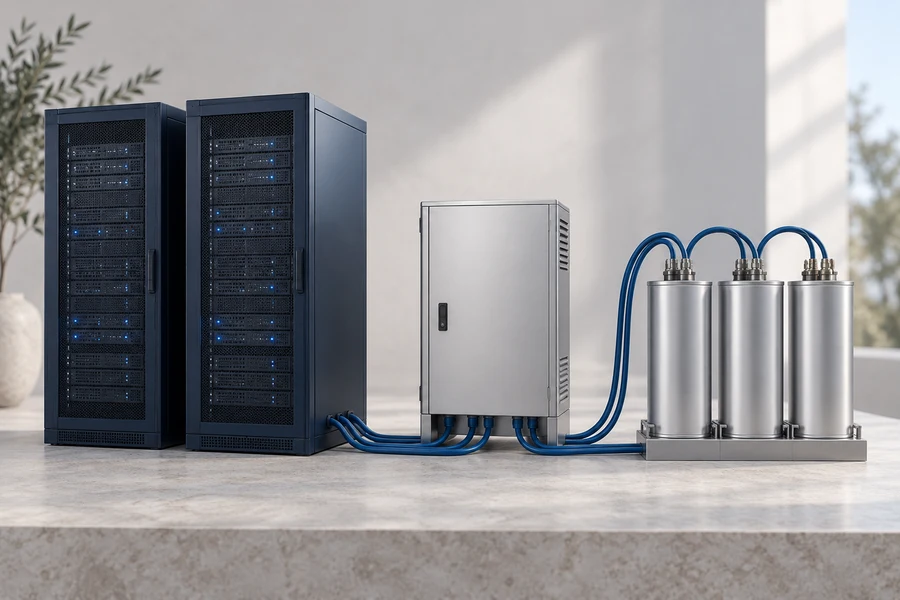
The Strategic Newb / AI-generated editorial illustration
India has approved one of its most important energy-infrastructure programmes of 2026: ₹145 billion, approximately $1.53 billion, in public support for 92 gigawatt-hours of new grid-scale energy storage.
The decision matters beyond the battery industry. Storage determines how much solar and wind power an electricity system can use reliably. It also influences power prices, factory reliability, fuel imports and the location of future manufacturing investment.
India is therefore not simply subsidising batteries. It is using electricity policy to build a larger domestic energy-storage supply chain.
What did India approve?
On 4 November 2026, India’s Union Cabinet approved a viability-gap funding programme covering the period from fiscal year 2026–27 through 2030–31.
The government plans to support:
- 60 GWh of pumped-hydro storage;
- 30 GWh of battery energy-storage systems;
- 2 GWh of emerging storage technologies.
The public funding is intended to support an official estimate of ₹976 billion, or roughly $10.3 billion, in total project investment. That larger figure is an estimate, not money that has already been committed by private investors.
Projects will be awarded through competitive tariff-based bidding. Battery projects will also face a minimum domestic-content requirement of 40%.
What is grid-scale energy storage?
Electricity must normally be consumed when it is generated. Storage changes that equation by absorbing power when supply is abundant and releasing it when demand is higher.
Battery installations can respond within seconds. This makes them useful for managing short-term changes in electricity demand, supporting grid frequency and shifting solar electricity from the afternoon into the evening.
Pumped-hydro storage works differently. Surplus electricity pumps water to an elevated reservoir. When the grid needs power, the water flows downhill through turbines. Pumped hydro usually requires more construction but can store large amounts of energy for longer periods.
The programme’s 2 GWh allocation for emerging technologies gives India room to test other approaches without making them the centre of the plan.
Why 92 GWh matters for India’s economy
India is adding renewable generation quickly, but solar panels and wind turbines do not produce electricity at a constant rate. Without storage, the grid may have too much power at one moment and too little several hours later.
That creates several economic problems. Renewable electricity may be wasted, grid operators may need expensive backup generation, and industrial users can face unreliable supply.
Storage can help address these problems through four mechanisms.
1. More renewable electricity can reach customers
Storage reduces the need to curtail solar and wind generation during periods of excess supply. Better utilisation can improve the economics of existing renewable projects and make future projects easier to finance.
2. Grid reliability can improve
Factories, data centres and transport systems depend on stable electricity. Storage can respond rapidly when generation or demand changes, reducing some of the operational pressure on the grid.
3. Private investment may become easier
Viability-gap funding covers part of the difference between project costs and the revenue initially available from electricity buyers. This can make projects financeable that would otherwise remain too expensive or risky.
4. India can build a domestic manufacturing market
The 40% local-content rule creates demand for Indian-made equipment and components. That could benefit battery-pack assembly, power electronics, control systems, construction and engineering.
The local-content rule is the strategic part
The programme is also industrial policy.
India wants storage deployment to create domestic manufacturing capacity rather than only increasing imports. A guaranteed pipeline of projects can give manufacturers more confidence to invest in factories, workers and supplier relationships.
However, localisation creates a trade-off. Domestic requirements can support local companies, but they can also restrict access to the cheapest global equipment. If local production does not expand quickly enough, project costs or construction times could rise.
The economic outcome will depend on whether Indian suppliers can increase quality and production while competitive bidding continues to restrain prices.
Who could benefit?
Likely beneficiaries include:
- Indian battery and power-electronics manufacturers;
- pumped-hydro developers and engineering companies;
- renewable-energy developers;
- electricity-distribution companies;
- industrial consumers that need reliable power;
- construction and grid-infrastructure suppliers.
Foreign manufacturers could still participate if they localise production or meet the domestic-content rules. Suppliers that depend entirely on imported systems may be disadvantaged.
Coal- and gas-fired plants used mainly for balancing peak demand may also face more competition if storage becomes cheaper and widely available.
What is confirmed, and what remains uncertain?
The cabinet approval, funding allocation, 92 GWh target and 40% domestic-content requirement are confirmed government decisions.
The estimated ₹976 billion investment is not confirmed spending. Projects still need competitive awards, financing, permits and construction. It is also too early to know how the programme will affect consumer electricity prices.
The direction is clear, but delivery will determine the result.
The Strategic Newb view
The most important part of the announcement is not the headline subsidy. It is the attempt to connect renewable-energy expansion with domestic industrial development.
If India successfully creates both storage demand and competitive local supply, the country could reduce power-system costs while becoming a larger producer of battery and grid equipment. If localisation increases costs without creating scale, the programme could deliver less capacity than its headline numbers suggest.
This makes the policy a useful test of a wider economic question: can a large emerging economy use its electricity transition to capture more of the technology supply chain?
Frequently asked questions
How large is India’s new energy-storage programme?
It targets 92 GWh of new grid-scale storage capacity supported by ₹145 billion, approximately $1.53 billion, of viability-gap funding.
Is the programme only for batteries?
No. It includes 60 GWh of pumped hydro, 30 GWh of battery storage and 2 GWh of emerging storage technologies.
Has the full $10.3 billion already been invested?
No. The larger ₹976 billion figure is the government’s estimate of total investment that the programme may support.
Why does energy storage matter for renewable power?
It allows electricity generated during periods of strong sun or wind to be used later, improving grid reliability and reducing wasted renewable output.
Will the programme support Indian manufacturing?
Battery-storage projects must meet a minimum domestic-content requirement of 40%. The effect will depend on the ability of local suppliers to scale competitively.
Sources
- Press Information Bureau, Government of India — official programme details
- Prime Minister of India — Cabinet approval
- Reuters — India approves $1.53 billion energy-storage programme
This article explains economic and technological developments and does not provide personal investment advice.
More news →