Intel’s AI Hardware Puts the Cost of Useful Work First
New hardware details highlight memory and operating costs. Customer deployment and reliable useful output must establish the economic benefit.
By The Strategic Newb Editorial Team
Event: · Published:
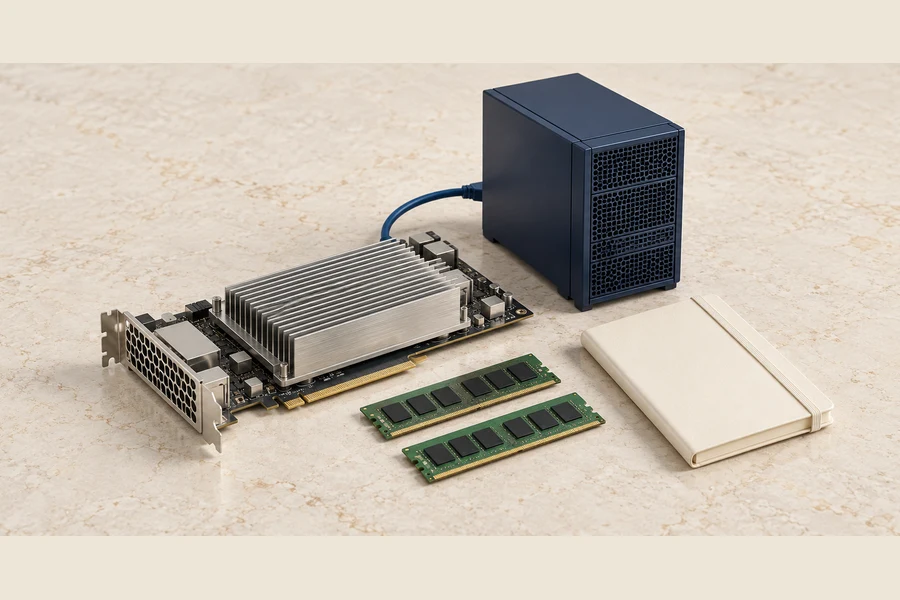
AI-generated with OpenAI image generation for The Strategic Newb
Intel’s 12 October OCP announcement adds technical detail to its GPU D-series, previously called Crescent Island. The investment question is broader than which chip looks fastest: can businesses run useful AI services at a cost their customers will support? This analysis examines that question through memory, equipment use and the expense of putting a system into service.
Three key points
- A hardware specification describes a capability, not a customer’s profit.
- Memory capacity, response time and equipment use jointly shape service costs.
- Sampling, commercial deployment and recurring profitable demand are separate milestones.
What the new information establishes
Intel says customer sampling is underway. Its own branded card has 160 GB of memory; partner designs can reach 480 GB. That distinction in the release’s footnote matters: the largest advertised capacity is not automatically the configuration every buyer receives. The announcement establishes what the supplier is offering for evaluation, not independently measured savings across customer businesses.
The product page describes an air-cooled, 350-watt PCIe card for inference. Inference means using an already trained AI model to produce an answer or perform a task. PCIe is a standard connection inside a computer. The specification concerns the card; it is not a complete server’s electricity bill. The 13 October SiliconANGLE guest column discusses the launch, but its strategic argument is analysis rather than an independent performance test.
Why memory changes the bill
An AI service must hold information while it works: the model, the user’s request and intermediate material. Think of capacity as available workspace and bandwidth as the rate at which material can move through that workspace. More room and faster movement solve different problems. Neither is a direct measure of how accurate or commercially useful an answer will be.
If the required information does not fit, an operator may need additional equipment or another way of dividing the work. That can add purchase costs and coordination. If there is plenty of unused memory, paying for still more may bring little benefit. This is why the appropriate comparison is a particular service under realistic demand, rather than the largest number printed beside a component.
Useful output is the missing denominator
A business ultimately pays for completed work. A cheap answer that must be corrected by an employee may cost more than a more expensive answer that can be used immediately. A fast service that fails during busy periods can lose customers. Hardware economics therefore connects technical measures with error rates, response times, support and the value of the task being completed.
A useful calculation divides total service costs by successfully completed tasks. Include equipment over its useful life, electricity, cooling, software, staff and financing. Then examine how much of the available capacity is actually used. Fixed costs do not disappear when demand is quiet. Equally, loading a system too heavily can create waiting times that make its apparent efficiency unattractive to customers.
Existing buildings can help, but integration still costs
Equipment that fits an existing installation may avoid some building work. That possibility matters to organisations with limited power or investment budgets. It does not remove compatibility checks, maintenance, staff training or replacement schedules. Software may need changes before a different processor can run the same application reliably. Time spent on that transition is an economic cost even when a component is attractively priced.
The competitive effect could run in two directions. More viable suppliers could give buyers bargaining power and encourage experimentation. But maintaining several technical environments can increase complexity. A buyer may accept a higher component price if its existing software, support and staff experience reduce the overall bill. Openness creates options; it does not itself prove that switching is cheaper.
Who could benefit, and over what period?
Now, the evidence is strongest for the supplier’s disclosed design and evaluation stage. Over one to three years, the meaningful tests are repeat orders, reliable installations and customers willing to pay for services. Beyond that, changing models and rival equipment could alter the economics again. These are assessment horizons, not a promised shipping schedule or a forecast of Intel’s earnings.
Server makers, software integrators and customers may gain opportunities if a new design works well in practice. Rival suppliers could face price pressure. Employees may gain useful tools while also needing training and oversight processes. None of those outcomes follows automatically from a launch. Demand can disappoint, integration can take longer and competitors can respond before an investment pays back.
What to watch next
Look for clearly specified commercial configurations, availability, prices and independent tests on comparable tasks. Customer evidence should describe the entire service, including reliability and human review. For a new investor, a chip company’s share represents a claim on business results, not on a benchmark. A technically sensible design still needs manufacturing execution, customer demand and sufficient margins to become a successful investment.