$15bn Iowa steel plant tests America’s tariff-led industrial strategy
Mesabi Metallics plans a $15 billion mine-to-mill steel chain linking Minnesota iron ore with a new Iowa complex. Its enormous proposed capacity could reshape imports and manufacturing, but financing, construction and tariff policy will decide whether the project matches the announcement.
By The Strategic Newb Editorial Team
Event: · Published:
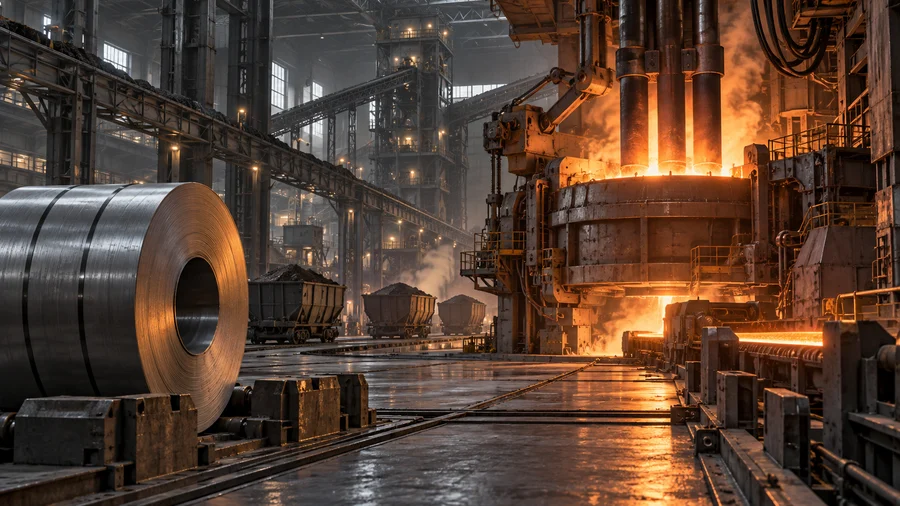
The Strategic Newb / AI-generated editorial illustration.
The planned Iowa steel plant announced at the White House on 28 September 2026 is designed to become one of the largest industrial investments in recent US history. Mesabi Metallics, an American company owned by India’s Essar Group, says it will invest $15 billion in a fully integrated steel complex in eastern Iowa, using iron ore from its newly started Minnesota mine and pellet operation.
Production could begin as early as 2030. Official Iowa and congressional statements put initial annual capacity at 7.5 million tons, with potential expansion to roughly 10 million tons. These are the source’s reported units, not a conversion to metric tonnes. The project is expected to support more than 1,700 permanent jobs, while larger construction-job estimates relate to the build phase and should not be confused with long-term employment.
President Donald Trump presented the proposal as proof that his tariffs are rebuilding American industry. That is a political claim, not an independently demonstrated cause. A plant of this size depends on financing, electricity, transport, permits, construction execution and future steel prices. The announcement is material, but the mill is not yet producing steel.
Fact box
| Item | Announced detail |
|---|---|
| Developer | Mesabi Metallics, owned by Essar Group |
| Planned investment | $15 billion |
| Location | Eastern Iowa; precise site details were limited in initial reporting |
| Initial capacity | 7.5 million tons a year, as reported by officials |
| Possible later capacity | About 10 million tons a year, as reported by officials |
| Target start | As early as 2030 |
| Feedstock | Direct-reduction-grade pellets from Mesabi’s Minnesota operation, plus recycled scrap |
| Jobs | More than 1,700 permanent jobs cited; construction estimates are higher |
What changed with the Iowa steel plant announcement?
Mesabi had already invested more than $2.5 billion in a Minnesota iron-ore mine and pellet plant. The new step is the proposed downstream mill in Iowa. It would connect extraction, pellet production, rail or river logistics and steelmaking within one controlled supply chain.
The company plans to use electric arc furnaces, which melt scrap and can use iron inputs produced for direct-reduction processes. Compared with traditional blast-furnace production, electric arc routes can be more flexible and potentially less carbon-intensive, depending on the electricity mix and iron feedstock. No verified project-level emissions estimate was available in the reviewed sources.
The location provides access to the Mississippi River and transport links from Minnesota. That logistical advantage must offset the cost of moving enormous quantities of material. The precise site, power arrangements, incentives and full construction schedule will determine whether the announced economics hold.
Why the scale matters
An initial 7.5 million tons (the reported source unit) would represent a large addition to US steelmaking capacity. Capacity, however, is not the same as output. Mills run according to demand, maintenance and margins. A new facility may replace imports, displace older domestic plants, serve new demand or combine all three effects.
The steel is intended for infrastructure, manufacturing, energy and defence-related supply chains. High-quality domestic production can reduce exposure to foreign disruption, particularly where specialised grades are required. But “national security” does not make a project commercially risk-free. Buyers will still compare price, quality and reliability.
The plant’s vertical integration may help manage costs by securing iron ore from Mesabi’s own mine. It may also concentrate risk. A disruption or quality problem in Minnesota could affect the Iowa mill. The project will need dependable rail, river, energy and scrap supplies at enormous scale.
The tariff argument
Trump credited a 50% tariff on imported steel with encouraging the investment. Tariffs can raise the domestic price that producers receive, improving the economics of new capacity. They can also increase costs for carmakers, construction companies, machinery producers and other steel users. The net effect depends on how much new supply arrives, how quickly and at what price.
The planned 2030 start creates a timing gap. Downstream manufacturers can face higher input prices now, while the promised capacity arrives years later. If trade policy changes before completion, the project’s assumptions could shift. If tariffs remain high and domestic competition expands, steel prices may eventually face downward pressure.
Reuters noted a contrasting effect in Canada, where Cleveland-Cliffs was idling some production at its Hamilton operation and laying off workers while blaming US tariffs. One investment announcement therefore does not prove that the policy benefits the entire North American industrial system.
Who gains and who comes under pressure?
Iowa gains a potential anchor employer and a cluster of construction, logistics and supplier activity. Minnesota’s mining operation gains a major internal customer. Mesabi and Essar gain access to a protected, strategically important market if they can deliver the project.
US defence and infrastructure buyers could gain another domestic supplier. Railways, ports, power providers and equipment manufacturers may benefit during construction and operation. Workers could gain high-paying jobs, although workforce availability and training will be important.
Foreign steel exporters face pressure if the plant replaces imports. Existing US mills could face stronger domestic competition, especially if demand does not grow as fast as capacity. Steel-consuming manufacturers may benefit from more supply in the long run, but can still be hurt by tariffs and construction-related price effects before the mill opens.
Taxpayers and public lenders need clarity on exposure. Earlier federal support discussed by the Export-Import Bank concerns Mesabi’s Minnesota mine and pellet facility. Initial news reports and political statements should not be read as proof that $10 billion of public financing has been finally committed specifically to the Iowa mill. Financing arrangements require separate verification.
Economic and geopolitical consequences
The announcement reinforces a global shift towards industrial policy. Governments increasingly treat steel, chips, energy and critical minerals as strategic capabilities rather than ordinary commodities. The United States is combining tariffs, public finance and political support to attract capacity.
Foreign ownership complicates simplistic claims about economic nationalism. Essar is Indian-owned, while the mine, mill, workers and much of the supply chain would be American. The project shows that “reshoring” can rely on international capital even when production is domestic.
For Europe, Canada and Asian exporters, the lesson is that US market access may increasingly depend on building inside the tariff wall. That can redirect investment from efficient existing plants to new American capacity. It may strengthen US resilience while fragmenting global trade and encouraging retaliatory measures.
The project also points towards changing steel technology. Direct-reduction-grade pellets and electric arc furnaces are important to efforts to reduce dependence on coal-intensive blast furnaces. The environmental result will depend on electricity, fuel, feedstock and operational choices that have not yet been fully disclosed.
What happens next?
The most important evidence will be a final site decision, permits, binding financing, engineering contracts, power agreements and construction milestones. Watch for incentive packages from Iowa, environmental filings and procurement announcements. These will show whether the project has moved from political announcement to executable investment.
Analysts should also track Mesabi’s Minnesota ramp-up. The mine and pellet plant are the upstream foundation of the proposed integrated chain. Legal disputes, financing delays or production problems there could affect the Iowa schedule.
By 2030, tariff policy and steel demand may look different. A recession, lower import barriers or excess global capacity could weaken returns. Conversely, defence spending, infrastructure programmes and data-centre construction could support demand. Both scenarios are plausible; neither should be presented as certain.
Strategic Newb assessment
The Iowa steel plant is a serious industrial proposal because of its scale, upstream mine and potential contribution to domestic capacity. It is also a political showcase announced weeks before US midterm elections. Those facts can coexist.
The strongest angle is not that tariffs have already “won”. It is that America is testing a mine-to-mill strategy built around protection, public support and strategic manufacturing. Success will be measured in operating furnaces, competitive steel and durable jobs — not in the size of the announcement. The unanswered question is whether the project’s economics remain credible through four years of construction and possible policy change.
Frequently asked questions
Who is building the Iowa steel plant?
Mesabi Metallics, a Minnesota-based company owned by India’s Essar Group.
How much steel could it produce?
Officials cite 7.5 million tons annually in the first phase, with possible expansion to about 10 million tons. These are reported source units, without a metric conversion.
When will production begin?
As early as 2030, according to the announcement. That target depends on financing, permits and construction.
Did US steel tariffs cause the investment?
Trump and supporters say they did. Tariffs may improve domestic economics, but the causal claim cannot yet be independently proved and tariffs also raise costs for steel users.
Is $10 billion in federal financing confirmed for the Iowa mill?
Not in the sources reviewed. Federal financing references relate to Mesabi’s Minnesota mine and pellet project and should not be automatically assigned to the Iowa plant.
Sources
- Reuters — Trump unveils $15 billion planned Iowa steel project
- Associated Press — Trump announces a new $15B Iowa steel plant and claims it will be the nation’s biggest
- Office of Iowa Governor Kim Reynolds — Gov. Reynolds attends White House announcement on nation’s largest-ever steel manufacturing investment coming to Iowa
- US Senator Joni Ernst — Ernst Joins President Trump to Tout Transformative $15 Billion Steel Investment in Iowa
- US Export-Import Bank — EXIM Chairman Visits America’s First New Iron Ore Mine in 50 Years as Operations Begin in Northern Minnesota
- The Guardian — Trump announces $15bn Iowa steel plant as he bids to boost flagging midterm hopes