Japan's Planned 400 MW AI Data Center Puts Power at the Center of the Compute Race
A planned AI campus next to a gas-fired power station could shorten the wait for electricity, but the $15 billion-plus estimate remains a project ambition.
By The Strategic Newb Editorial Team
Event: · Published: · Updated:
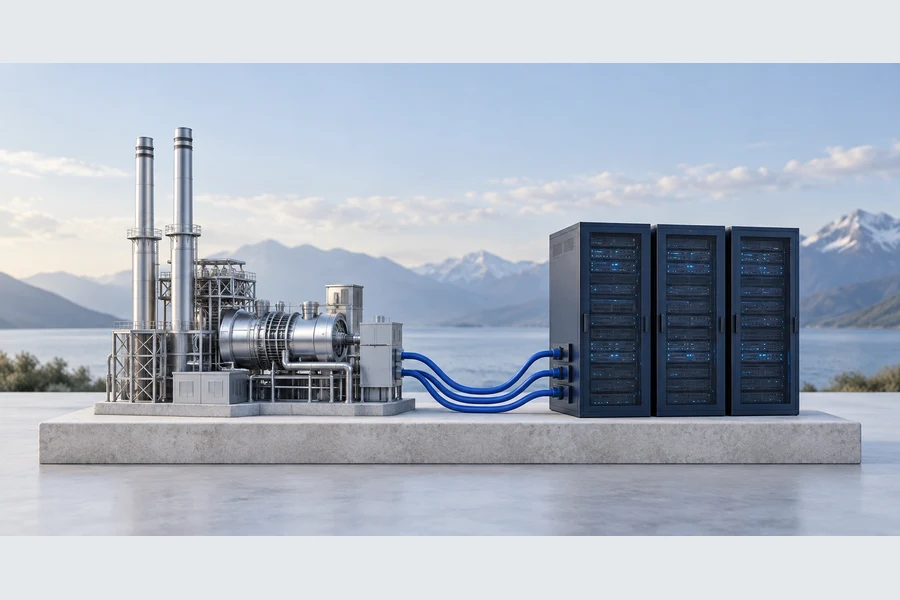
AI-generated with OpenAI image generation for The Strategic Newb
The scarce input in an AI data center is increasingly the electricity connection. On October 1, 2026, Japan's JERA, Dell Technologies and RHAELM announced a memorandum of understanding to develop a model for large AI infrastructure projects. Their first proposed application is at JERA's Chiba Thermal Power Station, where a project being developed by JERA and RHAELM would have access to up to 400 megawatts of power capacity.
The partners estimate that total capital deployed across land, power infrastructure, buildings and computing equipment could exceed $15 billion over all phases. They target operations around 2028. These figures describe a proposed project and its potential full buildout. The announcement does not establish that $15 billion has been committed, that 400 MW has been installed, or that the facility has begun operating.
What makes the Chiba proposal different?
A conventional data center seeks a connection to the public electricity grid. A large AI cluster can require enough power that securing a connection, upgrading substations and coordinating transmission become major parts of the development schedule. At Chiba, the proposed campus would sit beside an operating JERA generation asset and receive power behind the meter. In plain language, its supply would be arranged at the generating site rather than waiting for the full conventional grid connection path described by the partners.
That still leaves difficult engineering and commercial work. The project has to integrate generation, electrical systems, cooling, server racks and the networks connecting those servers. Dell's planned role is a standardized, rack-scale AI computing platform; JERA contributes the power site and gas and LNG capabilities; RHAELM leads infrastructure delivery. Apollo intends to act as a strategic investment and financing partner for RHAELM, according to JERA. An intention is not proof of closed financing.
Why power access changes the economics of AI
The direct economic mechanism is time. If a developer can bring high-density computing online sooner, it may be able to earn revenue or establish capacity while competitors wait for connections. The arrangement could also direct investment toward power stations, electrical equipment, cooling systems, construction, servers and local services.
For Japan, domestic computing capacity can matter to companies that want to develop or run AI services with local infrastructure. Yet the proposal does not show that Japan will become self-sufficient in chips, nor does it prove a particular boost to national productivity. Those outcomes depend on what equipment is procured, what workloads arrive and whether businesses use the resulting capacity profitably.
There is a second side to the power strategy: fuel exposure. JERA's announcement explicitly connects the model to gas-fired generation and LNG supply. A project built around a gas station can offer controllable power, but its operating costs and emissions will depend on fuel prices, plant operation and any later changes to the energy mix. A faster power path is therefore an economic tradeoff, not a free solution to data-center electricity demand.
Who could gain or lose?
JERA could gain a large new use for its generation and site infrastructure. RHAELM and Dell could gain a high-profile development and hardware deployment if the plan proceeds. Builders, electrical-equipment suppliers, cooling specialists and LNG suppliers may see demand during construction and operation. Japanese AI companies could benefit from more nearby capacity, subject to the price and availability of compute services.
Competitors relying on slower grid connections might lose a timing advantage. Customers and the wider power system could face risks if fuel costs rise or if rapid data-center growth competes for scarce equipment and skilled labor. None of those effects has yet been measured for this project.
The immediate impact is a concrete proposal and a possible pipeline of contracts. The earliest planned operational effect is within one to three years, because the partners target 2028; a wider productivity effect would take longer and would depend on actual use of the capacity. A memorandum of understanding is an early development milestone, not a completed data center.
The question the project will answer
The next checkpoints are binding construction and financing agreements, permits, confirmed equipment orders, power and fuel arrangements, customer commitments and an operating timetable. They will show whether the proposed model genuinely shortens delivery and whether its economics hold up once capital and fuel costs are counted.
The Strategic Newb angle: AI capacity is becoming a race to assemble power, land and capital before a single model runs. Chiba tests whether placing compute beside generation makes that race faster enough to justify a potentially expensive, gas-linked buildout.
Sources and evidence
- JERA, October 1, 2026: MoU and proposed Chiba project. Primary source for the scope, estimate and target date.
- RHAELM, October 1, 2026: partners' project announcement. Partner account, not independent confirmation of project execution.
- Reuters, October 1, 2026: reporting on the JERA–Dell–RHAELM plan.
Evidence: Strong that the MoU was announced; early-stage for the final investment, size and delivery. Confidence: High on the announcement, low to medium on the proposed buildout and timing. Cost and acceleration claims are the partners' expectations.
More news →