OPEC+ holds December targets: why oil delivery still matters
Unchanged production targets do not guarantee deliveries. Transport, refining and contracts determine how oil costs reach companies and households.
By The Strategic Newb Editorial Team
Event: · Published:
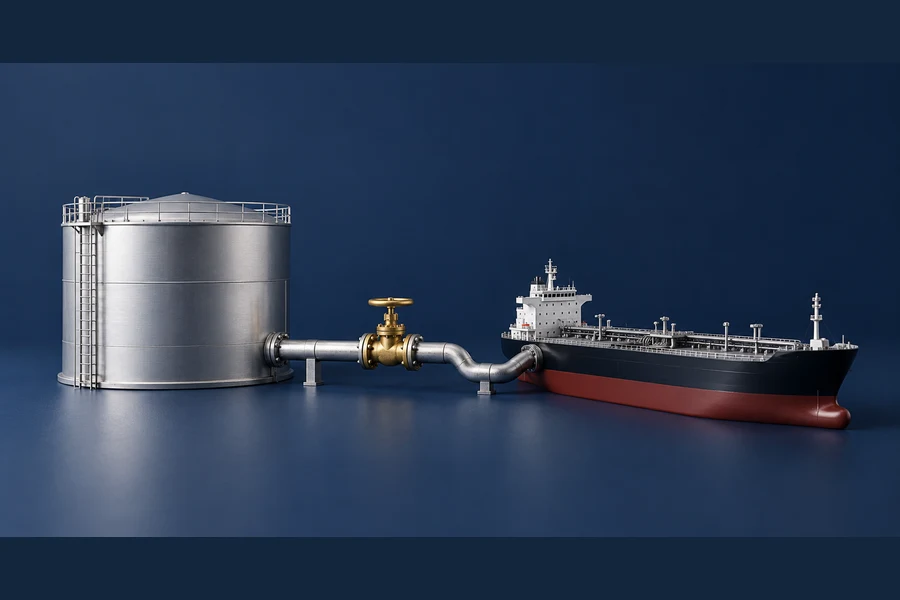
The Strategic Newb / AI-generated editorial illustration
Seven OPEC+ producers have kept their December production requirements at September levels. The decision, announced on 1 November, provides a new policy reference point for the end of the year. It does not tell us how much oil will reach refineries, or what households will pay for fuel. For a beginner, the important distinction is between a production target, actual output and a usable delivery.
- An unchanged target is a policy decision, not a measurement of available supply.
- Transport, refining and contracts determine how crude-oil costs reach businesses and households.
- Reliable deliveries and the next producer meeting matter more than treating this announcement as a price forecast.
What the producers decided
The official OPEC statement identifies Saudi Arabia, Russia, Iraq, Kuwait, Kazakhstan, Algeria and Oman as the participants. They will meet again on 29 November. OPEC+ is the cooperation framework linking OPEC oil producers with partner countries. This decision concerns the seven named participants; it should not be described as a new production increase across every member.
Reuters reporting places the decision against continuing disruption to oil exports during the Iran war. That context makes the distinction between permitted production and delivered barrels especially useful. This article explains the transmission mechanism; it does not forecast a particular oil price or attribute a market move to the meeting.
A target is only one step in the supply chain
A production requirement establishes a policy level. Actual output also depends on operating wells, equipment, staff and the ability to move oil away from the field. A producer can have permission and technical capacity to produce more while lacking a dependable route to its customers. Conversely, drawing from storage can temporarily support deliveries without an equivalent increase in current production.
The next step is export availability. Some output serves domestic users, and some enters or leaves storage. Exported crude then needs pipelines or tankers, insurance and a receiving terminal. Finally, a refinery must be able to process that particular crude into products customers need. These stages help explain why a headline about production does not immediately settle the supply question for diesel, petrol or aviation fuel.
For an importing business, the practical issue is the cost and timing of usable energy. A shipment that arrives late can create costs beyond the purchase price: replacement purchases, idle equipment or disrupted schedules. Predictability therefore has economic value even when the nominal volume in a producer agreement stays the same.
How costs reach company earnings
Fuel is an input for transport operators and many other businesses. If delivered fuel becomes more expensive, the effect on earnings depends on whether the business can charge customers more. A contractual fuel surcharge can transfer some costs, but the calculation may update with a delay. Competition can also make price increases difficult. Higher revenue is therefore not necessarily evidence of a healthier profit margin.
A profit margin is the share of revenue left after the relevant costs. Consider a purely hypothetical delivery company earning €100 on a service with €80 of costs, including €20 of fuel. If that fuel bill rises by 10% and nothing else changes, costs rise to €82 and the remaining amount falls from €20 to €18. The example illustrates sensitivity; it is not an estimate for any listed company.
Producers face a different combination of variables. A higher selling price can help revenue per barrel, but total revenue also depends on volumes sold. Operating expenses, taxes, financing and investment still have to be paid. Refiners face yet another calculation: the difference between what they pay for crude and receive for processed products, alongside their operating costs. “Energy companies benefit” is too broad a conclusion.
Households, inflation and interest rates
Households can feel energy costs through transport, heating where oil is used, and the delivery costs embedded in goods. The timing varies with taxes, suppliers’ contracts and pricing decisions. A change in wholesale oil does not imply an identical percentage change at the pump. Exchange rates can also affect importers whose fuel purchases are priced in a different currency from their sales.
Inflation measures changes in a broad basket of prices. Energy can influence that basket directly and through business costs. However, a producer announcement alone cannot determine the next inflation reading. Nor does it determine a central bank’s policy rate, the short-term rate set as part of monetary policy. Bond yields are market rates and can change for several reasons, including expectations about growth, inflation and borrowing needs.
What this means for a new investor
Exposure matters more than a simple label. An airline, an oil producer, a refinery and a diversified fund can all be connected to oil while facing different costs and income streams. Existing contracts, debt payments and cash reserves can change how quickly a disruption affects each business. Ownership of an energy share is a claim on a business, not ownership of a barrel at the headline market price.
The announcement is strong evidence of the stated policy decision. It is not evidence that transport constraints have disappeared, that every participant will deliver the specified amount, or that a particular company’s profit will rise. Those questions need operating and financial data. Keeping them separate prevents a verified policy fact from turning into an unsupported investment conclusion.
What to watch next
The next meeting of these seven producers is scheduled for 29 November, according to OPEC. Before then, actual production, export arrivals, inventories and refinery operations will help explain whether usable supply is improving. Compare like periods and distinguish preliminary estimates from confirmed data. For companies, watch fuel-cost disclosures, contract adjustments and cash flow rather than assuming the target decision has already changed earnings.
Sources
- Seven producers reaffirm commitment to market stability — OPEC, 2026-11-01.
- OPEC+ keeps December oil output targets steady ahead of tougher call for 2027 — Reuters via Euronext, 2026-11-01 14:35 (display timezone unspecified).