OPEC+ Keeps November Targets Steady: Supply Still Matters
Seven OPEC+ countries keep November production targets unchanged. Actual output, transport and refining determine how the decision reaches customers and company costs.
By The Strategic Newb Editorial Team
Event: · Published:
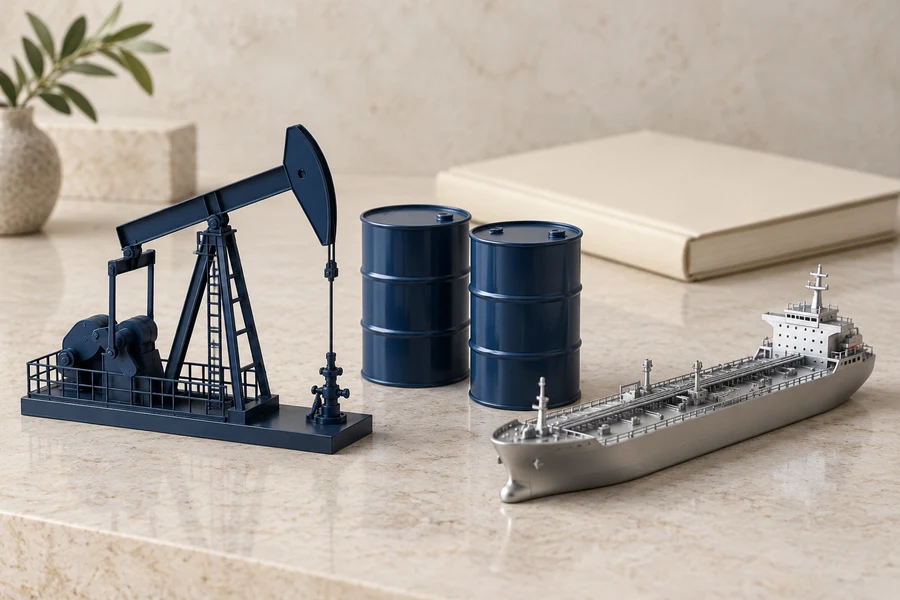
AI-generated with OpenAI image generation for The Strategic Newb
Seven OPEC+ countries decided on 4 October to keep their required oil production unchanged for November. The official statement says the September 2026 requirements remain the reference. The decision settles the next month’s targets; it does not establish how much oil will actually reach customers. That distinction matters for anyone trying to connect an oil headline with fuel costs, company margins or inflation.
Three key points
- A production target is an agreed level, not a measurement of delivered oil.
- Refining, transport and demand help determine how crude supply reaches fuel bills.
- The next meeting is scheduled for 1 November; its outcome is not known.
What the decision covers
The participants are Saudi Arabia, Russia, Iraq, Kuwait, Kazakhstan, Algeria and Oman. They form a group within OPEC+, the cooperation between the Organization of the Petroleum Exporting Countries and allied producers. Independent reporting carried by Asharq Al-Awsat also confirms the decision to hold November targets steady. The official release schedules their next meeting for 1 November. This article uses no live oil price and makes no claim that the decision has already moved a market.
A target is not a shipment
The economic chain has several stages. A producer needs operating wells and equipment, then storage and transport capacity. Oil must reach a buyer that can use the particular grade. A stated production allowance cannot by itself repair a pipeline, make a shipping route available or complete a delivery. Comparing targets with measured production and exports therefore answers different questions. The first describes policy; the others help describe physical supply.
From crude oil to a household bill
Crude oil is a raw material. Refineries turn it into fuels and other products, while distributors bring those products to customers. Refinery availability, transport charges, taxes and exchange rates can all affect the final bill. Unchanged production targets consequently do not promise unchanged petrol or diesel prices. Demand also matters: a supply policy cannot be interpreted fully without asking how much fuel households and businesses want to use.
Different businesses face different costs
For a transport operator, fuel is an input cost. Its effect on profit depends partly on whether contracts allow higher charges to customers and how quickly those charges change. An oil producer faces a different calculation involving sales volumes, selling prices and operating costs. A refinery buys crude and sells processed products, so the gap between those prices matters. A broad energy label on a fund can conceal these different business models.
What to watch next
Follow subsequent production and export data, the availability of transport and refining capacity, and the next official meeting statement. Check the period covered by each number before comparing it with a target. A stock release, such as the separately reported G7 measure, concerns stored oil or fuel rather than the same monthly production decision. These mechanisms can interact, but they should not be counted as identical supplies. The useful question is which change becomes usable supply, when, and at what cost.