Opentrons funding puts the cost of running AI experiments in focus
Laboratory robots still need validation, integration and steady use. A funding round does not prove lower research costs or profitable deployment.
By The Strategic Newb Editorial Team
Event: · Published:
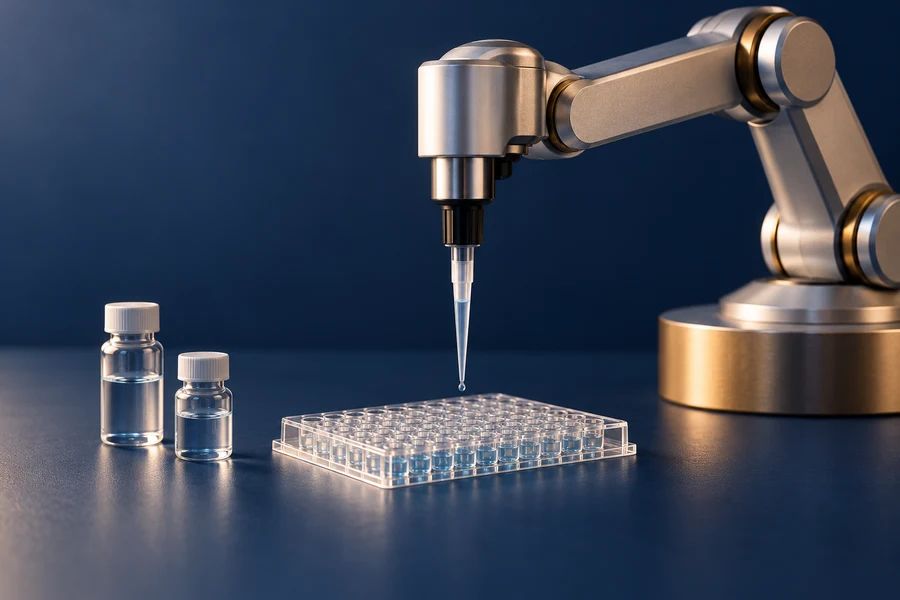
The Strategic Newb / AI-generated editorial illustration
Artificial intelligence can suggest an experiment, but a laboratory still has to perform it. Opentrons’ financing announcement offers a concrete way to examine that gap. On 29 October 2026, the company announced a $40 million Series E round led by Avego, with BroadOak Capital Partners participating. Series E describes a later named stage of private fundraising; it is not evidence of profitability or an offer of publicly traded shares.
- The new money is intended to expand laboratory robotics, software and data tools.
- Automating an experiment can change labour requirements and repeatability, but it also adds equipment and integration costs.
- A funding round confirms investment interest; evidence of reliable, economical deployment must come separately.
An announced investment, not a proven scientific breakthrough
In its 29 October announcement, Opentrons says it will expand automated experimental execution, software and integration with other laboratory equipment. These are intended uses of capital, not completed results. SiliconANGLE’s reporting describes the company’s benchtop robots, which use pipettes to transfer small quantities of liquid between samples.
A pipette is a tool for measuring and moving liquid. Many experiments involve repeated transfers, mixing and carefully ordered steps. This makes laboratory automation a useful example of a broader industrial question: when does converting a manual process into a programmed one improve the total economics of the work?
The financing announcement establishes a specific development to analyse. It does not establish that autonomous laboratories have become universal, that a particular drug will succeed, or that research budgets will necessarily fall.
The useful measure is a usable result
A machine can repeat a movement quickly without producing a scientifically useful answer. A laboratory also needs suitable samples, correct instructions, calibrated equipment and reliable measurements. Calibration means checking that an instrument performs within the required tolerances. If any of these elements fails, faster execution may simply create unusable results sooner.
The economic objective is therefore not just more movements per hour. It is more usable experimental evidence for the money and time spent. That includes time spent preparing a run, detecting mistakes, cleaning equipment and interpreting the results. A comparison that counts only the robotic transfer stage can miss substantial work elsewhere.
Repeatability can nevertheless matter. When a process is recorded and performed consistently, researchers may find it easier to distinguish a meaningful result from a change in procedure. That potential advantage still needs to be demonstrated for the specific workflow. Biological materials and experimental conditions can vary even when the machine behaves consistently.
Where costs move when work is automated
Manual execution mainly consumes staff time alongside materials and laboratory space. Automation adds an upfront equipment purchase or another financing arrangement, plus installation, maintenance, software and training. Some costs move from each individual run to the system that supports many runs.
Utilisation then becomes important. Utilisation means how much of the available equipment capacity is actually used. A frequently used system can spread its fixed costs across more experiments. A machine waiting for samples, staff approval or another instrument cannot deliver the same benefit merely because it is technically capable of running faster.
Consumables also remain part of the calculation. Tips, reagents and sample containers are not free because a robot handles them. Poorly designed automation can increase waste if an error is repeated across many samples. A sound comparison includes the cost of failed runs as well as successful ones.
Connecting instruments is part of the product
An automated workflow needs instructions to pass between software and physical equipment. Different instruments can have different interfaces, operating limits and data formats. Integration means making those components work together reliably, rather than merely placing them on the same bench.
That work can create opportunities for software and service providers. It can also make changing suppliers expensive if a laboratory has invested heavily in a particular setup. Buyers therefore need to understand which parts of a workflow remain portable and which require additional development when equipment changes.
AI-generated instructions introduce another responsibility. A plausible-looking protocol is not automatically safe or scientifically appropriate. A protocol is the sequence of steps used to run an experiment. The need to review, test and document it does not disappear when software proposes it.
Who could benefit, and over what horizon?
Researchers could gain time for planning and interpretation if repetitive work is transferred successfully. Laboratories with stable, repeated workflows may find a clearer case than facilities whose work changes substantially each day. Equipment suppliers could gain orders, while service teams may find demand for installation and support. These are conditional channels, not measured outcomes of this financing.
The immediate evidence is the funding announcement and existing product reporting. Over the next one to three years, repeat purchases, utilisation and comparable workflow results would help show whether expansion is commercially useful. Longer-term claims about broadly autonomous science require stronger evidence across different experiments and institutions. These are analytical horizons, not company delivery dates.
Jobs may change rather than simply disappear: less repetitive handling can accompany more work in validation, troubleshooting and data management. The net effect depends on adoption, training and how much additional research organisations choose to undertake.
What a new investor should watch next
Look for evidence that customers can operate systems reliably, connect them to existing equipment and justify their full costs. Commercial deployment should be separated from a demonstration; profitability should be separated from revenue. Neither a successful experiment nor a new funding round establishes an attractive investment return.
For this trend, the strongest near-term evidence would be repeatable results under real laboratory conditions and transparent cost comparisons. The announcement supports a story about capital moving into physical experimental work. It does not yet settle how much scientific or financial value that investment will produce.
Sources
- Opentrons, Series E announcement, 29 October 2026; primary company statement linked above.
- SiliconANGLE, laboratory automation funding report, updated 29 October 2026 at 12:40 EDT; linked above. Independent reporting does not independently prove claimed performance.