Qilimanjaro’s Funding Puts Quantum Manufacturing to the Test
Qilimanjaro’s first close funds industrial ambitions. Reliable systems, repeat customers and total operating costs must establish commercial value.
By The Strategic Newb Editorial Team
Event: · Published: · Updated:
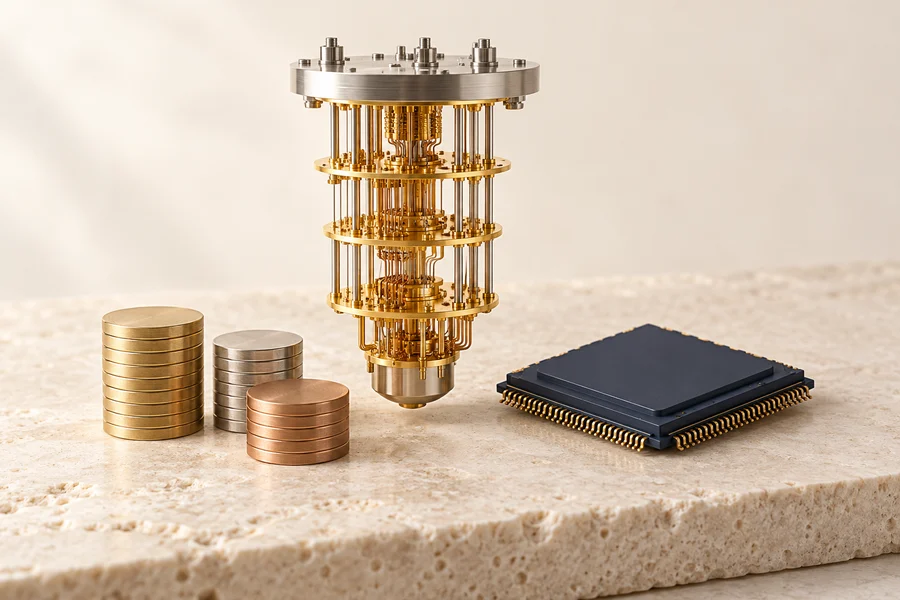
AI-generated with OpenAI image generation for The Strategic Newb
Qilimanjaro’s new financing is a useful way to understand an emerging technology without assuming it will immediately transform company profits. The commercial challenge is to turn specialised computing research into systems that customers can install, use and justify economically. Money can support that process; it cannot substitute for evidence that it works.
Three key points
- The company announced a €19.6 million first close of its Series A financing on 14 October 2026.
- Industrialisation means making systems repeatably and supporting their use, not merely demonstrating a laboratory result.
- Technical performance, commercial demand and an attractive investment return require different evidence.
What the financing announcement says
Qilimanjaro’s announcement identifies €10 million from Indra Group through IndraMind and €9.6 million from Spain’s public technology-investment entity SETT. It says the funding will support industrialisation, chip development and deployment capacity. These are stated uses of capital, not completed outcomes.
Indra’s own release confirms its participation and describes potential applications involving physical AI and robotics. Cinco Días reported the financing on 14 October. Independent reporting supports the existence of the announcement; it does not establish future technical superiority or profitability.
A Series A is a funding round commonly used to develop and expand a young business. A first close means an initial part of the round has been completed. Readers should not treat an ambition to raise more money as cash already secured, or confuse capital raised with revenue earned from customers.
From a working experiment to repeatable equipment
Quantum computing uses quantum states to process information. It is being developed for particular classes of problems, rather than as an automatic replacement for ordinary computers. A useful commercial test asks whether a complete workflow solves a relevant task better after including preparation, running time, checking results and operating costs.
The company describes a full-stack approach: developing chips, software and algorithms while integrating the equipment required to operate them. The economic significance of that approach is coordination. A chip may work in isolation yet still need dependable control, cooling and software to become part of a service a customer can use.
Owning more of those capabilities can give a supplier greater control over integration. It also expands the range of engineering work, skills and spending the supplier must manage. Neither outcome is automatic. A broader product scope can reduce some dependencies while increasing organisational complexity.
Manufacturing adds another test. A successful prototype does not establish that multiple units can be built to the same standard at an acceptable cost. Production processes need consistency, components need qualification and customers need maintenance and support. Those activities can absorb capital before sales become predictable.
Why an industrial investor can matter
An industrial partner may contribute more than money. Access to practical customer problems can help a technology company choose what to test and how to measure a useful result. Integration experience may also help connect a new computing system to established software and operations.
There is a trade-off. Work designed for a particular partner may be less transferable to other customers. A project can meet a sponsor’s research objectives without becoming a widely sold product. Investors therefore need to distinguish a strategic collaboration from repeatable demand across an independent customer base.
Public funding adds a separate policy objective: building capabilities, expertise and supply chains. Such objectives can be valuable even before a business generates sustained profits. But public participation is not a guarantee that shareholders will receive a return or that every proposed application will succeed.
Where the economic benefits would have to appear
For a customer, the relevant gain could be a better decision, a shorter development process or less resource use. The cost comparison must include the people and conventional computers needed around the quantum system. Ignoring those supporting costs can make a technically interesting result appear more commercially compelling than it is.
For the supplier, revenue must eventually cover hardware, engineering, service and continuing research. Selling access remotely and installing equipment at a customer site can produce different cost patterns. A recurring service may create ongoing receipts, while also leaving the provider responsible for operating the system.
These are analytical tests, not claims about Qilimanjaro’s current margins or contract structure. The announcements reviewed here do not provide enough evidence to calculate a sustainable return on the new investment. No market size, target valuation or earnings forecast is inferred from the financing amount.
Now, the next few years and beyond
Now, the strongest evidence concerns the announced financing and the partners involved. Over the next one to three years, relevant evidence would include delivered systems, reliable operation, repeat customers and clearer unit costs. That is a monitoring horizon, not a promised timetable for the company.
Over a longer period, broader commercial adoption would depend on useful performance against improving conventional alternatives. The comparison cannot stand still: an ordinary computing solution may also become faster or cheaper while quantum equipment develops.
Potential beneficiaries include specialised component suppliers, engineering teams and customers with suitable problems. Potential disadvantages include integration costs, scarce specialist staff and dependence on a technology that may take longer than expected to prove its value. Those risks need to be assessed alongside technical progress.
What this means for a new investor
A financing round is evidence that investors have committed resources under particular terms. It is not proof that the underlying technology is ready for every customer, and it does not make a private company’s shares generally available to the public. An investment in a partner company also provides exposure to that partner’s wider activities, rather than a pure claim on one quantum project.
What matters next is the bridge from engineering milestones to customer economics: independently interpretable performance, dependable delivery and revenue that can support the cost base. The financing makes that work possible. Its eventual success remains a question for subsequent evidence.
Sources
Qilimanjaro Quantum Tech and Indra Group, company announcements dated 14 October 2026; Cinco Días, financing report dated 14 October 2026. Direct links appear above. Company descriptions of prospective applications remain claims and plans; no independent benchmark was used to establish commercial advantage.
More news →