The Quad Is Mapping AI Chip Chokepoints Before the Next Supply Crisis
The US, Japan, India and Australia will map AI-chip chokepoints and fund critical-mineral recovery as technology alliances become industrial policy.
By The Strategic Newb Editorial Team
Event: · Published: · Updated:
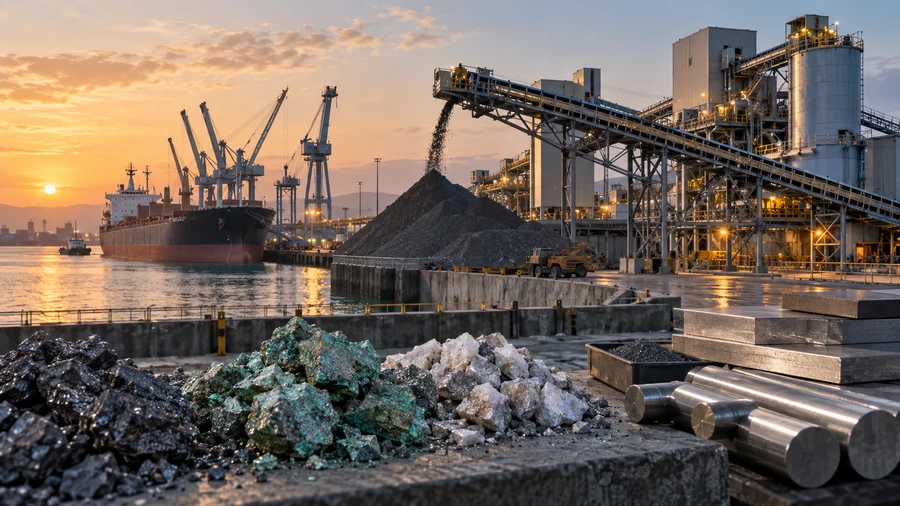
The Strategic Newb / AI-generated editorial illustration
The United States, Japan, India and Australia are preparing to identify weaknesses in semiconductor and AI-hardware supply chains before the next disruption exposes them.
At an October 31 meeting, the four countries—known collectively as the Quad—announced a new effort to map supply-chain chokepoints. They also committed more than $85 million in technical and financial assistance for trusted artificial-intelligence technologies across the Indo-Pacific.
The initiative is important because modern AI systems depend on a narrow network of mineral processors, equipment manufacturers, chip factories, packaging facilities and communications infrastructure.
The Quad is therefore evolving from a diplomatic and security grouping into a form of coordinated industrial policy.
What the Quad announced on October 31
The four governments said they would launch an effort to identify vulnerabilities in advanced semiconductor and AI-hardware supply chains before those vulnerabilities produce disruptions.
The joint statement also included:
- More than $85 million for access to trusted AI technologies across the Indo-Pacific.
- A $10 million US commitment for infrastructure in India and ASEAN countries that recovers critical minerals from electronic waste and other scrap.
- Support for private investment in collection networks, processing facilities and refineries.
- Work on trusted 5G, 6G, Open RAN and future AI-enabled communications systems.
- Continued development of secure and redundant undersea data-cable routes.
- A new Quad Business Leaders' Forum.
- A meeting of Quad export-credit agencies in Tokyo on November 18.
These are confirmed announcements. The governments did not disclose a complete list of projects, private investment, deadlines or the specific supply-chain weaknesses that will be identified.
What is a semiconductor supply-chain chokepoint?
A finished AI chip is the product of a long international chain.
Critical minerals and refined materials are needed for electronics and manufacturing equipment. Chip designers require specialist software. Factories use silicon wafers, chemicals, gases, lithography machines and precision tools.
After fabrication, chips may need advanced packaging that connects processors to high-bandwidth memory. The completed systems require networking equipment, storage, power electronics and data-centre infrastructure.
A chokepoint exists when one country, company or facility controls something that is difficult to replace quickly.
The vulnerability may involve a rare material, a type of manufacturing equipment, advanced packaging capacity or an undersea cable connecting data centres and markets.
Mapping these dependencies allows governments and companies to decide where they need alternative suppliers, inventories or new manufacturing capacity.
Why critical minerals are part of the AI economy
AI is often described as a software industry, but it depends on physical materials.
Data centres contain semiconductors, cables, cooling systems, batteries, transformers and communication equipment. Producing these systems requires copper, rare-earth elements, lithium, nickel and many other processed materials.
The Quad's critical-minerals initiative focuses partly on recycling. Electronic waste and industrial scrap can contain valuable materials that would otherwise be discarded or exported for processing.
Recovering these materials inside trusted supply networks could reduce dependence on newly mined supply and on individual processing countries.
However, recycling infrastructure requires collection systems, consistent feedstock, specialized technology and buyers willing to sign long-term contracts.
Technology alliances are becoming industrial alliances
Traditional alliances focused mainly on military security and diplomacy. The AI era is expanding the definition of national security.
Access to semiconductors, cloud infrastructure, communications networks and critical minerals now affects economic growth, government services and military capability.
The Quad initiative connects these areas. Government funding can support infrastructure, while export-credit agencies can reduce the financial risk of large industrial projects. A business forum can connect private companies with government priorities.
This approach may direct more capital toward suppliers in India, Southeast Asia, Japan, Australia and the United States.
It may also create separate technology ecosystems: one built around suppliers regarded as trusted by Quad countries, and another serving companies and states outside that network.
The China question
The Quad statement expressed concern about economic coercion, arbitrary export restrictions and non-market practices, but it did not name China.
Reuters placed the initiative in the context of concern about China's position in rare-earth and critical-mineral supply chains.
The distinction matters. It is confirmed that the Quad wants more resilient and diversified supply chains. It is an editorial inference—supported by the geopolitical context—that reducing dependence on Chinese suppliers is one of the initiative's strategic motivations.
China remains a major source of processed minerals, manufacturing capacity and technology components. Replacing those supply chains quickly would be difficult and expensive.
How the initiative could affect investment
The most direct effect could be new demand for recycling plants, mineral-processing facilities and trusted communications networks.
Public funding and export-credit support can lower financing costs or protect investors from political and commercial risks. That can make projects viable even when they are initially more expensive than established supply routes.
Semiconductor companies may use the mapping exercise to identify alternative suppliers and locations for new factories or packaging facilities.
Telecommunications companies could receive support for 5G, 6G and Open RAN networks that use approved suppliers.
Ports and undersea cables also matter because digital and physical trade depend on reliable connections across the Indo-Pacific.
The wider economic effect will depend on whether the announcements lead to actual factories, contracts and infrastructure.
Who could gain from the Quad supply-chain strategy?
Critical-mineral recycling companies in India and Southeast Asia could receive funding, infrastructure and access to international customers.
Australian mining and materials companies may benefit from demand for diversified mineral supplies. Japanese and American semiconductor-equipment companies could gain from new manufacturing investment.
Indian electronics and chip industries may receive more capital, technology partnerships and export opportunities.
Open RAN, undersea-cable and cybersecurity providers could benefit from the push for trusted digital infrastructure.
Companies that can demonstrate traceable sourcing and strong security standards may become preferred suppliers.
Who could lose or face disruption?
Chinese mineral processors and technology suppliers could lose business if Quad countries deliberately diversify purchases.
Companies dependent on a single low-cost supplier may face higher costs when they redesign supply chains or hold larger inventories.
Smaller suppliers could struggle with new reporting, cybersecurity and traceability requirements.
Countries excluded from trusted networks may find it harder to access financing or advanced technology.
Consumers and manufacturers may pay higher prices in the short term. Resilient supply chains often include duplication, spare capacity and alternative suppliers, all of which cost money.
Resilience has a price
The most efficient supply chain concentrates production where costs are lowest. The most resilient supply chain spreads production across several countries and keeps alternative capacity available.
These goals can conflict.
Building new refineries, recycling plants and semiconductor facilities may reduce vulnerability but increase costs. Governments may need to provide subsidies or guarantees until production reaches sufficient scale.
The economic question is whether the extra cost of diversification is smaller than the damage caused by a future supply interruption.
The semiconductor shortages earlier in the decade demonstrated that missing components can stop production across automobiles, electronics and industrial equipment. The Quad is attempting to act before the next shortage.
When will the economic impact appear?
The policy and research work can begin immediately.
Meaningful industrial effects could take one to three years or longer; this is an analytical timeframe, not a published project schedule. Selecting projects, arranging financing and building recycling or communications infrastructure takes time.
New semiconductor factories and mineral-processing facilities can require even longer. The larger transformation toward a diversified technology ecosystem is therefore a long-term project.
What to watch next
The first test is whether the Quad publishes a practical map of semiconductor and AI-hardware chokepoints.
The second is project selection. The $10 million critical-mineral commitment will matter more once specific facilities, locations and partners are identified.
The November 18 meeting of export-credit agencies may show whether governments are ready to finance large industrial projects rather than only studies and technical assistance.
Private-sector participation is another important indicator. Long-term purchase contracts can make new recycling and processing facilities financially viable.
Finally, any response from China could affect trade policy, mineral exports and technology competition.
The Strategic Newb view
The Quad's announcement shows that economic security now begins inside the technology supply chain.
AI competition depends on far more than who builds the best model. It depends on who controls minerals, equipment, factories, packaging, networks and finance.
By mapping vulnerabilities before a crisis, the Quad is trying to convert political alignment into industrial resilience.
The announcement illustrates how political alliances can shape investment, sourcing and financing decisions in the AI economy.
Evidence and limitations
Evidence rating: Strong. Confidence: High that the initiatives were announced; medium that they will materially reduce dependence.
The funding commitments and initiatives are confirmed in the joint statement and by Japan's Ministry of Foreign Affairs. Reuters independently corroborated the announcement and supplied geopolitical context.
Specific projects, deadlines, total private investment and measured resilience improvements were not available at publication time. The statement did not explicitly name China.
This article provides economic analysis and does not constitute investment advice.