Refrigeration Cyberattacks Put Food Supplies at Risk
A new US government warning shows how vulnerable connected freezers and cold-storage systems can turn a simple cyber intrusion into food waste, equipment damage and higher supply-chain costs.
By The Strategic Newb Editorial Team
Event: · Published:
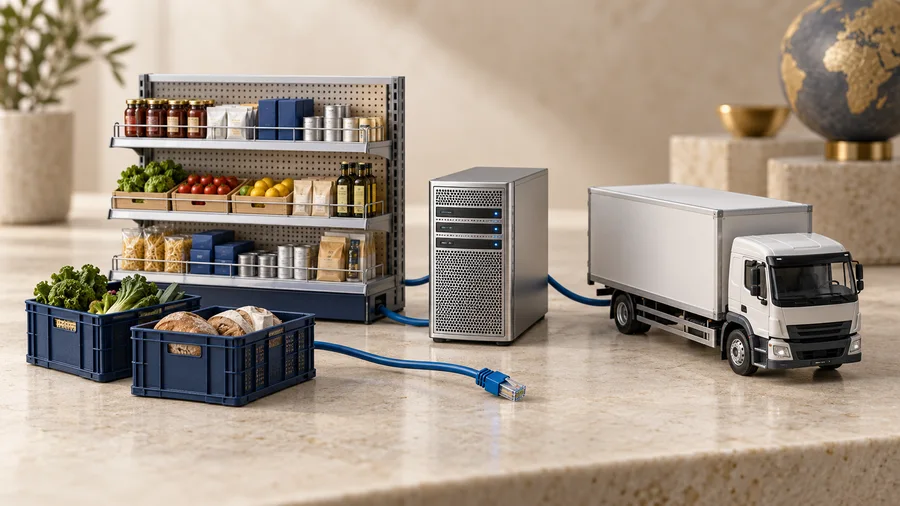
The Strategic Newb / AI-generated editorial illustration
Cybersecurity has moved beyond stolen passwords and encrypted office computers. Hackers are now targeting the machines that keep food, medicines and other sensitive products cold.
On 5 November 2026, the US Cybersecurity and Infrastructure Security Agency, the FBI and the departments of Health and Human Services, Agriculture and Transportation issued a joint warning about malicious activity targeting industrial refrigeration and cold-chain monitoring systems worldwide.
The agencies said attackers may exploit internet-accessible or unpatched controllers. Once inside, they can alter temperature settings, trigger continuous heating or defrost cycles, hide accurate temperature readings and create equipment hazards.
This is not a theoretical scenario. European authorities have confirmed incidents across several EU member states. Recent attacks affected commercial refrigeration systems used by supermarkets and other cold-storage operators.
Why are refrigeration systems connected to the internet?
Large refrigeration installations are controlled by specialised computers. These controllers manage temperatures, defrost cycles, alarms and energy consumption.
Connecting the equipment to a network allows technicians to monitor several locations remotely. It can reduce travel, identify faults earlier and lower operating costs. The same connection can also create an entry point for attackers.
Some systems were originally designed to operate inside isolated local networks. They may now be connected through cellular modems or remote-access tools without modern security controls. Older devices can also use default passwords, unsupported firmware or weak authentication.
An attacker does not always need to shut the equipment down. Changing a temperature setting or forcing a unit into defrost mode may be enough to destroy inventory.
The economic risk reaches far beyond supermarkets
Refrigeration is a hidden foundation of the modern economy. It supports food production, grocery retail, pharmaceutical distribution, healthcare and refrigerated transport.
When a refrigeration system fails, the economic damage can begin within hours. Products may have to be discarded even when they appear undamaged, because operators can no longer prove that they stayed within a safe temperature range.
The immediate costs can include:
- Lost food, medicines and biological materials
- Emergency repairs and equipment replacement
- Store closures and interrupted deliveries
- Additional cybersecurity and monitoring expenses
- Insurance claims and higher future premiums
- Regulatory investigations and product-safety checks
If attacks become frequent or affect major distribution centres, they could also reduce local availability and contribute to higher consumer prices. A short disruption at a supermarket is inconvenient. A disruption at a regional warehouse, food processor or pharmaceutical distributor can affect many customers at once.
Digital efficiency created a physical vulnerability
The central economic tension is clear. Remote monitoring made refrigeration more efficient, but insecure connectivity can expose physical equipment to remote manipulation.
This is an example of operational technology risk. Operational technology controls machines and industrial processes, while traditional information technology manages data and business applications. A compromised office computer can expose confidential information. A compromised refrigeration controller can spoil food or create a fire hazard.
Companies therefore face a new calculation. The cheapest connected controller is not necessarily the lowest-cost option over its full lifetime. Security support, software updates, network architecture and replacement planning now influence the real cost of ownership.
What authorities recommend
The US joint advisory urges operators to identify every controller that can be reached from the public internet. Unnecessary remote access should be removed.
Where remote access remains necessary, operators should use firewalls, strong authentication and restricted network access. Refrigeration controllers should be separated from normal corporate networks. Default passwords should be changed, firmware should be updated and unsupported equipment should be replaced.
The advisory also recommends reliable offline backups, activity logging and safe limits for temperature settings. These measures can reduce the chance that one compromised account or device affects an entire organisation.
The European Union Agency for Cybersecurity has separately called for rapid information sharing and coordinated action following incidents in multiple countries.
Who could gain and who could lose?
Industrial cybersecurity providers could benefit from increased demand for network monitoring, segmentation and secure remote access. Manufacturers that provide supported controllers with secure-by-design features may gain an advantage over suppliers of cheaper legacy equipment.
Refrigeration contractors may also see additional work as customers audit, update and replace installations.
The financial burden will fall first on supermarkets, food processors, logistics companies, cold-storage operators and healthcare organisations. Smaller businesses may be particularly exposed because they often lack dedicated operational-technology security teams.
Consumers ultimately carry part of the risk. Higher security, insurance and replacement costs can be passed through the supply chain. Product losses can also create temporary shortages.
The bigger lesson for connected infrastructure
Refrigeration is only one category of equipment that moved online faster than its security model evolved. Pumps, building systems, industrial sensors and energy controls can face similar problems.
The refrigeration attacks demonstrate how a digital weakness can produce immediate physical and economic consequences. Cybersecurity is no longer only an information-technology expense. It is becoming part of food security, healthcare resilience and supply-chain management.
For companies, the question is no longer whether connected equipment improves efficiency. It often does. The more important question is whether the savings still exist after the cost of securing, monitoring and eventually replacing that equipment is included.
Frequently asked questions
Can hackers really change the temperature of commercial freezers?
Yes. Government agencies say attackers can exploit exposed or vulnerable controllers and remotely alter settings, including heating and defrost cycles.
Which industries face the greatest risk?
Food retail, cold storage, refrigerated transport, healthcare, pharmaceuticals and chemical operations all depend on reliable temperature control.
Does disconnecting a controller solve the problem?
Removing unnecessary internet access reduces exposure, but operators still need to update equipment, change weak credentials, isolate networks and monitor systems.
Could refrigeration cyberattacks affect food prices?
Individual attacks may have limited price effects. Repeated or large-scale disruption could increase inventory, insurance, security and logistics costs, which may eventually reach consumers.
Evidence note
The incidents and government mitigation advice are confirmed. The identity and motivation of the attackers remain unclear. Wider effects on inflation and international food supplies are plausible economic risks, not confirmed outcomes.
Sources
- US government partners, US Government Partners Urge Hardening Industrial Refrigeration and Cold Chain Monitoring Systems, 5 November 2026
- Reuters, US warns of ongoing cyber threat to industrial refrigeration systems, 5 November 2026
- ENISA, Joint statement on cyber incidents in refrigeration systems across the EU, 4 November 2026