Second Thomas Shoal Resupply Mission Halted by Chinese Vessels
A Philippine mission to resupply the BRP Sierra Madre was suspended after Chinese vessels interfered on 24 September. No one was injured, but the failed delivery tests a fragile 2024 arrangement and raises the stakes for Manila's next attempt to reach its outpost.
By The Strategic Newb Editorial Team
Event: · Published:
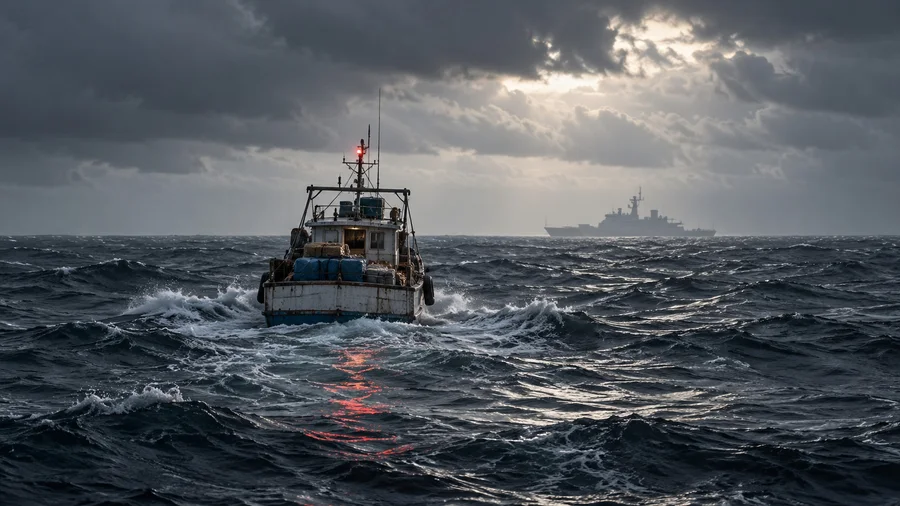
The Strategic Newb / AI-generated conceptual illustration.
Philippine forces suspended a mission to their stranded military outpost on 24 September after Chinese vessels obstructed the route. There was no collision or injury, but the failed delivery raises a harder question: can Manila keep supplying the garrison under the fragile understanding reached with Beijing in 2024?
The Second Thomas Shoal resupply route has become dangerous again. Philippine authorities say Chinese naval and coastguard vessels interfered with a routine operation on 24 September 2026, forcing the mission to be suspended before supplies and replacement personnel reached the BRP Sierra Madre. Beijing describes its conduct as monitoring and warnings after a Philippine vessel ignored its objections. The practical result is clear: this particular Philippine mission did not complete its task. Philippine task-force statement · Reuters
That distinction matters. The confrontation was serious, but it was not a collision, an exchange of fire or a confirmed attack. Philippine coastguard spokesman Jay Tarriela told Reuters that nobody was injured. Manila's armed forces said they paused the operation because continuing risked escalation. The episode is therefore best understood as an interruption of access and a warning about the next attempt, not proof that a wider conflict has begun. Reuters · Philippine News Agency
What changed in the Second Thomas Shoal resupply mission?
The Philippines maintains a small military presence aboard the rusting BRP Sierra Madre, deliberately grounded at Second Thomas Shoal, which Manila calls Ayungin Shoal. Keeping that outpost viable requires regular deliveries of food and other essentials and rotation of its personnel. The 24 September operation was one of those routine missions. It was halted about 60 nautical miles from the shoal, according to the Philippine military account carried by the Philippine News Agency and by USNI News. PNA · USNI News
Philippine armed forces spokesman Roy Vincent Trinidad said three People's Liberation Army Navy vessels, including two Houbei-class missile boats, and five China Coast Guard vessels interfered. He placed the encounter between about 8.35pm and 11pm local time. The Philippine Coast Guard said one Chinese vessel came within roughly 1,000 yards of its supply ship, creating a risk of collision. These detailed vessel counts and distances are Philippine official claims; independent reporting establishes the interruption but does not itself verify every manoeuvre or range. PNA · Reuters
China's coastguard gave a different account of the authority to operate there. Its spokesman Jiang Lue said the Philippine vessel ignored Chinese warnings, prompting on-site monitoring and verbal warnings. That account does not change Manila's report that the mission was suspended, but it does show why a routine logistical journey can become a sovereignty dispute. Each side treats the same water and the same approach to the shoal as subject to different rights. Reuters
Fact box
Event: Philippine rotation and resupply operation suspended, 24 September 2026.
Destination: BRP Sierra Madre, grounded at Second Thomas/Ayungin Shoal.
Forces cited by Manila: Three Chinese navy vessels and five coastguard vessels.
Outcome: No reported collision or injuries; delivery did not finish.
Diplomatic context: A provisional resupply arrangement has been in place since July 2024.
Why one stopped delivery matters
At first glance, a supply boat turning back may appear less dramatic than a clash at sea. Strategically, access is the story. A small garrison cannot remain indefinitely without replenishment, while a state that can make each delivery uncertain can apply pressure without firing a shot. If the Philippine assessment is accurate and the interruption becomes a pattern, Beijing could raise the cost of holding the outpost even while claiming that it is merely policing waters it considers its own.
The incident also matters because it touches a mechanism designed to prevent escalation. After a more violent confrontation in June 2024, the two governments reached a provisional arrangement governing humanitarian resupply. Its full terms have not been published. USNI News says this was the first publicly reported blocked resupply since that arrangement went into effect in July 2024. One stopped mission does not prove the arrangement has collapsed, but it tests whether both sides still interpret it in a workable way. USNI News · Reuters
The legal dispute is related but should not be flattened into a slogan. Manila points to the UN Convention on the Law of the Sea and the 2016 arbitral award, which rejected the legal basis for China's sweeping historic-rights claims in much of the South China Sea. Beijing rejects that award and continues to assert authority around the shoal. The tribunal did not resolve every sovereignty issue in the sea; its decision nevertheless remains central to the Philippines' case for operating within its exclusive economic zone. Philippine task-force statement · US-China Economic and Security Review Commission
Who gains and who comes under pressure?
China may gain tactical leverage if its ships can delay access to the Sierra Madre and compel Manila to expend more vessels, diplomatic capital and public attention on each attempt. The Philippines faces the immediate logistical problem of resupplying its personnel, plus a political decision about how visibly to respond. Yet a conspicuous obstruction can also strengthen Manila's diplomatic case and invite closer scrutiny from partners. That is an assessment of possible effects, not an established outcome from a single operation.
The United States is a critical outside actor because of its defence treaty with the Philippines. An armed attack on Philippine armed forces, public vessels or aircraft in the South China Sea could bring alliance commitments into focus. This incident, with no reported collision or injury, should not be described as having triggered that threshold. Its significance is instead that repeated close encounters increase the chance of an accident or a misread move involving a treaty ally.
Commercial shipping is not reported to have been disrupted by this event. The broader sea is a major trade route, however, so persistent military tension matters to governments, insurers and companies that depend on predictable passage. It would be misleading to claim that this one interrupted delivery has already altered freight rates or supply chains. The credible consequence today is higher security uncertainty around the shoal.
What happens next?
The immediate test is whether Manila can make another supply run and whether China allows it to proceed. Philippine authorities say they will continue lawful operations. Beijing may again insist on its own procedures, including the warnings cited by its coastguard. Diplomatic channels could clarify how the 2024 arrangement applies, but its undisclosed wording means outsiders cannot know exactly which side, if either, departed from a mutually agreed procedure. Philippine task-force statement · Reuters
There are several plausible outcomes. A subsequent mission could complete after quiet diplomacy, leaving 24 September as a severe but isolated interruption. The two governments could continue their tense coexistence, with each sailing accompanied by warnings but no contact. Or another operation could produce a collision or injury, turning a dispute over access into a much sharper crisis. None is inevitable; the next mission will provide better evidence than today's rhetoric.
The Strategic Newb assessment
The central question is whether a routine Philippine lifeline remains reliable. On 24 September, it was not: the mission was suspended short of its destination. The absence of casualties is reassuring, but it does not erase the strategic change. If access can be interrupted repeatedly, pressure on the outpost rises without a formal blockade or battle. The next resupply attempt is the decisive indicator of whether the 2024 arrangement still works in practice.
FAQ
What is Second Thomas Shoal? A disputed feature in the South China Sea where the Philippines maintains an outpost aboard the grounded BRP Sierra Madre.
Did Chinese and Philippine vessels collide on 24 September? No collision or injury was reported by the Philippine Coast Guard.
Why was the mission suspended? Philippine officials say Chinese naval and coastguard manoeuvres made continuing too risky; China says it monitored and warned a vessel that ignored its objections.
Has the 2024 resupply arrangement ended? No formal termination has been established. The interrupted mission calls its practical effectiveness into question.
Sources
- Philippine Information Agency / National Task Force for the West Philippine Sea, “Statement of the National Task Force for the West Philippine Sea”, 25 September 2026 — primary statement confirming Manila's account and the date of the mission.
- Reuters, “Philippines accuses China of obstructing resupply mission in South China Sea”, 25 September 2026 — independently reports the interruption, no collision or injury, and China's response.
- Philippine News Agency, “AFP reports Chinese interference in resupply mission in Ayungin Shoal”, 25 September 2026 — records AFP and PCG claims about vessel counts, timing and suspension.
- USNI News, “Chinese Cutters, Warships Block Philippine Resupply Mission to Second Thomas Shoal”, 25 September 2026 — specialist independent reporting on the vessels, 2024 arrangement and interrupted mission.
- US-China Economic and Security Review Commission, “South China Sea Arbitration Ruling: What Happened and What's Next”, 2016 — authoritative background on the scope and importance of the arbitral award.