SEMIFIVE and Mobilint: The Economics of AI on Farm Robots
A Korean chip development contract puts local AI in focus. Farm economics depend on reliable work, total costs and practical support, not processor speed alone.
By The Strategic Newb Editorial Team
Event: · Published:
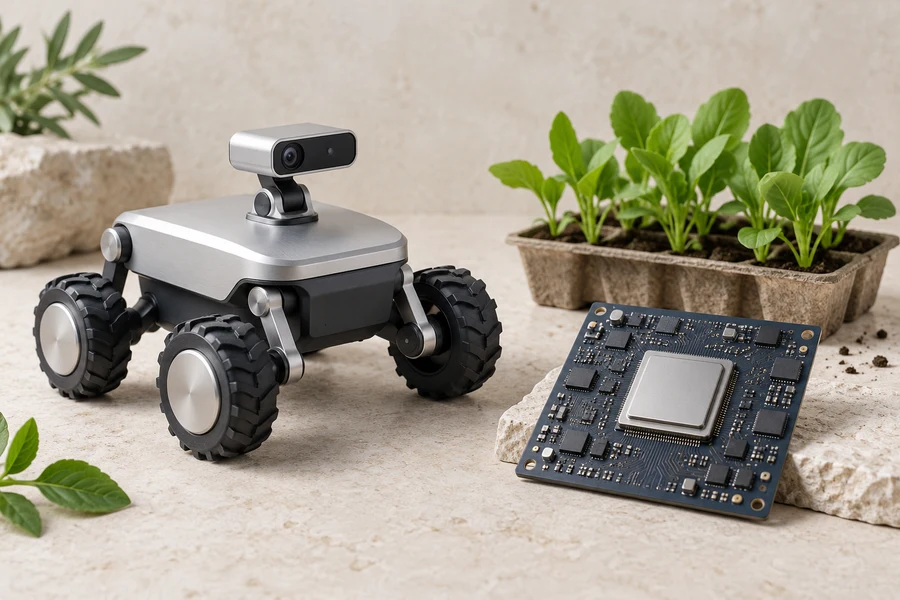
AI-generated with OpenAI image generation for The Strategic Newb
Robots working away from reliable internet connections need a way to make useful decisions nearby. SEMIFIVE announced on 1 October a contract with Mobilint to develop an AI chip for robotics under a Korean government programme. Agricultural robots are among the intended applications. This is a development agreement, not evidence of a finished product operating on farms. The economic question is whether moving computation onto equipment can make useful work more dependable at an acceptable total cost.
Three key points
- Local AI can reduce dependence on a network connection, but it adds computing costs to the machine.
- A chip development contract is an early commercial step; field performance and customer savings remain unproven.
- Farm economics depend on useful work, maintenance and utilisation, not just processor speed.
A concrete project with results still ahead
IN Electronics & Design reported on the project on 2 October, describing its development-stage status. That coverage supports the distinction between a signed agreement and completed hardware; it is not an independent field trial. Later coverage does not make this a new 3 October launch. This analysis uses the original announcement date and treats economic benefits as possibilities to test.
Why the location of computation matters
On-device AI means running a model on the equipment itself. Inference is the use of an already trained model to produce an output from new information. A camera might supply an image and software might identify an object. That is different from training a model, and recognising an object is still different from safely controlling a moving machine. Keeping those tasks separate helps explain both the opportunity and the limits.
Sending every decision to a remote server introduces dependence on a communications link. Processing nearby can reduce that dependence for the tasks handled locally. It does not make a robot completely independent: software updates, supervision and other services may still need communication. The useful comparison is the reliability of a complete working process, including what the machine does when information is missing. A fast answer that triggers the wrong action has little economic value.
Costs move onto the equipment
Local computing requires hardware, electricity, software and support. A buyer may exchange some recurring remote-computing expense for a larger equipment bill and ongoing maintenance. Whether that is attractive depends on how often the system works and how much value each hour creates. The same machine can have different economics on a busy operation and on a farm where it sits unused for much of the year.
For a farm, useful output might be a task completed within the available weather window with less rework. A calculation should include installation, operator training, repairs, charging, supervision and downtime. It should also count failures, rather than measuring only the hours when everything goes well. These are evaluation questions, not claims that the announced chip already improves any of those outcomes. No customer saving is established by the announcement alone.
A better processor is not a complete robot
The chip is one component in a larger system. Sensors must provide usable information, software must interpret it, and mechanical parts must perform the intended action. Improving one component cannot automatically remove a bottleneck elsewhere. A machine limited by its battery or a worn mechanical part will not necessarily complete more work because its processor is faster. Whole-system trials therefore matter more to a buyer than an isolated headline benchmark.
There is also a manufacturing question. Designing hardware, producing working samples and supplying consistent quantities are different achievements. Buyers need confidence that replacements, software support and repair services will remain available. A low initial price may be unattractive if a failure interrupts seasonal work. These commercial requirements explain why a technical demonstration can be encouraging without yet proving a viable business.
Who might gain, and who carries the risk?
Equipment makers could gain a new way to differentiate their machines. Farmers could benefit if dependable automation saves scarce working time. Service businesses might earn revenue by maintaining or operating equipment for several customers, spreading its cost across more work. These possibilities also imply costs for training and changes to existing jobs. The announcement does not establish either a net employment gain or a specific number of displaced workers.
A new investor should distinguish adoption from profit. A supplier can win an order yet spend heavily to develop and support the product. A customer can improve productivity while competition passes the benefit on through lower prices. A share represents an interest in a company with costs, financing needs and competitors. Progress in robotics does not establish an attractive return on that share.
Evidence, time horizon and what to watch next
The evidence is strongest for the announced contract. Now, the relevant milestones are a working design and clearly described tests. Over one to three years, useful evidence would include repeated field use, support arrangements and total operating costs. This is an analytical horizon, not a promised delivery date. Longer-term impact depends on whether reliable applications expand beyond initial customers.
Watch for results that identify the task, operating conditions, comparison system and failures as well as successes. Independent repetition would strengthen confidence in performance. Commercial deployment would answer another question; durable profitability would answer a third. The project is worth following because it connects AI to physical work, while leaving all three tests open.