Siemens and Skeleton Put AI Power Buffers in Focus
Siemens and Skeleton target rapid power changes. Customer results must show whether better computing utilisation outweighs equipment and integration costs.
By The Strategic Newb Editorial Team
Event: · Published: · Updated:
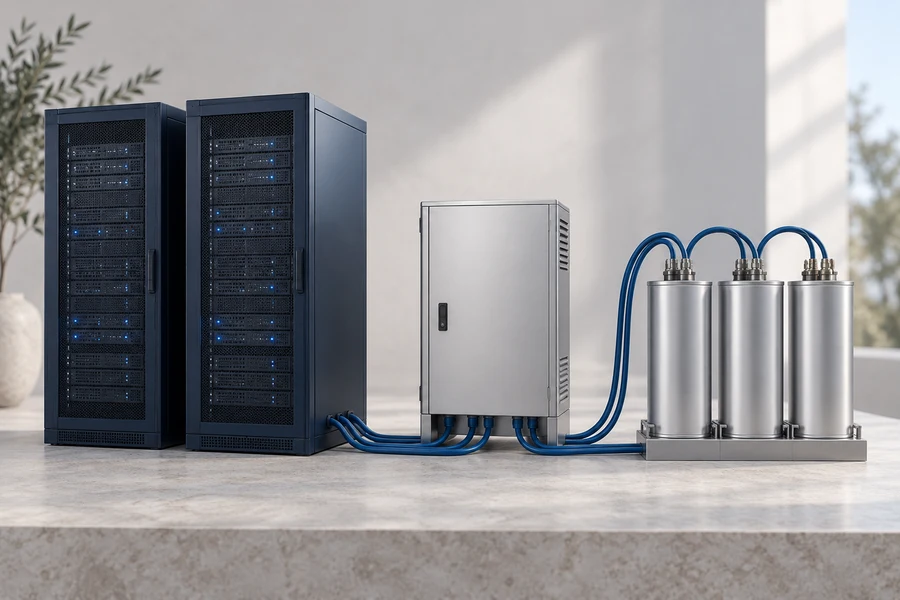
AI-generated with OpenAI image generation for The Strategic Newb
Siemens announced on 14 October an investment in Skeleton Technologies and an exclusive global partnership for its data-centre products. The plan brings supercapacitors into electrical infrastructure for AI computing. This analysis explains the economic question behind that announcement: can equipment that responds quickly to changing demand make expensive computing systems more useful, after its own costs are included?
Three key points
- A short power fluctuation is different from a long-term shortage of electricity.
- Buffers add equipment and integration costs; useful output must justify those costs.
- The partnership is announced, while independently verified customer benefits remain uncertain.
What has actually been announced
Siemens says it will integrate Skeleton’s technology and receive exclusive global rights to sell and scale its products in the data-centre market. Its release also says completion follows customary formalities. Skeleton describes plans to expand US manufacturing and research. These are corporate announcements, not evidence that every planned installation is operating. Data Center Dynamics independently reports the agreement, but does not provide an independent performance test.
Power and energy answer different questions
Power is the rate at which electricity is used or supplied. Energy is the quantity used over a period. A system can have enough energy available across a day while still struggling with a sudden change in demand. Equipment must handle the relevant operating conditions, not merely the daily average. That distinction explains why a fast buffer might have a role even where electricity is already available.
A supercapacitor stores electrical energy and can release it quickly. In a buffering application, it can supply a short burst and recharge later. It does not create electricity. Charging and discharging also involve losses. Such equipment therefore cannot automatically replace a grid connection, provide unlimited backup during an outage or solve a persistent shortage of generation. Those are separate engineering and economic problems.
The business case starts with usable computing
For a data-centre operator, computing equipment represents money committed before customers generate enough revenue to cover it. If electrical constraints prevent that equipment from doing useful work, the investment can earn less than expected. A buffer could be valuable if it removes a real constraint. Its value depends on the specific installation, workload and controls; a product announcement cannot establish that result for all customers.
The comparison must include more than the purchase price. Installation, control software, maintenance, space and energy losses all belong in the calculation. There may also be interruption costs while a facility is modified. A cheaper component can be an expensive system if integration is difficult. Conversely, a higher-priced component can be worthwhile if reliable operation creates enough additional useful output. Neither conclusion follows from a headline specification alone.
What would credible evidence look like?
A useful customer test would compare equivalent workloads under clearly described conditions. It would measure completed computing work, total electricity consumed and reliability, including the buffer’s own requirements. A temporary demonstration is less informative than repeatable operation over time. Results also need a baseline: an improvement against an unsuitable comparison can exaggerate the benefit available to a well-designed existing facility.
This article does not repeat the companies’ numerical performance promises as established outcomes. Independent reporting of a partnership confirms that it was announced; it does not validate efficiency claims. The evidence is strong for the existence of the announcement and limited for the size of customer savings. That difference matters because expected savings often help justify capital expenditure, which means spending on assets used over several years.
Distribution, competition and manufacturing
An established infrastructure supplier can give a smaller technology provider access to procurement teams and service relationships. Customers may benefit from dealing with fewer parties during integration. Exclusivity also raises practical questions about supplier dependence, compatibility and support. Buyers need to understand who maintains the equipment and whether it can work with the rest of their infrastructure. A wider sales channel is an opportunity, not a guaranteed order book.
Manufacturing expansion can create demand for equipment, specialised workers and suppliers. It also ties up capital before output is sold. Qualification, consistent quality and customer demand determine whether planned capacity becomes a sustainable business. Existing power-equipment suppliers may face new competition or opportunities to integrate complementary technology. It is too early to assign lasting winners from the partnership alone.
Time horizon and what to watch next
Now, watch completion of the announced transaction and the scope of actual products offered. Over one to three years, customer installations, independently documented operating results and manufacturing execution would be useful evidence. This is an assessment horizon, not a promised delivery schedule. Longer-term success depends on dependable service and profitable repeat sales. For a new investor, better technology and an attractive investment return remain different questions: costs, competition and the price paid still matter.
Sources
- Siemens: Siemens invests in Skeleton Technologies, expanding its data center portfolio — 2026-10-14
- Skeleton Technologies: Skeleton Technologies secures strategic investment led by Siemens to expand US manufacturing — 2026-10-14
- Data Center Dynamics: Siemens makes strategic investment in energy infrastructure firm Skeleton Technologies to bolster AI data center offering — 2026-10-15