South Korea's AI Chip Boom Is Rewriting the Economics of Global Trade
South Korea's semiconductor exports surged 259% as AI demand pushed trade towards $1 trillion, strengthening growth but increasing chip dependence.
By The Strategic Newb Editorial Team
Event: · Published: · Updated:
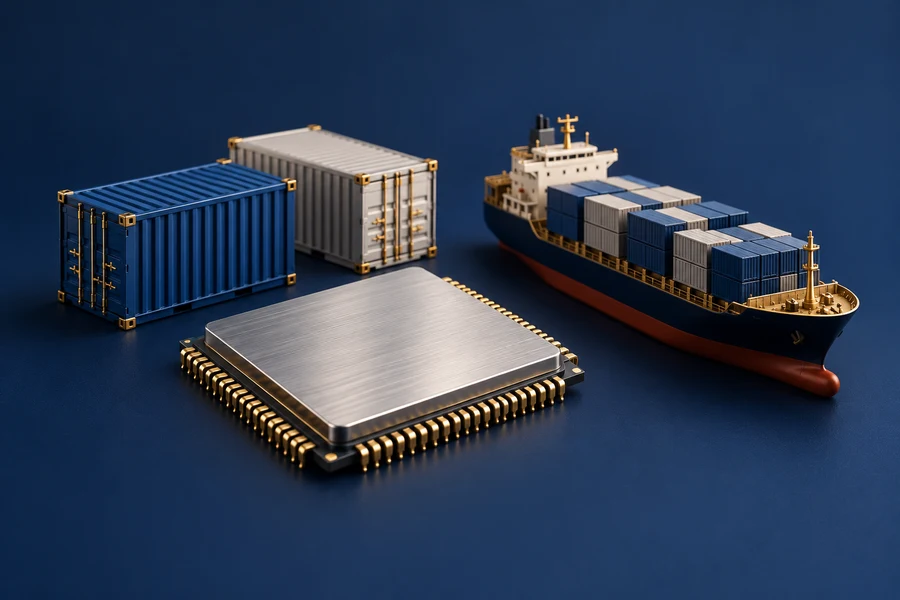
The Strategic Newb / AI-generated editorial illustration
Artificial intelligence is no longer changing only technology companies. It is beginning to change the trade position and economic influence of entire countries.
South Korea exported $115.28 billion of goods in October 2026, according to data released by the country's Ministry of Trade, Industry and Resources on November 1. That was 93.7% more than a year earlier.
Semiconductors produced the most important change. Chip exports increased 259.4% to $56.44 billion as global technology companies continued investing in AI data centres. Computer exports increased 496.6%, supported by demand for AI servers.
The figures show how control over advanced memory and computing components can translate directly into national income, industrial investment and geopolitical influence.
What South Korea announced on November 1
October was South Korea's second consecutive month with exports above $110 billion. The $115.28 billion total was the country's highest result for any October and its second-highest monthly export value overall.
Imports increased 36% to $72.78 billion, creating a monthly trade surplus of $42.5 billion.
Exports during the first ten months of 2026 reached $930 billion. The government expects the annual total to pass $1 trillion during November. If achieved, South Korea would join a very small group of countries that have exported more than $1 trillion of goods in one year.
That milestone had not yet been reached when the data was released. It remains a government expectation based on the current export rate.
The calendar effect matters—but does not explain the boom
The year-over-year increase was unusually large partly because South Korea had more working days in October 2026 than in October 2025. The Chuseok holiday fell in different months, creating a favorable comparison.
However, the calendar effect does not explain the full increase.
Average exports per working day rose 76.1% from a year earlier. Semiconductor prices and shipment volumes remained high, while demand for computers and electrical equipment used in AI infrastructure increased across major markets.
The underlying economic signal is therefore still strong even after accounting for the additional working days.
Why AI data centres need South Korean chips
An AI data centre contains more than a collection of powerful processors.
The processors must continuously receive large quantities of data. High-bandwidth memory, or HBM, moves that data rapidly between memory and the processors performing AI calculations.
Servers also need conventional memory, solid-state storage, networking equipment and power-management components. As AI models become larger and more widely used, each data centre requires more of these products.
South Korea is especially important because Samsung Electronics and SK Hynix are major manufacturers of advanced memory. Their factories supply components used in AI servers, cloud systems, conventional data centres and electronic devices.
When American, Chinese and other global technology companies increase AI infrastructure spending, a significant part of that demand reaches South Korean production lines.
AI investment is reshaping South Korea's trade balance
The export surge affects the economy through several channels.
First, semiconductor sales bring foreign income into South Korea. That supports the trade balance and can strengthen corporate profits, tax receipts and national investment.
Second, high demand encourages manufacturers to expand factories, packaging facilities and research operations. These projects create demand for construction, engineering, industrial equipment and specialist materials.
Third, the sector supports highly skilled employment in chip design, manufacturing, process engineering and supply-chain management.
Fourth, control over scarce components increases South Korea's influence in international trade. Countries and companies building AI infrastructure have a direct interest in stable access to Korean memory.
Finally, the boom attracts more imports. Semiconductor factories require manufacturing equipment, chemicals, energy and raw materials. October imports increased partly because companies continued buying machinery and other inputs.
South Korea could become the fourth trillion-dollar export economy
Annual goods exports above $1 trillion have historically been achieved by only a few major industrial economies.
Reaching that level would be economically significant for South Korea, a country with a much smaller population than the United States or China.
It would demonstrate how specialization in high-value industrial products can compensate for a smaller domestic market. Memory chips are light enough to ship globally but contain enormous value because they require advanced intellectual property, expensive factories and difficult production processes.
The milestone would also strengthen the government's argument for continuing to support semiconductor infrastructure, energy supply and technical education.
Who benefits from the AI chip export boom?
Samsung Electronics and SK Hynix are the most direct corporate beneficiaries. Strong demand and limited supply can support production volumes, prices and long-term customer agreements.
Semiconductor-equipment companies benefit when manufacturers add capacity. The same applies to suppliers of industrial gases, chemicals, silicon wafers, substrates and advanced packaging technology.
Construction and engineering companies can gain from new factories and supporting infrastructure. Ports, airports and logistics companies benefit from moving high-value equipment and finished products.
South Korea's government can gain through higher economic activity and tax revenue. Universities and technical institutes may receive more investment as companies compete for trained workers.
AI companies also benefit when additional Korean production reduces shortages of memory and storage components.
Who faces higher costs or disruption?
Smaller technology companies may struggle to compete with hyperscale cloud providers for scarce advanced memory. Large customers can reserve future production through long-term contracts.
Consumer-electronics manufacturers can face higher component prices if memory producers prioritize more profitable AI products.
Other South Korean industries must compete with chipmakers for engineers, construction capacity, electricity and public support. Rapid expansion in one sector can raise costs elsewhere.
Countries without advanced semiconductor manufacturing may become more dependent on a small number of foreign suppliers.
South Korea itself also faces risk. The more its trade and growth depend on AI-related chips, the more exposed it becomes to a reduction in global data-centre investment.
The hidden concentration risk
South Korea's strength in memory provides economic power, but it also creates concentration.
Demand currently depends heavily on a limited number of cloud companies and AI-infrastructure buyers. These companies are spending extraordinary amounts on data centres, processors and electricity.
If their AI services generate sufficient revenue, investment could remain high for years. If returns disappoint, capital expenditure could slow quickly.
A reduction in orders would affect chip prices, factory utilization, export income and the trade balance. The same industrial specialization producing exceptional growth could therefore amplify a future downturn.
Geopolitical and operational risks matter as well. Semiconductor factories require stable electricity, water, materials and international shipping. A disruption at a major facility can affect customers around the world.
When will the economic impact appear?
The export values and trade surplus are already visible in the release. Higher export revenue does not by itself establish stronger profits at every company.
Investment effects could develop over the next one to three years; this is an analytical timeframe, not an announced delivery schedule. Semiconductor factories and advanced packaging facilities take time to construct, equip and qualify.
The longer-term result depends on whether South Korea maintains its technological lead as competitors in the United States, China, Japan and Europe invest in their own semiconductor capacity.
What to watch next
The first indicator is whether South Korea crosses $1 trillion in annual exports during November as the government expects.
The second is semiconductor pricing. Export growth based on both higher prices and larger volumes is more durable than growth driven by prices alone.
The third is capital expenditure by the world's largest cloud providers. Their data-centre plans influence future memory demand.
Manufacturing capacity also matters. New Korean factories can reduce shortages, but too much expansion could eventually produce oversupply and lower prices.
Finally, energy availability will become increasingly important. Semiconductor production and AI data centres both consume significant electricity, creating competition for reliable power.
The Strategic Newb view
South Korea's October trade data reveals the economic scale of the AI infrastructure boom more clearly than another product announcement.
The country is converting its position in advanced memory into export revenue, factory investment and international influence. AI demand may soon help South Korea become only the fourth economy to export more than $1 trillion of goods in one year.
That success comes with a strategic warning. South Korea is gaining power from the AI investment cycle while becoming more dependent on it.
The real story is therefore not simply that chip exports increased. It is that artificial intelligence is reorganizing national trade—and deciding which countries capture the industrial value behind the digital economy.
Evidence and limitations
Evidence rating: Strong. Confidence: High for the reported data; medium for the durability of the boom.
The export values and growth rates are official preliminary trade data and are corroborated by Reuters, Yonhap and other established publications. The role of additional working days is acknowledged in the official and independent reporting.
The expectation that annual exports will exceed $1 trillion is a government projection. Future chip demand depends on global AI investment, prices, production capacity and broader economic conditions.
This article provides economic analysis and does not constitute investment advice.