Teradyne and Sereact Put Fashion Returns at the Centre of Robotics
A partnership targets variable warehouse tasks. Reliable processing, human intervention and total costs determine whether deployment creates lasting economic value.
By The Strategic Newb Editorial Team
Event: · Published:
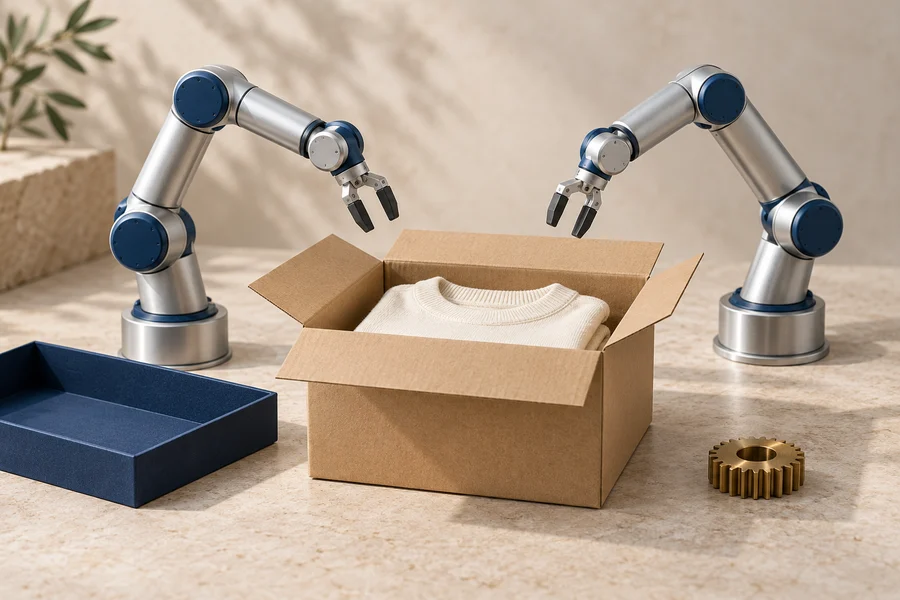
AI-generated with OpenAI image generation for The Strategic Newb
Teradyne Robotics and Sereact announced a partnership on 21 October combining Sereact’s Cortex software with Universal Robots arms. Their company release reports deployment with CEVA Logistics at Zalando facilities in Germany and Poland, processing returned fashion items. That is a concrete commercial-use claim, rather than only a laboratory demonstration. It remains a claim from the companies, without independently verified unit economics in the evidence reviewed.
This analysis examines why returns are an economically interesting task for automation. It does not assume that a robot’s ability to handle an item proves lower total costs, fewer jobs or an attractive return for shareholders.
- Variable products make returns handling a useful test of adaptable automation.
- Business value depends on the whole workflow, including errors, maintenance and human intervention.
- Reported deployment is stronger evidence than a demonstration alone; independently measured profitability remains a separate test.
Why a returned parcel is a difficult business problem
A conventional production line can repeatedly move the same part between fixed positions. A returned parcel presents a less predictable problem. Packaging may differ, an item may lie at an awkward angle, and soft fabric changes shape when handled. A system must identify what it sees, decide how to grasp it and complete the movement without damage.
For a retailer, the physical movement is only one step. Returned goods may need inspection, identification, sorting and preparation before they can be offered for sale again. Automating a handling task does not automatically automate all those decisions. A credible evaluation therefore asks which steps are covered and where people still need to intervene.
The partnership matters as a specific route for combining software and physical machinery. It is not evidence that every warehouse can install the same configuration and obtain identical results. Product mixes, buildings and existing systems differ, so a successful task at one location is a starting point for evaluation elsewhere.
How the technology could change costs
The economic mechanism begins with processing capacity. If a system can reliably handle more items within a shift, a warehouse may reduce a queue or process a larger volume with its existing space. Faster movement through the returns process can also make saleable inventory available sooner. Those are possible benefits, not outcomes quantified by this announcement.
A useful cost measure is the total cost per successfully processed item. It includes machinery, installation, software, maintenance, electricity, supervision and the work needed to correct mistakes. A fast robot that often needs rescuing can shift labour into exception handling rather than remove it. A slower but dependable system may fit some operations better.
Upfront spending also matters. A machine can lower a recurring expense while requiring substantial cash before those savings arrive. Financing terms and the expected working life of the equipment affect the calculation. Throughput alone cannot show whether an installation will recover its initial cost.
Adaptability must survive contact with the warehouse
Adaptable automation means responding to variation instead of following only a fixed sequence. In practical terms, the system needs to cope with the actual products, lighting, packaging and interruptions of a working site. The important question is how performance changes when conditions differ from the setup used to present it.
Safety is another operating requirement. An arm described as collaborative is not automatically safe in every layout or task. The complete installation needs appropriate assessment, controls and procedures. Protecting nearby workers, managing faults and maintaining equipment all remain part of deployment rather than optional extras after purchase.
Software updates bring their own operational questions. A change intended to improve one task must not undermine another. Customers need ways to test changes and recover from failures. These are general implementation considerations; this article does not allege that the announced systems have a particular defect.
What the available evidence does and does not establish
The release reproduced by Nasdaq carries the 21 October publication date. It is the same announcement, not an independent second test. The evidence supports reporting that the partnership was announced and that the companies describe customer deployment. It does not provide a verified comparison of full costs before and after installation.
Three stages should remain separate. A demonstration shows that a task can be performed under the conditions presented. Commercial deployment shows use in an operating setting. Sustained profitability requires the value created over time to exceed all associated costs. Moving beyond a demonstration is meaningful without making the third stage automatic.
Useful follow-up evidence would include comparable processing volumes, error rates, downtime, intervention time and total operating expenditure. An average can also hide difficult periods. Seasonal peaks or changes in the items being returned may reveal constraints that a short demonstration misses.
Who could benefit, and what happens to work?
Retailers and logistics operators could benefit from faster processing and more consistent capacity. Hardware suppliers and software providers could receive orders and service revenue. However, the customer’s savings and the supplier’s profit are different measurements. Discounts, support costs or integration work can distribute the value differently between them.
For workers, the task mix may change. Less repetitive handling could come alongside more monitoring, fault resolution and maintenance. Some activities may shrink while others grow. The announcement does not establish a net employment outcome, and it would be misleading to turn one deployment claim into a broad prediction about job losses.
Competition also affects who keeps a productivity gain. A retailer might retain savings as profit, pass some to customers or use them to improve service. A logistics provider may face pressure to lower contract prices. Better technology does not guarantee that one company captures all the economic benefit.
The timeline and what to watch next
Now, the evidence is an announced partnership and company-reported operational use. Over an analytical horizon of one to three years, repeated deployments and transparent performance data would help establish whether the approach travels well between sites. That horizon is an editorial framework, not a promised company rollout schedule.
Longer term, the question is whether adaptable systems remain useful as products, workflows and software evolve. Replacement needs and ongoing service costs will influence returns. Beginners can follow repeat orders, customer evidence and margins rather than treating an impressive task demonstration as an investment signal. A technological capability and a profitable business remain connected questions that require different evidence.
Sources
Teradyne Robotics and Sereact partnership announcement, Teradyne Robotics via Business Wire, 21 October 2026. Nasdaq reproduction, 21 October 2026: same primary release, used for publication-date corroboration, not independent performance evidence.
More news →