UK Saudi Arabia Military Support: Why Britain Is Refuelling Saudi Jets
Britain has agreed to refuel Saudi aircraft following renewed Houthi attacks. The RAF Voyager mission is limited, but it adds a new form of military support while Saudi oil infrastructure and Red Sea shipping face pressure. Here is what has changed, what Britain has committed to, and what remains uncertain.
By The Strategic Newb Editorial Team
Event: · Published:
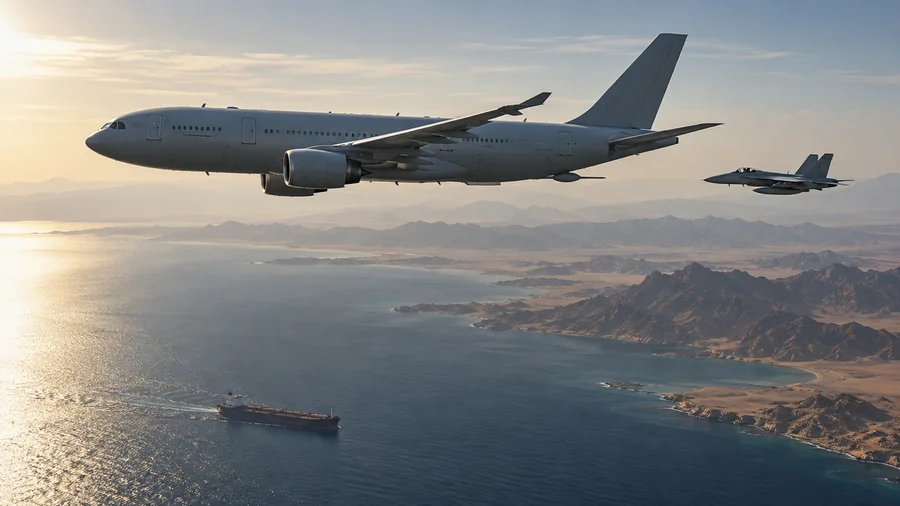
AI-generated editorial illustration / The Strategic Newb
Britain is sending an RAF refuelling aircraft to support Saudi defensive missions after renewed Houthi attacks. The commitment is limited, but it brings the UK into a more direct supporting role at a moment when Saudi oil exports and Red Sea shipping face pressure.
The UK's new Saudi Arabia military support will take the form of an RAF Voyager aircraft refuelling Saudi planes. Prime Minister Andy Burnham announced the agreement on 21 September 2026 after a Saudi request; the Ministry of Defence confirmed it the following day. Britain describes the mission as defensive. Its significance lies in what aerial refuelling can do: allow aircraft to remain on mission longer while Saudi Arabia responds to missile and drone attacks. The precise missions the Voyager will support have not been publicly detailed. UK Ministry of Defence; Reuters.
What changed in UK Saudi Arabia military support?
Britain and Saudi Arabia had an established defence relationship before this announcement. The UK says it already had equipment and personnel helping protect the kingdom from missile and drone attacks. The new element is air-to-air refuelling of Saudi aircraft using one RAF Voyager. Reuters reported that the aircraft was expected to deploy in the days following the announcement.
A refuelling aircraft supplies fuel to other planes in flight. That can extend the time they spend airborne and reduce the need to return to base. It is a support role, but support can affect how long an air operation can be sustained. The UK government says this assistance is for Saudi defensive activity. That stated purpose should be distinguished from a claim that every future flight or operational decision is already known.
The Associated Press reported that the arrangement was expected to last a matter of weeks, subject to review. Burnham likewise described it as time limited. Neither description guarantees when it will end: the review, and events on the ground, will matter.
At a glance
Decision: The UK agreed to provide one RAF Voyager refuelling aircraft.
Announced: 21 September 2026; confirmed by the Ministry of Defence on 22 September.
Stated purpose: Support Saudi defensive activity following renewed Houthi attacks.
Expected duration: Weeks, with the arrangement kept under review.
Unanswered question: Which operations will the aircraft support in practice?
Why do the attacks matter beyond Saudi Arabia?
The immediate concern is renewed fighting involving the Houthis in Yemen and attacks on Saudi territory. AP reported that a missile aimed at Riyadh on 19 September was intercepted. It also reported Houthi attacks on Saudi-linked vessels and oil facilities, alongside a declared blockade on Saudi shipping in the Red Sea and the Bab al-Mandab Strait. Claims about individual attacks and their effects must be assessed separately; a claimed strike does not by itself establish damage.
The wider concern is geography. The Bab al-Mandab connects the Red Sea with the Gulf of Aden. Disruption there can affect vessels using the route towards the Suez Canal, including cargo and energy shipments relevant to European markets. In a 22 September statement, G7 foreign ministers and the EU's foreign policy representative warned that the Yemen conflict threatened maritime security, energy security and supply chains. That is an official assessment of the risk, rather than evidence that every threatened shipment has been stopped.
Saudi Arabia's oil system was already under strain. Reuters reported that drone attacks forced the shutdown of the kingdom's East–West Pipeline on 13 September, halting crude loadings at Yanbu on the Red Sea. Saudi loadings then shifted towards Gulf terminals. According to shipping data cited by Reuters, Gulf crude loadings averaged about 3.7 million barrels a day from 12 September, compared with 2.9 million earlier that month. These figures show a shift in export routing; they do not prove that British refuelling will restore Red Sea flows.
A short timeline
| Date | Development |
|---|---|
| 13 September | Attacks forced the East–West Pipeline shutdown, according to Reuters. |
| 19 September | A missile aimed at Riyadh was intercepted, AP reported. |
| 21 September | Burnham announced agreement to refuel Saudi aircraft. |
| 22 September | The UK Ministry of Defence confirmed the Voyager commitment; the G7 issued a statement on maritime and energy security. |
Who gains, and who comes under pressure?
For Saudi Arabia, access to British refuelling support could give its aircraft more flexibility while defending against attacks. How much difference one Voyager makes depends on its availability, the missions assigned to it and the wider Saudi response. None of those operational details should be assumed from the announcement alone.
For Britain, the decision offers a way to support an established partner and defend its stated interest in stable trade and energy supplies. It also brings closer scrutiny. The UK has committed an aircraft to a live regional conflict and will need to account clearly for the purpose and limits of that support. The Ministry of Defence explicitly presents the deployment as defensive; whether that description remains straightforward will depend on how the operation develops.
For the Houthis, the move means Saudi Arabia has obtained additional outside assistance. It does not establish that Britain has entered a direct fight with Houthi forces. Refuelling a partner's aircraft, flying British combat missions and conducting British strikes are different actions. The announced commitment concerns the first of those.
Shipping firms, energy buyers and European businesses have a more practical question: can vessels and oil cargoes move reliably? The G7 identified threats to the movement of energy, food and fertiliser. Reuters' account of Saudi export rerouting shows why the condition of infrastructure and available routes matters. Neither the government announcement nor the available reporting supports a firm prediction about oil prices.
Could the mission draw Britain deeper into the conflict?
It could increase pressure for further decisions, but escalation is a scenario, not an announced policy. If attacks persist, the UK may face requests to extend or alter its support. If they ease, the arrangement could conclude after the planned review. The Voyager might also contribute to Saudi defensive capacity without producing a visible change in the wider conflict.
The key uncertainty is the operational boundary. The Ministry of Defence says the aircraft will support Saudi defensive activity. Public information does not provide a flight-by-flight account of what that means. Readers should therefore avoid treating the announcement as proof of British participation in a particular Saudi operation, or as a promise that no later policy decision could change Britain's role.
The Yemen conflict has costs beyond military planning. In its statement, the G7 condemned attacks affecting civilians and civilian infrastructure and called for a return to a political process. A longer confrontation could increase humanitarian harm even if outside support improves the defence of particular sites. Conversely, more effective protection and renewed diplomacy could reduce the immediate threat without resolving Yemen's underlying conflict.
What happens next?
Three developments will show whether this commitment remains narrow.
First, watch for confirmation of the Voyager's deployment and the terms of its use. The decision to provide the aircraft is confirmed; its subsequent operations are a separate matter.
Second, watch the pattern of attacks. A reduction in strikes on Saudi cities, infrastructure and shipping would change the immediate case for sustained assistance. Further attacks could strengthen Saudi requests for support, though they would not automatically dictate Britain's response.
Third, watch oil exports and vessel movements. Reuters has documented a shift from Saudi Red Sea loadings towards Gulf terminals following the pipeline disruption. Recovery at the affected infrastructure, and safe passage on maritime routes, would be more concrete signs of easing pressure than rhetoric alone.
The Strategic Newb assessment
Why is Britain refuelling Saudi jets? The UK says it is helping Saudi Arabia defend itself after renewed Houthi attacks and protecting wider economic and security interests. The new commitment is specific: one RAF Voyager for aerial refuelling, initially for a limited period. Its wider importance comes from the setting. Saudi energy infrastructure has been disrupted, Red Sea shipping faces threats, and Britain has chosen to add operational support to an existing defence relationship.
Whether that support helps contain the crisis or becomes the first step towards a longer commitment cannot yet be known. The test is what the aircraft actually does, what happens to the attacks, and whether trade and energy routes become more secure.
Frequently asked questions
Is the UK sending fighter jets to attack Yemen?
No such new mission was announced. The confirmed commitment is one RAF Voyager aircraft to refuel Saudi planes in support of what the UK calls defensive activity.
How long will British support last?
AP reported that the agreement was for a matter of weeks, subject to review. The UK has not announced a fixed end date in the Ministry of Defence statement.
Why does the Red Sea matter to Europe?
Shipping through the Red Sea connects with the Suez route. The G7 warns that insecurity around the Red Sea and Bab al-Mandab could disrupt global supply chains, including energy, food and fertiliser flows.
Will this bring oil prices down?
That cannot be concluded from the announcement. Prices depend on several factors, including the extent of disruption and the availability of alternative export routes.
Sources
- UK Ministry of Defence — UK military support to the Kingdom of Saudi Arabia, 22 September 2026: official commitment and stated purpose.
- Reuters — UK's Burnham agrees to Saudi request for refuelling support, 21 September 2026: announcement, duration and deployment plans.
- Associated Press — UK to offer Saudi Arabia aerial refuelling to counter Houthi attacks, 21 September 2026: conflict and shipping context.
- UK Foreign, Commonwealth & Development Office — G7 Statement on Bab al-Mandab and Navigational Rights and Freedoms, 22 September 2026: official risk assessment.
- Reuters — Saudi Arabia ramps up Gulf oil exports after pipeline attack, data shows, 21 September 2026: pipeline and loading figures.