The U.S. Battery Manufacturing Accelerator Targets a Critical Industrial Weakness
America produces important battery research, but often struggles to manufacture inventions at scale. BattMan is designed to close that gap.
By The Strategic Newb Editorial Team
Event: · Published: · Updated:
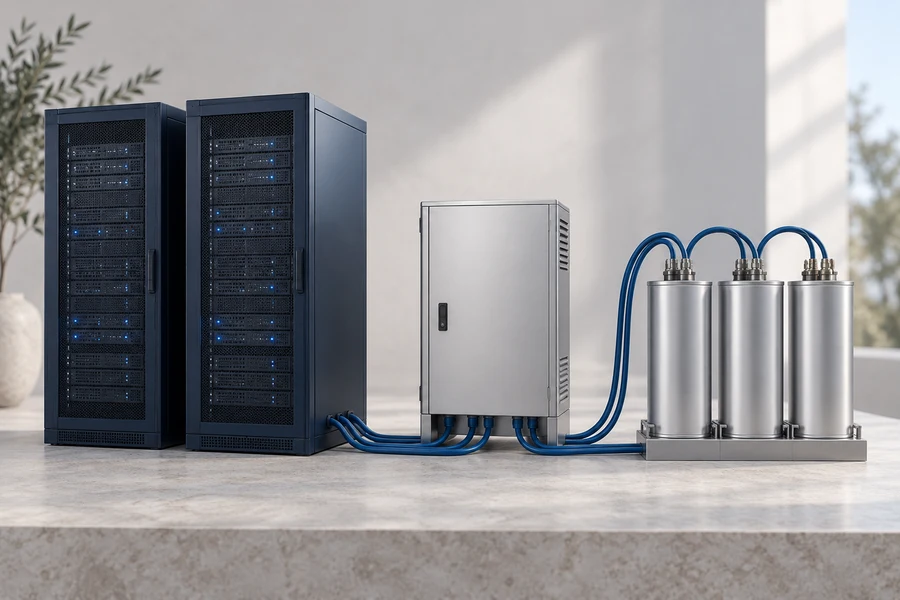
The Strategic Newb image library
The United States has produced important battery inventions, research institutions and startup companies. It has been less successful at turning every promising discovery into a competitive domestic factory.
A new federal initiative is designed to address that weakness.
On October 28, 2026, the U.S. Department of Energy announced a national battery strategy and launched the Battery Manufacturing Accelerator, known as BattMan. The consortium will combine materials research, artificial intelligence, digital twins, process monitoring and manufacturing automation.
Its purpose is not simply to invent a better battery. It is to make new batteries easier and less expensive to manufacture at commercial scale.
What the Department of Energy launched
BattMan is led by Pacific Northwest National Laboratory. Its founding research network includes Argonne National Laboratory, Oak Ridge National Laboratory, the National Laboratory of the Rockies and five university partners.
The accelerator is also establishing relationships with battery and materials companies. According to the programme announcements, the consortium will work on the difficult transition from laboratory discovery to factory production.
The accompanying national strategy sets two broad targets: an integrated domestic battery supply chain by 2030 and U.S. leadership in battery technology and manufacturing by 2035.
Those targets are government objectives. They should not be interpreted as achieved results.
Why battery inventions often fail at the factory stage
A battery can perform well in a controlled laboratory experiment and still be unsuitable for mass production.
Manufacturers must produce thousands or millions of cells with consistent quality. Small differences in material purity, coating thickness, temperature, pressure or assembly can affect safety, performance and lifetime.
Production must also be economically competitive. A technically superior chemistry may fail commercially if it requires rare materials, expensive equipment, slow processing or an unusually high rejection rate.
This is often called the scale-up problem. It is the gap between proving that a technology works and proving that a factory can manufacture it reliably at an acceptable cost.
BattMan is designed to address this gap earlier in the development process.
How AI and digital twins could change battery manufacturing
The programme plans to integrate real-time process monitoring, AI-assisted analysis, digital twins and closed-loop controls.
A digital twin is a virtual representation of a physical product or manufacturing process. Engineers can use it to test how changes in materials, equipment or production settings might affect the final battery.
Real-time sensors can collect information from a production line. AI systems can then look for patterns that indicate defects, wasted material or unstable processes.
Closed-loop control goes one step further. It allows a manufacturing system to adjust settings in response to measured conditions, subject to safety rules and human oversight.
The economic objective is to reduce trial-and-error development, identify problems sooner and improve production yields.
These benefits remain programme goals. BattMan has not yet demonstrated a nationwide reduction in battery manufacturing costs.
The economic problem behind the programme
Battery manufacturing influences several major industries. Electric grids use storage to balance supply and demand. Data centres may use batteries to manage sudden changes in power use and improve resilience. Vehicles, drones, robots, defence systems and consumer electronics also depend on battery performance.
The Department of Energy projects that U.S. demand across transport and energy-storage applications will rise from 179 gigawatt-hours in 2025 to 707 gigawatt-hours in 2035.
That is a government projection, not an observed outcome. However, it illustrates the size of the industrial opportunity the strategy is targeting.
If domestic manufacturing cannot meet demand, more of the economic value will flow to imported materials, components and cells. Dependence on foreign supply can also expose manufacturers to trade restrictions, transport disruptions and price volatility.
Why critical minerals are part of the strategy
Battery supply chains begin before cell assembly. They include mineral extraction, chemical processing, active materials, separators, electrolytes, electrodes, cells, packs and recycling.
The United States has gaps in several upstream and midstream stages. China holds a strong position in the processing of important battery materials and the production of many components.
BattMan says it will support work on materials based on more abundant domestic elements. If successful, this could reduce exposure to some foreign sources and lower material costs.
The word “if” is important. Alternative materials still need to meet requirements for performance, safety, lifetime and manufacturability. A domestic input is not automatically competitive merely because it is available locally.
Who could benefit?
Battery startups could gain access to manufacturing expertise and facilities that would be expensive to develop independently.
Universities and national laboratories may benefit from a clearer route for transferring research into industrial use.
Manufacturers of production equipment, sensors, industrial software and automation systems could receive new demand if companies adopt data-driven battery factories.
Vehicle manufacturers, utilities, data-centre operators and defence contractors may gain if domestic battery supply becomes more reliable and competitive.
Regions that attract factories could receive construction activity, supplier investment and skilled manufacturing employment.
Who may lose or face disruption?
Foreign suppliers could lose market share if domestic alternatives become commercially competitive.
Manufacturers using older, labor-intensive or wasteful processes may face pressure to invest in automation and digital controls.
Some production roles may change or disappear as factories use more monitoring and automated adjustment. At the same time, demand may increase for process engineers, technicians, data specialists and maintenance workers.
Projects that cannot demonstrate a credible route to manufacturing may also find it harder to attract public support or private capital.
The missing number: programme funding
The announcements describe the consortium’s participants, objectives and technical approach. They do not identify a single total budget for the full initiative.
That limits the strength of any conclusion about its future scale. A national strategy can coordinate research and set priorities, but meaningful industrial change also requires sustained funding, factory investment, customer demand and qualified suppliers.
The absence of a disclosed total budget does not make the programme irrelevant. It means its ambitions should be evaluated separately from its demonstrated resources and results.
The likely time horizon
BattMan can begin research partnerships and pilot projects immediately. Within one to three years, it may produce new manufacturing methods, data systems and test results.
The national economic effects will take longer. New factories require permitting, financing, construction, equipment installation and product qualification. Supply chains also need dependable volumes and long-term customers.
The programme should therefore be judged through practical milestones:
- Technologies moving from laboratory work into pilot production.
- Measured improvements in yield, cost, energy use or production speed.
- New industrial partners and private co-investment.
- Commercial products using processes developed through the consortium.
- Reduced reliance on vulnerable imported materials or components.
What happens next
The first question is which companies join the consortium and what manufacturing problems they bring.
The second is whether BattMan publishes measurable results. Claims about faster commercialization will become more credible when supported by production data, cost comparisons and successful technology transfers.
The third is whether the programme connects with demand. A factory process has greater economic value when vehicle manufacturers, grid operators or defence customers are prepared to buy the resulting product.
The Strategic Newb view
The most important idea behind BattMan is that manufacturing knowledge is itself a strategic technology.
Scientific discovery receives attention because it produces patents, papers and impressive prototypes. Economic power often comes later, when a company or country learns how to manufacture the technology reliably, cheaply and at scale.
The United States does not primarily lack battery ideas. It lacks a complete and dependable bridge between research and industrial production.
BattMan is an attempt to build that bridge using data, automation and coordinated expertise. Its success will not be measured by the number of participating institutions. It will be measured by the number of technologies that reach competitive factories.
Evidence and limitations
Evidence rating: Moderate. Confidence: High that the programme has launched; Medium regarding its economic outcomes.
The Department of Energy, PNNL and participating institutions confirm the programme, its members and its stated strategy. No specific total programme budget or demonstrated reduction in manufacturing cost was disclosed.
Claims about lower costs, shorter timelines and stronger supply chains are objectives rather than measured results. This article provides economic analysis and does not constitute investment advice.
Sources
- U.S. Department of Energy — National battery strategy
- U.S. Department of Energy — BattMan launch
- DOE — A National Strategy for American Leadership in Batteries
- Pacific Northwest National Laboratory — BattMan consortium
- University of Alabama — Battery manufacturing consortium participation