Walmart's $6 Billion Robotics Deal Could Reset the Economics of Retail Logistics
Walmart's $6 billion Symbotic deal could cut logistics costs, expand warehouse capacity and intensify the automation race across global retail.
By The Strategic Newb Editorial Team
Event: · Published:
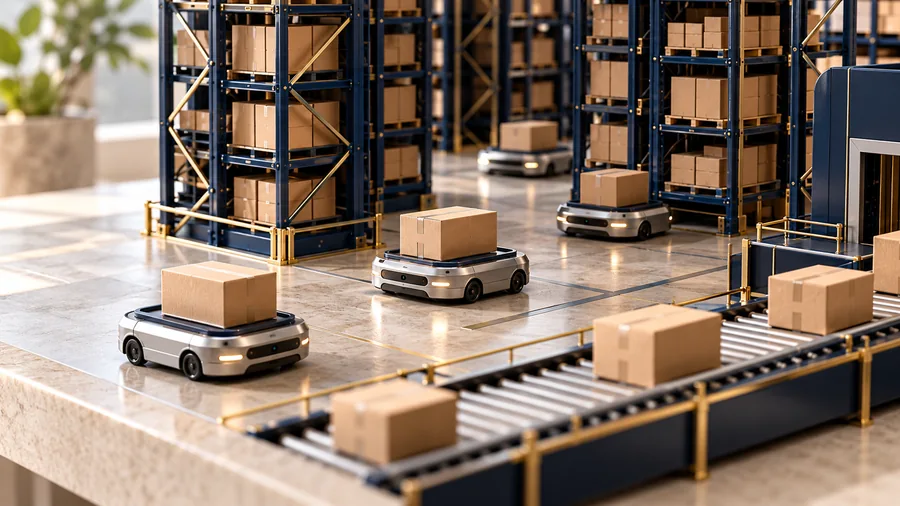
The Strategic Newb / AI-generated editorial illustration.
Walmart has made one of the clearest large-scale bets yet on the economics of warehouse robotics.
On October 29, 2026, Walmart and Symbotic announced an expanded automation agreement covering 25 regional distribution centres in the United States. Walmart committed approximately $6 billion of expenditure over several years, with additional fees expected for software, support, maintenance and parts.
The size matters. This is not a pilot involving a few robots in a demonstration facility. It is a multi-year effort to change how one of the world's largest retailers stores, moves and replenishes inventory.
If the systems perform as intended, the agreement could influence retail productivity, warehouse employment, supplier competition and consumer prices. It may also force rival retailers to decide whether they can afford to remain less automated.
What Walmart and Symbotic announced
The expanded Enterprise Master Automation Agreement adds automation systems at 25 Walmart regional distribution centres.
Walmart also committed $125 million to research and development. That work will focus on next-generation racking, picking, process flow and inventory-management technology.
Symbotic said the agreement could eventually add up to $6.92 billion to its backlog. That figure is a company projection. It is not guaranteed revenue, and actual orders, timing and implementation could change.
The approximate $6 billion initial commitment is supported by company materials and a regulatory filing. Reuters independently reported the agreement.
The important confirmed event is therefore the scale of Walmart's commitment. The eventual productivity savings remain a future outcome that must be demonstrated.
How the warehouse technology works
A conventional distribution centre depends heavily on people and vehicles moving through fixed aisles. Workers locate cases or pallets, transport them to another location and prepare them for shipment to stores.
An automated system reorganizes that process.
Inventory can be stored more densely because robots do not need the same aisle layout as human-operated equipment. Autonomous machines move products between storage locations and workstations. Sensors identify where goods are located, while software coordinates traffic and decides which items should move next.
Artificial intelligence can help the system forecast demand, prioritize orders and reduce unnecessary movement. Automated picking equipment can then transfer selected items for outbound delivery.
The value does not come from a single robot. It comes from combining robots, storage design, sensors and software into one continuous operating system.
Why the $6 billion robotics deal matters economically
Retail is a low-margin business. A small reduction in the cost of handling each case can become economically significant when repeated across millions of products.
Warehouse automation can affect four important cost categories.
First, it can increase labor productivity. Fewer manual movements may be required for the same volume of inventory. Workers can be concentrated in supervision, maintenance, exception handling and tasks that remain difficult to automate.
Second, dense storage can increase the amount of inventory held inside an existing building. That can delay or reduce the need for new warehouse space.
Third, better inventory information can reduce errors and shorten the time required to replenish stores. More reliable product availability can protect sales that would otherwise be lost when shelves are empty.
Fourth, automated distribution can support e-commerce. Online orders often require more complex picking and faster inventory decisions than traditional store replenishment.
These mechanisms could lower Walmart's cost per item. They do not guarantee lower consumer prices. Walmart could use savings to reduce prices, improve margins, invest elsewhere or combine all three.
The retail automation race is becoming a capital race
Walmart's commitment raises the competitive threshold for other retailers.
Amazon already uses extensive robotics in its fulfilment network. Walmart's expanded investment indicates that physical retail distribution is moving toward a similar level of automation.
Large rivals such as Target and Costco, along with grocery groups and logistics providers, may face pressure to increase their own spending. The challenge is that automation requires substantial capital before the savings are proven.
Large companies can spread development costs across many facilities and high order volumes. Smaller retailers may lack the scale to justify custom systems. They may instead depend more heavily on third-party logistics companies or shared automation platforms.
This could strengthen the biggest retailers while increasing consolidation pressure elsewhere in the sector.
Who could gain from Walmart's warehouse automation?
Walmart could gain through higher throughput, denser storage and more predictable operations. Reliable automation may also improve its ability to serve stores and e-commerce customers from the same distribution network.
Symbotic is a direct beneficiary of the expanded relationship. In addition to equipment deployment, the agreement creates potential recurring demand for software, support, maintenance and replacement parts.
Suppliers of sensors, industrial computing, machine vision, motors, warehouse equipment and power systems may also benefit if large-scale retail automation continues.
Consumers could gain if lower logistics costs improve product availability or contribute to lower prices. However, those benefits depend on execution and competitive behavior.
Workers with skills in robotics maintenance, software, electrical systems and operational analytics may see stronger demand.
Who could lose or face disruption?
Warehouse roles centered on repetitive product movement face the clearest disruption. Automation can reduce demand for some tasks even when total warehouse employment does not immediately fall.
The number of jobs affected cannot be established from the agreement alone. New technical jobs may be created, but they may require different skills and may not be located in the same places as displaced work.
Retailers with weaker balance sheets may also lose ground. If automation materially reduces Walmart's costs, competitors without comparable systems could face pressure on prices and margins.
Traditional warehouse-equipment providers may need to adapt as customers shift spending toward integrated robotic systems and software.
Symbotic itself carries execution risk. Deploying complex systems across many active facilities is difficult. Delays, performance problems or cost overruns could reduce the economic benefit for both companies.
When will the economic impact appear?
The investment effect is immediate because the agreement creates demand for engineering, equipment, software and facility work.
The larger operating impact is more likely within one to three years. Each distribution centre must be designed, installed, tested and integrated without destabilizing Walmart's existing supply chain.
The long-term consequence could be a new industry standard. If the systems generate reliable savings, automated high-density distribution may become a requirement for competing at the largest retail scale.
What to watch next
The most important evidence will be operational rather than promotional.
Walmart and Symbotic will need to show that deployments are completed on time, handle expected volumes and reduce cost per case. Investors and competitors should also watch system uptime, maintenance requirements and the pace at which additional centres enter service.
Another key question is labor transition. Training programmes and the mix of new technical roles will reveal whether the productivity gains are accompanied by credible paths for existing workers.
Finally, competitors' capital plans will show whether the agreement is an isolated Walmart strategy or the start of a wider retail investment cycle.
The Strategic Newb view
The most important robot story of the day is not a humanoid demonstration. It is a retailer committing billions to the less visible machinery behind everyday commerce.
Distribution centres determine how much inventory a company can handle, how quickly it can replenish stores and how expensive each product is to move. Improving that system at Walmart's scale could influence the cost structure of the entire retail sector.
The agreement therefore offers a stronger economic signal than another eye-catching robot prototype. Automation is moving into a part of the economy where performance can be measured in throughput, working capital and cost per item.
Evidence and limitations
Evidence rating: Strong. Confidence: High that the investment will proceed; medium that expected savings will be achieved.
The agreement, distribution-centre count and initial commitments are supported by company materials, a filing and independent reporting. Symbotic's potential backlog increase is a company estimate. Neither future savings nor employment effects have been independently demonstrated at the scale of the expanded programme.
This article provides economic analysis and does not constitute investment advice.