What is crypto mining? This is how mining cryptocurrency works
Translated from the original; figures and sources have been preserved. Read the original →
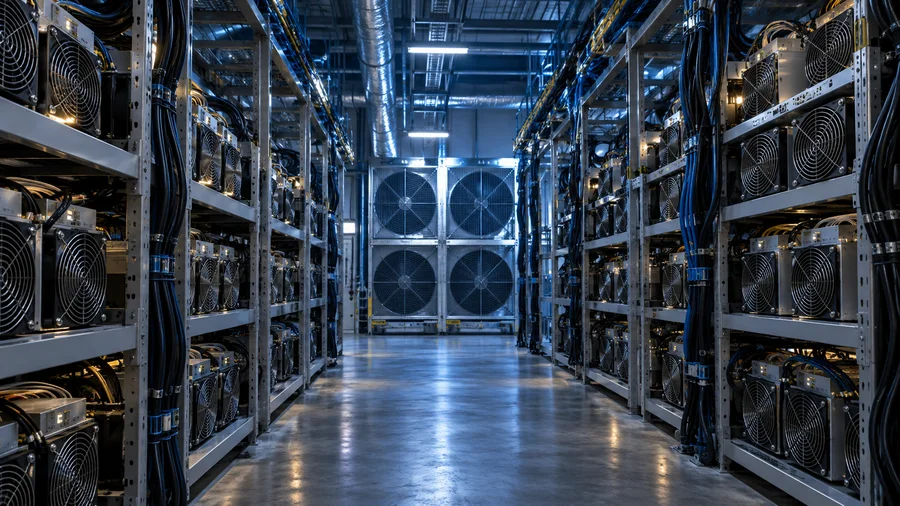
Crypto mining is the process where computers use computing power to add new blocks to a blockchain. With this, miners help secure the network. In return, they can receive a reward in cryptocurrency. Bitcoin is the best known example of a crypto coin that uses mining.
But how does crypto mining work exactly? Why does special equipment need to be used? And what determines whether the proceeds outweigh the costs?
How does crypto mining work?
In the case of cryptocurrency such as Bitcoin, transactions are recorded in a blockchain: a digital registry that is spread over many computers. Mining helps the network to reach agreement on the order of transactions, without a central administrator.
This is done via proof of work. Miners have to prove that their equipment has done computing before the network accepts a new block. The process consists roughly of four steps.
1. Transactions are collected
A miner collects transactions and therefore compiles a candidate block. Those transactions must comply with the rules of the network.
2. Mining equipment calculates hashes
The equipment repeats a calculation that produces a hash: a set of characters derived from digital data. At Bitcoin, the hash of the block header must be below a certain limit.
Miners change input data each time and try again. It is therefore mainly a question of making a lot of attempts. The speed at which equipment does this is called the hashrate.
3. The network checks the block
If a miner finds a valid hash, it spreads the block. Other computers in the network, the nodes, independently check that it complies with the rules. A valid hash doesn't suddenly make invalid transactions valid.
4. The miner receives a reward
If the block becomes part of the accepted blockchain, then the miner gets the corresponding reward. At Bitcoin it consists of newly issued bitcoins and transaction costs from the block. The technical operation is described in the Bitcoin documentation on the blockchain.
Why is crypto mining needed?
Within a proof-of-work network, mining makes it costly to rewrite the transaction history. An attacker has to do a lot of math and compete with the rest of the network.
Mining thus helps to confirm transactions and reduce double spending: attempts to spend the same coins more than once. In addition, Bitcoin ensures the issuance of new coins according to pre-defined rules. You can read more about this in the explanation of Bitcoin.org over mining.
Do all cryptocurrencies use mining?
No. Mining is part of crypto networks that use proof of work. Other networks work with a different mechanism, such as proof of stake.
Ethereum is a well-known example. Since switching to proof of stake in September 2022, ETH has no longer been mined on the Ethereum network. The network uses validators who stake ETH. This transition is known as The Merge.
Crypto mining and staking are therefore different processes. Mining relies on computing power; staking involves committing cryptocurrency under the rules of the relevant network.
What do you need to mine crypto?
What you need depends on the crypto coin and the mining algorithm used. For Bitcoin specialized hardware is the standard.
The main components are:
- Mining equipment: with Bitcoin usually ASIC devices, chips specially designed for the mining algorithm.
- Mining software: software that controls the equipment and communicates with the network or a mining pool.
- A wallet address: to receive payouts.
- A stable internet connection: to exchange mining work and results.
- Electricity and cooling: the equipment constantly uses electricity and produces heat.
An ordinary laptop is not suitable for competitive Bitcoin mining. The choice of hardware is closely linked to the network on which you want to mine. See also Bitcoin documentation on mining equipment and software.
What's a mining pool?
A mining pool allows multiple miners to work together. They provide computing power to the same pool, which distributes proceeds according to an agreed payout model.
At solo mining you try to find a block on your own. With little computing power, the waiting time for a reward can be extremely long. Through a pool smaller miners can get more regular payouts, although they usually pay a fee.
A mining pool doesn't make your equipment faster and guarantees no profit. The main difference lies in the distribution of revenue and its uncertainty. The Bitcoin Manual on Pooled Mining further explains this.
Is crypto mining profitable?
Crypto mining can make a profit, but that's not obvious. According to Bitcoin.org mining is a competitive activity without a profit guarantee.
In order to compare costs and revenues, you have to take into account, among other things:
- The purchase price and lifetime of your equipment.
- The power consumption and your electricity rate.
- Costs for cooling, maintenance and any pool fees.
- The amount of cryptocurrency you receive.
- The price at the time you value or sell the proceeds.
Example of calculation: electricity costs
Suppose a mining device continuously uses 3,000 watt, or 3 kilowatt. At a fictitious electricity rate of € 0.30 per kWh, the daily electricity costs are:
3 kW × 24 hour × € 0.30 = € 21.60 per day
In thirty days, that'll be € 648. Additional cooling, purchase and maintenance are not included.
This example only shows the electricity costs. Without data on the expected mining yield, you cannot calculate profit.
Why does mining use so much energy?
Proof-of-work mining revolves around continuously performing calculations. The devices that do so use electricity and emit heat. The removal of that heat can also cost energy.
Energy use is linked to security: the calculation makes attacks on the network costly. The environmental burden also depends on the energy sources and equipment used. Bitcoin.org describes this relationship in its Note on mining and energy use.
Frequently asked questions about crypto mining
What is the difference between crypto mining and Bitcoin mining?
Crypto mining is the general term for mining cryptocurrency. Bitcoin mining is specifically the mining process of the Bitcoin network.
Can you mine Bitcoin with a laptop?
An ordinary laptop can perform technical calculations, but is not competitive with the specialized ASIC equipment used for Bitcoin mining. A laptop is therefore not a practical choice to earn Bitcoin in this way. See the explanation of Bitcoin.org about starting mining.
Can you still mine Ethereum?
No. Since September 2022, Ethereum has used proof of stake. Mining ETH on the Ethereum network is therefore no longer possible. This is confirmed in the Ethereum mining documentation.
Is crypto mining the same as buying crypto?
No. When buying, you pay for existing cryptocurrency. In mining, you can deliver computing power to a proof-of-work network and receive a reward for that.
Do you always receive a reward at mining?
No. With solo mining, finding a valid block is uncertain. In a mining pool, payouts depend on your contribution and the conditions of the pool. Also a payout doesn't automatically mean you make a profit.
Understanding crypto mining starts with distinguishing revenue from profit. Miners help secure a network and may receive crypto in return, but equipment, electricity and ongoing expenses all cost money. Anyone considering mining needs a calculation that accounts for all these factors.