Cyberattack at Albert Heijn: how vulnerable are our supermarkets?
The Strategic Newb Editorial Team
Updated:
Translated from the original; figures and sources have been preserved. Read the original →
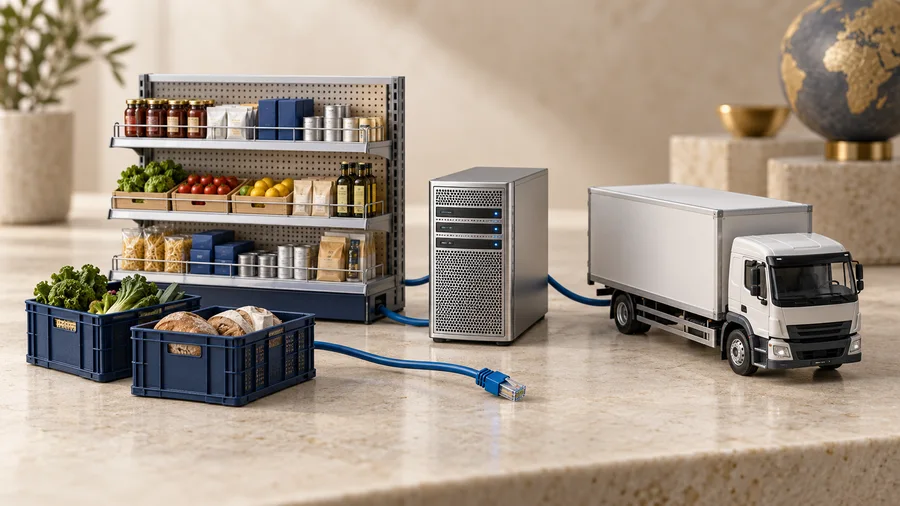
This article discusses Dutch and French examples. The Albert Heijn information concerns its Dutch services, based on the company update of 16 October 2026 at 17:15 CEST, checked on 18 October 2026.
You can manage without a grocery app. But what happens when computer systems stop directing lorries, warehouses grind to a halt or refrigerators cannot maintain their temperature?
The cybersecurity incident at Albert Heijn and attacks on French supermarket refrigeration show how dependent our daily groceries are on digital systems. The consequences reach physical stores too: from disrupted supplies to food that must be destroyed.
This situation also requires care. No link between the Dutch and French incidents has been established. According to Reuters, the Dutch National Cyber Security Centre saw no evidence of a connection.
What happened at Albert Heijn?
Albert Heijn, Etos and Gall & Gall have faced a cybersecurity incident since Sunday afternoon, 11 October. The company shut down systems as a precaution to protect its IT environment.
According to the official update of 16 October at 17:15, stores are being fully restocked. However, online grocery deliveries are cancelled at least up to and including Tuesday, 20 October. Placing new orders is not yet possible.
Albert Heijn also says there are so far no indications that personal data is involved. The nature and cause remain under investigation. The company officially describes a cybersecurity incident; the precise attack method has not been made public.
That distinction matters: service outages do not in themselves prove every affected application was hacked. Protective measures can also make systems temporarily unavailable.
France: cyberattack hits supermarket refrigeration
In France, digital attacks had immediate, visible consequences for food. According to the French finance minister, around 700 supermarkets were affected. The chains included Intermarché, Netto, Coopérative U, Carrefour and Monoprix.
The attacks disrupted refrigeration, forcing stores to discard products. The minister said the national food supply was not at risk.
Investigators examined vulnerabilities in outdated control systems and devices accessible over the internet. Reuters reported on 13 October that no group had claimed responsibility and no ransom had been demanded. The attackers’ identity and motive therefore remained unknown.
Why are cyberattacks on supermarkets so dangerous?
A supermarket sells physical products, but its operations depend on information: how much stock is where, which lorry should leave and which products need replenishing today?
If that information is missing or unreliable, a business may decide to halt processes. That causes losses even when attackers have not directly touched any products or machines.
1. Food can be lost
A delayed delivery of shelf-stable products is inconvenient. With fresh food, every day—and sometimes every hour—counts. Disrupted refrigeration can also make food unsafe to sell.
The risk therefore also affects farmers, producers and hauliers: products can pile up before reaching stores.
2. One incident can affect several links in the chain
A chain may have hundreds of stores while key processes are controlled centrally. If a central service fails, many branches may be affected at once.
Dependence on shared systems therefore creates a business risk. The relevant question is: which processes keep working when a central connection fails?
3. Trust becomes a target
After a widely reported incident, scammers can exploit uncertainty. Examples include messages about refunds, blocked accounts or supposedly necessary checks.
Albert Heijn warns about phishing related to the situation in its own communications. Customers should check updates directly through official channels.
What can businesses do about these cyberattacks?
An important security layer involves operational technology, usually abbreviated to OT. These systems control physical processes such as refrigeration, conveyor belts and warehouse automation.
CISA, the US cybersecurity agency, recommends reducing industrial devices’ exposure to the internet and carefully separating corporate networks from operational systems, among other measures.
For supermarkets, that translates into practical measures:
| Measure | Benefit |
|---|---|
| Separate refrigeration, warehouse systems and office equipment | Limits spread between systems. |
| Remove direct internet access to controls | Reduces potential entry points. |
| Make technician access temporary and individual | Gives greater control over external access. |
| Inventory and replace old devices | Reduces dependence on unmanaged technology. |
| Test and schedule updates | Addresses vulnerabilities while considering business continuity. |
| Practise recovery procedures and backups | Shows how quickly processes can actually resume. |
CISA also publishes guidance on industrial security and remote access.
Refrigeration also warrants an independent safety layer: separate temperature measurements, alarms and local emergency controls. This is a practical recommendation to limit consequences when normal controls do not work reliably.
Which listed companies offer solutions?
For investors, this topic shows why protecting physical infrastructure is a market of its own. Three listed companies have relevant activities.
Fortinet — Nasdaq: FTNT
Fortinet provides firewalls, secure connections and network segmentation solutions, among other products. It specifically offers OT security, including device identification and monitoring.
Its offering therefore fits businesses connecting stores, warehouses and industrial installations.
Palo Alto Networks — Nasdaq: PANW
Palo Alto Networks also offers industrial security. Its technology helps organisations identify devices, assess risks and restrict access to operational systems.
The company thus addresses the connection between digital security and physical business processes.
Schneider Electric — Paris: SU
Schneider Electric combines industrial automation with cybersecurity services. It supports organisations with security architecture, risk assessment and protection of operational installations.
Cybersecurity here is part of a much broader offering in energy management and automation.
These product activities do not prove that the companies are involved in restoring Albert Heijn or the French supermarkets. Nor does extra demand for security guarantee share-price gains. Valuation, competition, profitability and actual revenue growth also matter.
Frequently asked questions about the Albert Heijn cyberattack
Was Albert Heijn customer data stolen?
According to the official update of 16 October, there were no indications that personal data was involved. The investigation was ongoing.
Are the incidents in the Netherlands and France part of the same attack?
That has not been established. Reuters reported that the Dutch NCSC saw no evidence of a link.
Why is a backup alone insufficient?
A backup can restore information, but cannot prevent spoiled stock or temporary downtime. Businesses must also secure access, separate processes and practise operating during outages.
The next security question lies behind the supermarket shelf
The incidents expose a concrete business risk: a supermarket may have enough products, staff and lorries, yet digital controls can still prevent delivery.
For managers, that means investing in both prevention and recovery. For investors, industrial cybersecurity becomes a relevant research topic. For customers, it shows how much technology enables something everyday: groceries reaching stores on time, safely and properly chilled.
Sources
- Reuters — Customer data and the cyber incident, 13 October 2026
- Albert Heijn — Official incident update, checked 18 October 2026; latest visible update 16 October at 17:15 CEST
- AP — Cyberattacks on supermarket chains, 13 October 2026
- Reuters — Investigation into supermarket refrigeration attacks, 13 October 2026
- CISA — Reducing internet exposure
- CISA — Ransomware prevention and response
- CISA — Recommended industrial security practices
- Fortinet — OT security
- Palo Alto Networks — Industrial OT security
- Schneider Electric — Cybersecurity