Will humanoid robots make work cheaper? The economic calculation
The Strategic Newb
Updated:
Translated from the original; figures and sources have been preserved. Read the original →
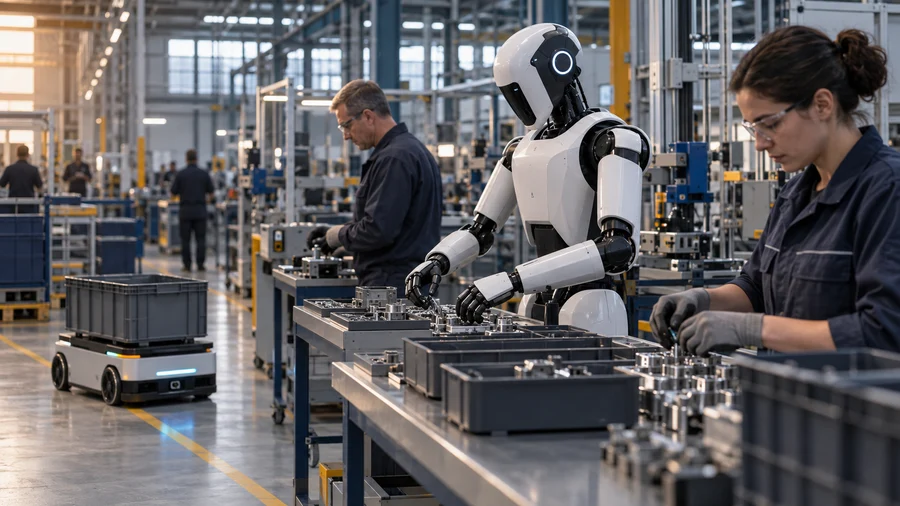
A robot moving a crate might seem expensive. A robot that is reliable every day for many years can be cheaper than the current working method. Going to make humanoid robots work cheaper?This depends less on the shape of the robot than on one hard question: What costs a properly performed task, including downtime, maintenance and human supervision?
The first commercial applications and factory pilots show that humanoids can perform real tasks. Public figures on total customer costs and reduced working hours are limited, however. So we can explain when the economy works, without claiming that an average humanoid in 2026 is already cheaper than an employee. BMW's factory results · Agility's commercial stake.
Checked on 29 September 2026. This article contains an explicit hypothetical cost model, no verified price of an existing robot or advice to replace staff.
The answer in one minute
Humanoid robots can be certain repetitive physical tasks make them cheaper when they last long enough, work a lot of productive hours and need little supervision. They can also cope with shortages, relieve heavy work and use an existing workplace without complete renovation. But a prototype price or impressive demonstration doesn't say anything about the cost per good output. Malfunctions, software, security measures, integration and lower working speed can eat the advantage. The International Federation of Robotics (IFR) still regards massive deployment as uncertain and sees humanoids as an addition to existing robotic technology. IFR.
| Question | When a humanoid can win | When another solution can win |
|---|---|---|
| Workplace | The environment is designed for people and is difficult to modify | A conveyor belt, lifting device or fixed robot arm can do one job cheaper |
| Task | A lot of repetition, stable quality, multiple tasks in one location | The task requires constant improvisation, sensitivity or conversation |
| Utilisation | Long deployment time and sufficient work per day | There are only short peaks or many empty hours |
| Risk | Heavy, ergonomically burdensome or dangerous work can be moved | The robot causes new safety or downtime risks |
What's really proven in 2026?
BMW and Figure.BMW reported that Figure 02 in Spartanburg for 10 months more than90,000 partsmoved in about1,250 operating hours, to support the production of more than 30,000 BMW X3's. The task was to position sheet parts for the welding process. BMW also announced in February 2026 a pilot with a humanoid of Hexagon in Leipzig and reported to investigate additional applications with Figure 03. The 30,000 cars are not cars that the robot built independently; it is the production to which the pilot contributed. BMW did not publish a complete comparison of customer costs per part with the previous method. BMW, February 2026.
GXO and Agility.In November 2025, Agility Robotics reported that Digit had moved more than100,000 totesat GXO in a live logistics environment. In June 2026, Agility reported more than65,000 operational hours across its commercial deployments and commitments for nine customer sites. These are supplier-reported figures. They demonstrate operational progress, not independently audited net savings per working hour. Agility, 100,000 baking · Agility, June 2026
The burden of proof is shifting from “can the robot do it once?” to “can it do it for months, quickly, safely and at a lower total cost than the alternative?”
The real price: cost per productive hour
A useful formula is:
Cost per equivalent productive hour = total annual robot cost ÷ hours in which the robot actually delivers usable output.
Bring purchase or lease, depreciation, financing, maintenance, parts, software, power, insurance, integration, training, security adjustments and supervision. Then measure the output against the same quality standard as the human or existing automated method. An hour in which the robot waits for a mechanic doesn't produce any savings.
Illustrative calculation — not a market quotation
Suppose a company pays €80,000for a robot and depreciates it overfour years. In this hypothetical model, maintenance costs €8,000 a year, software and energy €4,000, and allocated human supervision and integration €8,000. Total annual costs are therefore €40,000: €20,000 depreciation plus €20,000 other costs.
| Scenario | Scheduled hours | Availability | Effective task performance relative to reference | Equivalent productive hours | Costs per equivalent hour |
|---|---|---|---|---|---|
| Conservative | 2,000 | 70% | 80% | 1,120 | €35.71 |
| Strong operational performance | 2,000 | 90% | 95% | 1,710 | €23.39 |
The calculations are €40,000 ÷ (2,000 × 0.70 × 0.80) and €40,000 ÷ (2,000 × 0.90 × 0.95). If the fully allocated cost of the existing task is €35 per equivalent hour, the robot is cheaper under the strong scenario and more expensive under the conservative scenario. Here, €35 is an assumed benchmark, not a claim about average European wages. The task, collective agreement, shift pattern, country and company can all change the result.
This model is deliberately simple. Remaining value, financing costs, taxes, building adjustments, liability and a peak in malfunctions can shift the outcome. With a robot-as-a-service contract, you replace the purchase and depreciation with subscription and usage costs, but the demand for productive output remains the same.
Why the purchase price doesn't say enough
Goldman Sachs Research estimated in 2024 the production costof various humanoid models at approximately$30,000 up to $150,000per copy and predicted further scaling. These are research estimates for manufacture,no publicly proven sales prices, lease prices or full customer costs in 2026. A prognosis for a large future market is also not a cost reduction achieved in the workplace. Goldman Sachs Research.
Even a cheap machine can be expensive if it controls only one task, is often charged or needs constant help. A more expensive machine can be profitable if it safely performs multiple tasks on different services. The measure therefore remains total cost per correct operation and the value of avoided delay, quality loss or physical load.
Why do companies choose a human form at all?
Factories and warehouses are built around human dimensions, tools, racks and passageways. A robot with arms and mobility can use existing work processes in some places. That could limit the modification of a building. But the human form also has disadvantages: balance, many moving parts, energy use and safety make the design complex. For linear transport a cart or autonomous mobile robot can be cheaper; for a fixed welding movement an industrial arm can fit better. IFR therefore does not expect a complete replacement of existing robot types by humanoids. IFR.
The main economic promise is: flexibility: one platform that can handle more than one task after reprogramming. This value only exists when switching in a real factory or logistics operation succeeds quickly and reliably. A video demo doesn't prove that scalability yet.
Will products become cheaper?
Possible, but not automatic. If a robot reduces the cost per good product, a company can lower its price, increase its margin, expand production or invest in quality. How much benefit comes to consumers depends on competition, demand, raw materials, energy and the costs of the rest of the chain. A robot that makes one move of twenty cheaper does not automatically reduce the retail price of the whole product by the same percentage.
For countries and companies, higher productivity can help with labour shortages and competitiveness. At the same time, the demand shifts to tasks: maintenance, process design, quality control and safe human-robotic work get weight. What jobs grow or disappear depends on pace, sector and investment choices. Evidence of BMW and GXO is too limited to mention a net figure for the European labour market.
What does this mean for employees?
The first logical applications lie with predictable, physically heavy or monotonous parts of a job. This can relieve staff and add capacity where vacancies are open. It can also put pressure on the bargaining position and available hours of workers when companies automate tasks faster than people can retrain. The outcome depends on how the introduction is organised and who receives the productivity gains.
For an employer, there is also a difference between automate a taskandreplacing an entire employee. An employee who solves ten types of problems, helps customers and responds to unexpected situations will not be replaced as soon as a robot learns one recurring action. It is wiser to measure, per task, shift and location, what commitment improves quality and working conditions. The ILO also highlights the need for attention to safety and human-robot interaction in advanced robotics. ILO on robotics and safety.
Our conclusion: when do humanoid robots become cheaper?
Yes, for some defined tasks, humanoid robots can make work cheaper. The examples at BMW and GXO show that operational deployment is possible. A general claim that humanoids are already cheaper than human labour is not supported by the published cost information. The decisive factor is availability, speed, quality, number of tasks, monitoring and the price of alternative automation.
The real economic milestone is not the first robot on a factory floor. It is a repeatable customer casethat publicly compares costs per unit of usable output before and after deployment, including maintenance, safety and downtime. Until then,will humanoid robots make work cheaper? is best answered task by task and site by site.
Frequently asked questions
Are humanoid robots cheaper than employees already?
There are practical applications, but public, comparable data on total costs per equivalent task are often lacking. For certain repetitive tasks, the calculation can be positive; there is no general European response.
How much does a humanoid robot cost?
A much quoted Goldman Sachs estimate from 2024 estimated manufacturing costs at $30,000 up to $150,000 for different models. This is not a uniform purchase price and does not include automatic integration, maintenance, software or supervision. Source.
Are humanoid robots going to replace jobs?
They can automate certain tasks and change work. Whether jobs disappear, new jobs arise or job vacancies are filled, varies from sector to business. One automated operation is not equal to one full job.
Are humanoid robots better than ordinary industrial robots?
Not for every job. Their potential advantage lies in flexibility in an environment built for people. For a fixed, well-structured task, a specialised robot or a simpler transport solution can be cheaper and more reliable. IFR.
When do consumers see lower prices?
Only if productivity gains are large enough and through competition or business choices they reach sales prices. Lower labour costs in a single process are not sufficient for this in itself.
Sources and method
Primary sources: BMW over Spartanburg and Leipzig, Agility over Digit at GXO, Agility on commercial deployment, IFR position, Goldman Sachs Research and ILO on work safety. Operational figures of companies have been described as their own communications. The cost model is only an editorial illustration with explicit assumptions.