The most resilient jobs in an age of AI and robotics
Translated from the original; figures and sources have been preserved. Read the original →
Which jobs are best placed if artificial intelligence and robots take over more tasks? Students, workers and anyone considering retraining are asking this question.
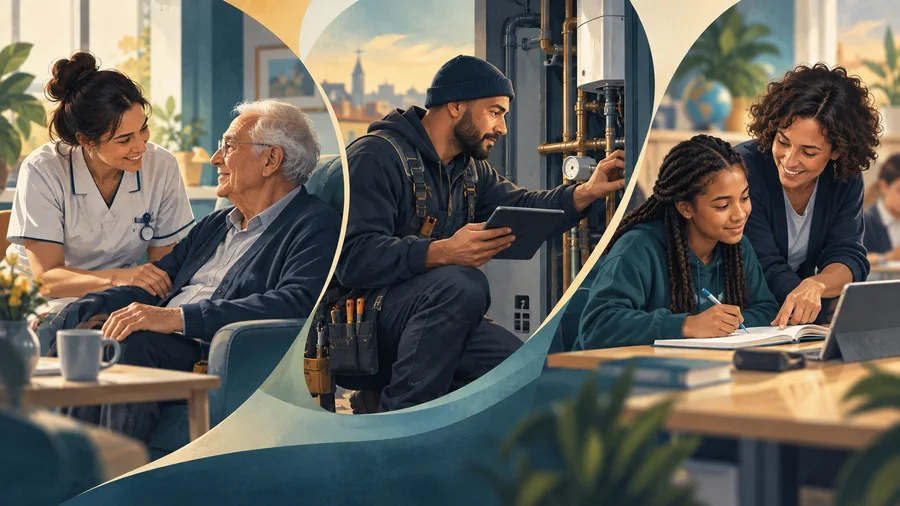
Care work, skilled trades on site and roles with substantial human responsibility appear relatively resilient. They combine skills that are difficult to automate completely: practical action, handling unexpected situations and building trust.
However, there is no job that is guaranteed to remain unaffected. The most useful question is therefore: which parts of your work remain valuable when technology gets better?
When is a job relatively resistant to AI?
AI and robotisation are different developments. Generative AI, for example, can produce texts, images and code. Robots perform physical actions. A profession that is not touched by a chatbot can change by machines.
Relatively resilient work often combines several features:
- Physical actions in changing environments.
- Personal contact where trust is important.
- Decisions for which a person is responsible.
- Unexpected problems requiring practical insight.
- Sufficient demand for the relevant services.
The International Labour Organization expects generative AI mainly to transform many occupations. Exposure to AI therefore does not automatically mean that an entire job will disappear. This research also concerns generative AI, rather than every form of robotics. Source: ILO
The following occupational groups are, on the basis of their work, promising examples, not an official ranking or guarantee for the future.
1. Electricians, plumbers and service technicians
Fixing a fault in an old house is different from repeatedly carrying out the same operation in a factory. Pipes may run differently than expected, installations may have been modified and work areas may be difficult to reach.
A professional must investigate, consult, act safely and implement a solution on the spot. That combination complicates complete automation.
AI can support this with technical documentation, fault diagnosis and planning. Physical implementation remains an important human contribution to many activities.
Examples are:
- Electricians.
- Plumbers.
- Installation and service technicians.
- Heating and cooling system technicians.
The European Labour Authority mentions building and related electricians among the professions for which there are shortages in many European countries. This supports current labour market opportunities, but does not predict how much work will be available in twenty years’ time. Source: European Labour Authority
2. Nurses and caregivers
Care requires a combination of physical assistance, observation, communication and professional judgement. Helping a patient move or noticing that their condition is deteriorating does not always happen in predictable circumstances.
Technology can support administration and facilitate certain actions. The whole care process involves far more than those separate tasks.
Nurses are also among the professions with widely reported shortages in Europe. This brings together two factors: difficult to fully automate work and existing demand for personnel. Source: European Labour Authority
Job security doesn't say much about workload. Anyone who chooses a care profession should also look at schedules, physical stress and training requirements.
3. Maintenance technicians for machines and robots
More automation requires people to install and maintain systems and get them running again when faults occur.
Especially functions in which mechanics, electrical engineering and software come together are interesting examples. Think of a mechanic who investigates why a production line stops and then safely replaces a part.
Maintenance is also being partly automated. Sensors can identify problems and software can suggest possible causes. A technician’s value increasingly lies in assessing that information and resolving complex situations.
A strong combination is therefore: technical craftsmanship plus knowledge of digital systems.
4. Childcare workers and teachers providing intensive personal support
Making teaching material and checking exercises are tasks in which AI can help. Education and childcare also include group dynamics, motivation, safety and personal development.
To reassure a child, to guide a conflict or to recognise why a student is stuck, requires insight into the person and the situation.
Especially functions with a lot of direct guidance therefore seem relatively resilient. Think of child care, primary education and specialist student guidance.
However, the amount of work remains dependent, inter alia, on population development, education policies and available budgets.
5. Psychologists and social workers
AI can hold conversations and provide information. Professional support also involves building a therapeutic or supportive relationship, weighing complex circumstances and taking responsibility.
In addition, psychologists and social workers often have a broader situation: family, health, work, debt or safety.
This makes these professions interesting examples of work in which human involvement remains important. At the same time, digital tools can change the division of labour, for example in reporting or preparation.
Empathy alone does not protect against change. The combination of expertise, trust and careful action is stronger.
6. Emergency workers in unpredictable situations
Firefighters and other aid workers must act in circumstances that change quickly. They combine physical commitment, cooperation and decisions under time pressure.
Drones, robots and AI can help explore dangerous situations or gather information. This changes the work, while human coordination and responsibility remain important.
These roles can be relatively difficult to automate completely. That does not make them a suitable career choice for everyone: training requirements, physical demands and risks all matter.
What jobs are more exposed to AI?
Work consisting largely of repeatable digital tasks is often more directly exposed to generative AI. Think of standard administration, data processing and producing simple texts according to fixed patterns.
The ILO refers to administrative professions as the profession with the highest exposure to generative AI. This is a measure of possible influence on tasks, not prediction of concrete redundancies. Source: ILO
Differences can also be large within one profession. An employee who only enters data has other activities than someone who investigates and solves complex customer problems.
How do you make your own career stronger?
Look beyond your job title. Explore which parts of your work are easily repeatable and which knowledge customers or colleagues are looking for from you.
Three investments can help:
- Deepen your professional knowledge. Make sure you can assess results and recognise errors.
- Learn to use relevant technology. Understand both the possibilities and the limitations.
- Develop communication and practical problem-solving skills. Connect technical information with what a situation actually requires.
In the case of retraining, also check regional demand for staff, duration of training, salary and working conditions. A difficult job to automate is only a good choice if it suits you.
Job security and financial security belong together
The previous articles concerned a European basic income and investing in technology. The demand for future-proof jobs is in line with that.
People can develop and prepare for change. At the same time, not everyone can easily switch to care or technical work. Therefore, accessible training, guidance and income security remain important.
The strongest position arises where craftsmanship, human responsibility and sensible use of technology come together. A society that invests in that combination helps people to grow with AI and robotisation.
Frequently asked questions
Which jobs are most resilient to AI?
Technical work on site, direct care and intensive human guidance seem relatively resilient. No profession is fully protected from change.
Are practical jobs safer than office jobs?
Some are, especially varied work carried out on site. Repetitive physical work in a predictable environment can be well suited to robotics.
Is a staff shortage a guarantee of job security?
No. A shortage describes the current relationship between supply and demand. Technology, policy and economic developments can change that relationship.
Should I change jobs because of AI?
Not automatically. First consider which tasks are changing and which new skills you can develop within your current occupation. Base retraining decisions on concrete opportunities and personal suitability.