European AI and robotics stocks: 6 companies building the future
Translated from the original; figures and sources have been preserved. Read the original →
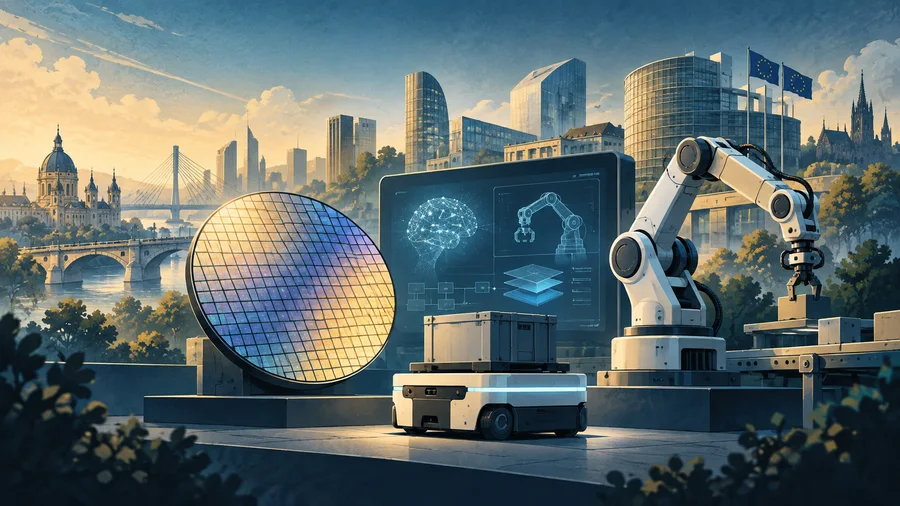
Those who think of artificial intelligence think of American technology companies. Yet Europe plays an important role in the development of AI and robotisation. European companies supply machines for chip production, develop business software and automate factories and warehouses.
ASML, Siemens, SAP, Schneider Electric, AutoStore and KION are six listed companies with different connections to AI and robotisation. Some build physical systems. Others provide software or the infrastructure that makes this development possible.
For those who want to understand European AI shares, the comparison therefore starts with one question: how does the company actually make its money?
European AI and robotics shares in a single overview
| Company | European basis | Exchange and ticker | Connection to the theme |
|---|---|---|---|
| ASML | Netherlands | Euronext Amsterdam: ASML | Machinery for chip production |
| Siemens | Germany | Frankfurt/Xetra: SIE | Industrial AI and automation |
| SAP | Germany | Xetra: SAP | AI in Business Software |
| Schneider Electric | France | Euronext Paris: SU | Energy management and industrial automation |
| AutoStore | Norway* | Oslo Børs: AUTO | Warehouse robots and logistics software |
| KION Group | Germany | Frankfurt: KGX | Warehouse automation and autonomous vehicles |
AutoStore has a Norwegian origin and operational basis. The listed holding company AutoStore Holdings Ltd. is registered in Bermuda. Norway belongs to Europe, but not to the European Union. Source: Norwegian Trade Register
This selection is not a ranking of the best investments. These companies differ in their activities, growth prospects and risks.
1. ASML: technology behind production of AI chips
ASML develops lithography machines that chip manufacturers use to apply patterns to silicon. This puts the Dutch company early in the production chain of chips used for AI, among others.
ASML does not produce AI processors itself. The connection to AI is mainly through the investments of chip manufacturers in production capacity and advanced technology.
In addition, ASML has announced a partnership with Mistral AI, combined with an investment in the company. This adds a more direct relationship with AI development. ASML is listed in Amsterdam and on Nasdaq under the symbol ASML. Source: ASML
What to watch: Customer investment plans, developments in the chip market and export restrictions are relevant. An increasing demand for AI does not mean that orders grow evenly every quarter.
2. Siemens: Apply AI in factories
Siemens connects industrial automation with software and AI. Among other things, the company focuses on the smarter design, control and improvement of production processes.
This makes Siemens an example of industrial AI: technology applied in the physical economy. The value is, for example, in more efficient production, better support for employees and faster response to problems.
Siemens is a broad technology group. Therefore, whoever buys shares invests in more than just AI or robotisation. Source: Siemens · Share data
What to watch: Research how industrial software and automation activities perform, but also look at the other business areas. The total result ultimately determines the financial development of the group.
3. SAP: AI within daily business processes
SAP provides software that enables organisations to manage finance, staff and logistics. The company integrates AI into these processes through its Business AI offer.
The appeal of this application is concrete: AI can be linked to data and work that companies use daily. Think of supporting analyses or automating parts of administrative processes.
SAP introduced its Business AI Platform in 2026 as part of this strategy. Its shares trade on Xetra under the symbol SAP. SAP AI strategy · Stock exchange listing
What to watch: Distinguish between announced AI functions and demonstrable commercial results. It is important whether customers use the applications and want to pay for them.
4. Schneider Electric: energy management and automation
Schneider Electric combines energy management with industrial automation. The company develops AI applications for energy and industry and provides technology that enables organisations to manage their installations.
Schneider thus has several connections to the subject: it applies AI and provides systems for an increasingly automated economy.
The share is listed on Euronext Paris under the symbol SU. AI activities · Share information
What to watch: Schneider is a large group. Assess which part of growth is related to automation and digital infrastructure, and which part comes from other markets.
5. AutoStore: robotisation of warehouses
AutoStore develops robots and software for automatic storage and order processing. The system uses a compact storage structure in which robots help to retrieve goods.
Here the relationship with physical robotisation is immediately visible. Customers invest in a system that helps to make more efficient use of warehouse space and goods flows.
AutoStore is listed in Oslo under the symbol AUTO. Company information · Share information
What to watch: Warehouse automation requires investments from customers. Delays in projects can influence the results, even if the need for automation continues in the longer term.
6. KION Group: autonomous vehicles and logistics automation
KION is active in internal transport and warehouse automation. The company works on autonomous vehicles and systems that support freight flows.
AI also has a role. In its business update for the first quarter of 2026, KION described the deployment of an autonomous industrial vehicle using physical AI at a logistics customer.
KION is listed in Frankfurt under the symbol KGX. Company update · Stock exchange listing
What to watch: In addition to technological developments, look at orders, project execution, margins and debts. New applications should ultimately contribute to a healthy operating result.
How do you compare European AI shares?
The term “AI stock” says little about a company’s quality or price. A warehouse robot manufacturer has a different business model from an enterprise software supplier.
Therefore use these five questions:
- How direct is the connection to AI or robotisation? Is it about the core activity or a limited component?
- Does the technology already deliver revenue? Product announcements are something other than paying customers.
- Is the company financially sound? View profitability, cash flows and debts.
- How strong is the competitive position? Research why customers choose this particular provider.
- What growth is already in the stock price? A good company can also be bought at too high a price.
Holding several stocks within the same theme does not automatically provide broad diversification. They may all be sensitive to falling investment or declining enthusiasm for AI.
From technological progress to shared prosperity
The previous articles focused on a European basic income and the future of work. These companies show where part of the technological development is taking place.
Share ownership can let people participate in business results, but it does not guarantee returns or provide financial security for everyone on its own. Wages, taxes, public services and accessible education remain relevant.
For investors, a good assessment starts with the company behind the technology. What does it deliver, why do customers need it and how much do investors pay for the expected returns?
Frequently asked questions about European AI and robotics shares
Which European companies are active in AI and robotisation?
Examples include ASML, Siemens, SAP, Schneider Electric, AutoStore and KION. Their activities range from chip production technology and software to warehouse robots.
Are these all pure AI companies?
No. Most of them have broad activities. For example, ASML supplies machines for chip production, while Siemens and Schneider Electric also have many activities outside AI.
What is the difference between AI shares and robotics shares?
AI often focuses on software, models and data processing. Robotics revolve around physical systems that perform operations. Both areas can come together in autonomous machines.
Are European AI shares automatically good investments?
No. Technological growth can create opportunities, but the return also depends on the purchase price, profit development and competition. This article is an informative business overview, not personal investment advice.