Basic income in the EU: an answer to AI and robotisation?
Translated from the original; figures and sources have been preserved. Read the original →
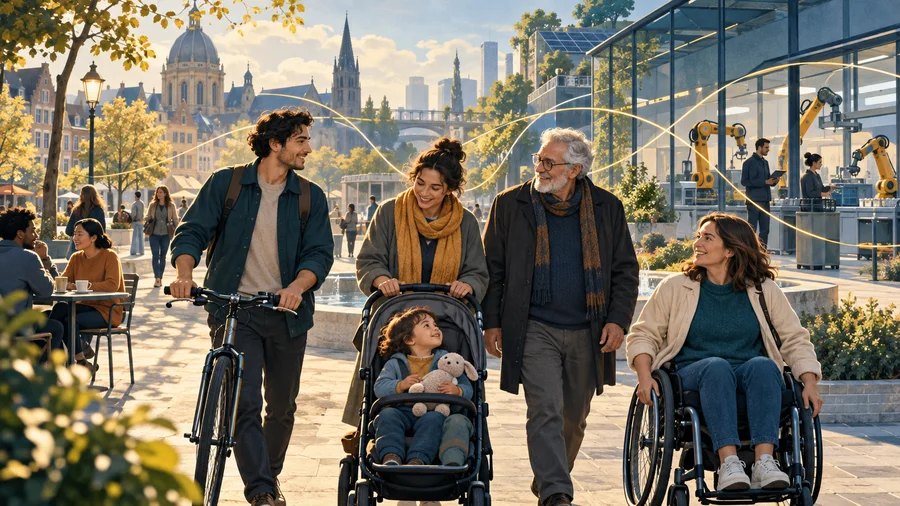
If artificial intelligence and robots take over more and more work, what will people live on? This question concerns everyone’s future in Europe. Technological progress only gains social value when citizens also share in the prosperity it creates.
A basic income for everyone in the European Union therefore deserves a serious place on the political agenda. A fixed monthly payment can offer financial security in an economy where paid work is changing. But should we abolish pensions and social benefits to achieve this? That requires a careful distinction between simplicity and fairness.
What is a universal basic income?
A universal basic income is a periodic payment to each individual within a defined target group, without any income test or obligation to work. It provides a financial basis, regardless of whether someone is an employee, an entrepreneur, a job seeker or a carer.
A European model still requires important decisions. Who would receive it: all residents, all adult residents or EU citizens under certain conditions? What amount would offer sufficient security? And how should differences in living costs be taken into account?
The starting point is simple: financial security does not have to depend entirely on paid employment.
Why AI and robotisation make the debate more urgent
AI can support and automate tasks. Robots can carry out parts of physical work. This does not automatically mean that all jobs will disappear. It can, however, change how many people companies need, which skills are valuable and how economic gains are distributed.
The European Parliament's Research Service mentions a possible shift from labour income to capital income as an important issue around AI. Those who possess technology can benefit more than those who depend mainly on wages. Source: European Parliament
That is where the political issue lies: how do we ensure that higher productivity also leads to greater security for citizens?
A basic income can be a way to distribute those revenues more widely. It's not a guarantee that automation will make everyone richer. It is a proposal to make people less vulnerable when their work changes.
What could a European basic income achieve?
A predictable monthly amount can give room to choose direction again. For example, when a person undergoes training after job loss, starts a company or temporarily works less to care for a family member.
A basic income could also replace some complex income-support schemes. If the payment itself is not reduced when someone starts earning, uncertainty about repayments disappears for that part of their income. How much people ultimately gain from working more still depends on taxes and any supplementary schemes.
Possible benefits are:
- More financial security during changes in the labour market.
- More scope for education, entrepreneurship and caring for others.
- Less administration if existing schemes can genuinely be replaced.
- A stronger negotiating position for people who depend on insecure work.
Whether these benefits occur depends on the level, financing and design of the system.
Eliminate pensions and benefits: is that wise?
One payment instead of numerous schemes sounds attractive. Yet abolishing pensions and social provision altogether is not automatically a good idea.
Accrued pension rights need protection
People have planned their financial futures around pension schemes to which they have often contributed for years. Introducing a basic income while removing their expected pension income could cause substantial income losses.
It is also necessary to distinguish public old-age benefits from supplementary pensions people have built up. These cannot simply be treated as one replaceable benefit.
A defensible proposal is therefore a gradual transition, protecting accrued rights and establishing clear arrangements for future pension accrual.
Equal payments do not cover unequal needs
A person with a disability or high care costs has different expenses than someone without those needs. An equal basic amount does not solve that difference.
A European basic income could therefore better function as a basis, with additional support for necessary care and special circumstances. The aim should be to provide sufficient support for people, even if their needs exceed the standard amount.
How do we pay a basic income in the EU?
Funding is the biggest practical question. Gross expenditure is straightforward to calculate: the monthly payment multiplied by the number of recipients and twelve months. Net fiscal costs also depend on taxes, spending that is replaced and the chosen supplements.
Possible ways of financing are another division of taxation between labour and capital, taxation of corporate profits and placing public investment in a fund from which revenues are shared.
Savings from simpler administration can also count. But without a concrete calculation, there is no reason to assume that cutting bureaucracy can fund an adequate basic income.
The same applies to a so-called robotic tax: first, it must be clear what is taxed, how much it will produce and what the impact on investment is. AI and robotisation do not automatically generate enough additional revenue for the government.
Can the European Union introduce this?
A European basic income requires political cooperation and an appropriate legal basis. The EU coordinates social security between countries, while Member States retain their own systems. It is therefore not a measure that can simply replace all national schemes with a single European decision. Source: European Commission
A possible route is a common European framework, with national implementation and amounts taking into account local costs. This requires agreements on financing, residence conditions and rights in case of relocation to another EU country.
Trials can help to investigate implementation and behavioural effects. However, a temporary trial cannot predict all the consequences of a permanent, fully funded system.
Progress should also strengthen financial security
A basic income in the EU deserves serious research in response to AI and robotisation. When technology produces more value, it is reasonable to discuss how everyone can share in it.
The strongest version of that proposal combines a financial basis for all with protection of accumulated pension rights and additional support for those who need it.
The aim goes beyond replacing benefits. It is about a European economy in which technological progress gives people greater security, time and freedom of choice.
Frequently asked questions about a European basic income
Is a basic income the same as a benefit?
A universal basic income is provided within the defined target group without an income or work test. Many existing benefits depend on income, employment history or personal circumstances.
Can a basic income replace all pensions?
That is not a simple or self-evident step. The impact varies per pension system and per person. A responsible proposal should distinguish between public services and supplementary pensions, and protect accumulated rights.
Does AI make a basic income necessary?
Not automatically. AI can change jobs, create new tasks and make existing tasks disappear. A basic income is one possible policy choice, alongside, for example, shorter working weeks, retraining and other forms of social protection.
Will everyone in Europe get the same amount?
Not necessarily. A European model could combine common principles with country-specific amounts. The choice between equal payments and comparable purchasing power is an important part of the debate.