Festival cup fees in the Netherlands: why a beer suddenly costs €6
The Strategic Newb Editorial Team
Translated from the original; figures and sources have been preserved. Read the original →
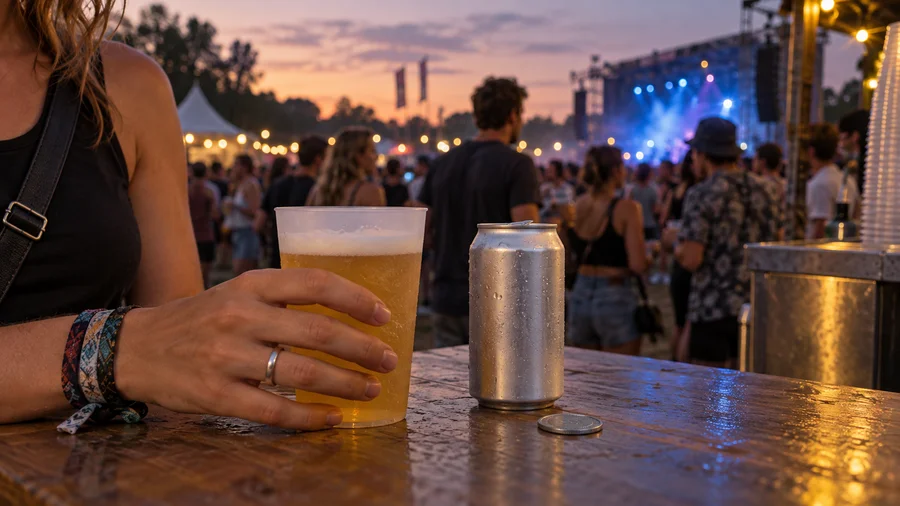
You buy a beer. You talk to friends, put your empty cup on the table and go dancing. A little later an employee cleared the table.
A normal moment during an evening out. Until you order something again.
Without an empty cup or can you pay €2 extra.
At some Dutch events, the packaging of your drink has become something that you have to monitor all evening. Anyone who loses their cup has to pay again. Even if, according to the visitor, the cup was taken by the staff.
The system must reduce waste. But what happens when the organization collects your packaging and you still receive the bill?
How do cup-return schemes work at festivals in the Netherlands?
At Dutch festivals and entertainment venues there are various systems for returning cups, bottles and cans.
For example, in a system with a return token, a visitor receives a coin for the first cup upon arrival. For the next order, the person returns the empty packaging. If you do not want to hold a cup in between, you can exchange the packaging for a new return token at some events.
If you lose both the packaging and the coin, an additional payment will be made.
This is similar to a deposit, but there is an important difference: a return token cannot always be exchanged for money. For example, AFAS Live explicitly states that visitors cannot exchange their cup, bottle or return token for money.
Therefore, visitors must know which system applies. Do you get a deposit back? Are you buying a cup? Or do you pay a surcharge that only allows you to avoid the next surcharge?
That difference determines what an evening out ultimately costs.
€2 extra without cup or can
Pearls of the City, a festival in Amsterdam, describes a recycling system for cups and cans on its website.
According to the current explanation, you pay €2 per drink for the packaging with your first order. For subsequent orders you can return one empty cup or one empty can per drink. Without packaging, €2 will be charged again. The organization links the system to recycling and a clean festival site.
A visitor who repeatedly returns his packaging will therefore avoid repeated surcharges. But anyone who loses the packaging, has it cleaned up or thrown away will pay again.
The price at the bar therefore also depends on what you still have in your hand.
From €4 to €6: a price increase of 50%
A visitor describes how a beer during his visit to Parels van de Stad cost one drink token of €4. Without a empty can to return, half a coin, or €2, was added.
Based on those amounts, the bill looks like this:
| Order | Total price |
|---|---|
| Beer with return packaging | €4 |
| Beer without return packaging | €6 |
| Difference | €2, or 50% extra |
The €4 drink price comes from this personal experience and has not been independently verified as a current festival price.
The visitor says he paid €16 in packaging surcharges during that festival day. That equals eight payments of €2, on top of the drinks.
On its own, €2 may not seem like much. During a long festival day it can become a significant part of the entertainment budget.
What if staff cleans up your cup?
This is where the main tension lies.
An organization asks visitors to return their packaging. At the same time, employees walk around to keep tables and the area clean.
Cleaning that up is helpful. Nobody wants a dance floor full of trash. But an empty cup on the table can still have financial value for the visitor within a return system.
The same visitor says that staff at Frank Borrel in Rotterdam quickly cleared away glasses, while he had to pay an extra €2 when he could not hand one back. He says that a glass was sometimes removed before it was completely empty.
This is his personal observation. Neither the reported clearing of glasses nor the associated charge has been independently confirmed.
But the question this experience raises applies to every event with such a system:
What happens to the return value when staff takes the cup away?
It is difficult for a visitor to hold on to an empty package all evening. People want to dance, go to the toilet or not order a new drink.
If staff collect the packaging without providing a return token or other compensation, the packaging will be returned to the organization. The visitor may then still have to pay again.
That is a problem that an organizer must solve practically.
Is a festival obliged to charge €2?
The Dutch rules for plastic cups and food packaging focus on less single-use plastic, reuse and collection.
For on-site consumption, restrictions apply on single-use plastic cups and food packaging. Collection and recycling options are available under certain conditions. However, the government regulations described do not prescribe a general festival surcharge of €2.
An organizer must therefore distinguish between a legal environmental requirement and the price of its own return system.
“We have to collect packaging” explains the goal. It doesn't explain why a lost cup costs exactly €2, or why a visitor pays again after an employee collects that cup.
Where does the money from the cup surcharge go?
Purchasing, collecting, transporting, washing or recycling cups costs money. A surcharge in itself is therefore not proof of abuse.
A clean festival site also does not prove that an organization is consciously trying to create extra income.
But visitors can ask for transparency:
- How much money is raised with packaging surcharges?
- What costs are paid with this?
- What happens to any revenues above those costs?
- Can you return an empty container without ordering a new drink?
- Do you get a return token when staff clears your cup?
Without information about income and costs, outsiders cannot determine how much an organizer earns from the system.
That is precisely why a clear explanation is important when the surcharge is presented as an environmental measure.
Festival surcharges are not a national deposit
The Dutch deposit on designated bottles and cans is a different system than your own festival surcharge.
The common idea that all uncollected deposits go directly to supermarkets is also incorrect. According to Statiegeld Nederland, there was €132 million in unclaimed deposits in 2024. That amount was used for maintenance and improvement of the national system.
An amount that an event itself charges for a cup or can must therefore be viewed separately.
The most important question for the visitor remains simple: can I get this amount back, and how?
What does a fair cup system look like?
A good return system fits in with how people actually go out.
Visitors must be able to easily return their empty packaging, even if they do not want to order a new drink. A return token can prevent them from always having to hold an empty cup. Several festivals already describe this option on their websites.
In addition, it must be clear what staff do with cups on tables. First asking if a cup can be thrown away, or giving a return token when collected, prevents proper tidying up from leading to a new bill.
The price must also be clear in advance. Before ordering, a visitor should know what a drink costs, what surcharge will be added and under what conditions that surcharge will be refunded or avoided.
A clean site should not become a financial trap
Less waste is a worthwhile goal. But an environmental system must also work fairly for the people who pay for it.
Anyone who returns their cup helps the collection. When an employee collects that cup, it is also collected. A good system takes both situations into account.
The criticism therefore goes beyond the amount of €2. It's about responsibility.
If the organization takes your cup, why do you have to pay again because you no longer have it?
As long as there is no clear solution for this, visitors can experience a sustainability measure as an unexpected increase in the price of drinks.
And that trust is difficult to earn back.
Frequently asked questions about deposits at festivals
Is a recycling token the same as a deposit?
Not always. A recycling token can only be used to receive new packaging for a subsequent order without an additional surcharge. Check whether the coin can also be exchanged for cash.
Why do some festivals charge €2 for a cup or can?
Organizers use such an amount as part of their returns system. For example, Parels van de Stad states €2 per package and again €2 if no empty packaging is returned for a subsequent order. That is not a generally legally prescribed festival amount.
What can you do if staff has taken your cup?
Report it immediately to the bar or a responsible employee and request a replacement return token or correction of the surcharge. Whether the organization allows this depends on its policy.
How do you avoid unexpected cup surcharges?
Read the return rules in advance. Ask if you can exchange an empty container for a coin without ordering anything, and check what happens to your last cup or coin when you leave.
Sources
Sources accessed October 1, 2026. Personal visitor experience is indicated separately; these sources do not confirm the cleaning behavior described.
- AFAS Live — return system: Source
- Pearls of the City — sustainability: Source and FAQ: Source
- Ondernemersplein - rules for plastic cups and containers: Source
- Deposit money in the Netherlands - progress and results 2024: Source
- Central Park Festival — cup recycling system: Source
Further reading
Also read our analysis on sports, events and the local economy and the explanation of US inflation and spending.