Cheap Raw Materials, Costly Dependence: Why Europe Is Exploring Minimum Prices
The Strategic Newb Editorial Team
Translated from the original; figures and sources have been preserved. Read the original →
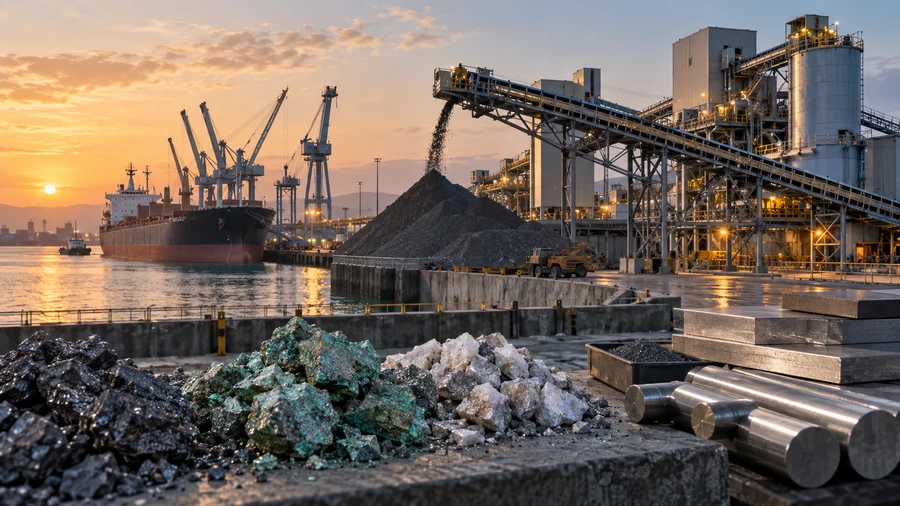
A low price is usually good news. Cheaper raw materials can make batteries, machinery and other products more affordable. Businesses have more room to invest, and consumers may benefit too.
But what happens if that low price prevents alternative suppliers from ever getting off the ground?
That is the dilemma behind the raw materials cooperation being explored by the European Union, the United States and Japan. In a letter to parliament dated 18 March 2026, the Netherlands describes possible tools such as minimum prices, subsidies and long-term offtake agreements. The aim is to make investment in new supply chains more attractive. The letter does not establish that a general minimum price has been introduced. It is a policy exploration.
The underlying question affects anyone buying an electric car, running a factory or depending on modern technology: could cheap imports ultimately prove costly?
Why cheap raw materials can become a problem
Imagine a company wants to build a new refinery. It needs financing, permits, equipment and future customers. Revenue only arrives when the plant actually produces material.
A financier therefore looks beyond whether Europe would like another supplier. They need to know whether that supplier can earn enough for years to come.
If existing producers supply much more cheaply, that becomes difficult. A new plant can be socially desirable yet remain financially unattractive.
This creates a tension. Buyers understandably choose the lowest price, while governments want more suppliers to reduce dependence. What makes sense for one company's purchasing can, in aggregate, leave an entire industry dependent on the same production chain.
This is an economic explanation of the policy dilemma. It does not prove that every low import price is deliberately used to drive competitors out. Cheap production can also reflect scale, efficient processes or favourable conditions.
Processing is another source of vulnerability
Finding a raw material is not the same as building a complete supply chain. Ore must be processed into material of the right quality before a manufacturer can use it.
Access to mines may therefore be insufficient if processing remains highly concentrated.
In its Global Critical Minerals Outlook 2025, the International Energy Agency found that China was the largest refiner for 19 of the 20 strategic minerals examined, with an average market share of around 70%. Those figures concern the group studied and must not be read as a single percentage for all raw materials.
The vulnerability therefore extends beyond mining alone. A new mine offers little independence if its material must still pass through the same foreign processing bottleneck.
What are the EU, US and Japan exploring?
The Dutch parliamentary letter describes several possible tools. A draft EU-US action plan dated 25 March 2026 also mentions examining reference-price measures, including price floors with border adjustments, price-gap subsidies and offtake agreements. Its initial focus is selected critical minerals and their supply chains. This document too discusses feasibility and design.
These tools can have very different effects:
| Tool | How it could work | Main trade-off |
|---|---|---|
| Minimum price or price floor | A lower price limit gives producers greater revenue certainty. The effects depend on implementation. | Who pays when the market price is lower? |
| Long-term offtake agreement | A customer agrees to buy material over several years. | Greater certainty, but less flexibility for the buyer. |
| Subsidy | Public support lowers investment costs or bridges a price gap. | Taxpayers bear part of the cost. |
| Standards-based market | Access or support is linked to specified production requirements. | Better conditions can require additional costs and monitoring. |
An offtake agreement need not contain a fixed price. It can also use a pricing formula or range. Certainty about the volume sold can itself help secure financing.
Deliberately paying more as insurance
The policy logic resembles insurance.
A business may choose to pay a little more for a second supplier. That extra cost may not deliver a cheaper product today, but could prevent a production stoppage tomorrow.
At European level, the reasoning is similar: extra suppliers, processing and recycling may carry a premium whose value becomes apparent during disruption.
The comparison has limits. A higher price does not guarantee a functioning plant. A supported project may be delayed, underperform technically or supply material for which demand is insufficient.
More expensive raw materials are therefore not evidence of greater security. Policy must demonstrably deliver additional, usable capacity.
The IEA identifies price stabilisation, including contracts that settle price differences and cap-and-floor models, as possible ways to support investment in more diverse chains. Their design determines how risks are shared among producers, buyers and governments.
Who pays the bill?
That is the hardest question.
If buyers pay more for material, their margins may shrink. They may try to pass on the costs. If government covers the difference, the bill shifts to the public budget.
A competition problem may also arise. A European manufacturer using more expensive material may face a foreign competitor that continues buying cheaper raw materials.
Supporting a refinery could therefore put pressure on a components factory further down the chain. Raw materials policy must account for the businesses using the material.
The Dutch government explicitly acknowledges this trade-off: measures must strengthen supply security while considering the consequences for Dutch businesses.
When can cheap imports become costly?
A low price becomes risky when there are few alternatives.
Consider a manufacturer that can obtain an essential material only from one dominant chain. An export restriction, technical failure or trade dispute could cause damage exceeding the earlier savings: production stops, deliveries are delayed and customers look elsewhere.
The IEA warns that even a well-supplied global minerals market can be vulnerable to disruption when production is geographically concentrated. Adequate supply on paper does not automatically mean every buyer retains access.
But the reverse deserves equal attention. Without targeted selection, price support can sustain inefficient production. Europe could then pay more permanently without gaining enough additional security of supply.
A useful policy exploration should therefore ask, for each raw material:
- How great is the risk of disruption?
- Which production or processing stage is the bottleneck?
- Does support actually create an additional supplier?
- Are recycling, substitution or inventories cheaper alternatives?
- When will support be evaluated, adjusted or ended?
Buying cheaply requires a broader calculation
Europe need not treat cheap imports as a problem in themselves. Low prices remain valuable to businesses and consumers.
But the purchase price does not tell the whole story. The consequences of outages, the lack of alternatives and the time needed to build new capacity also belong in the economic calculation.
Minimum prices and long-term offtake agreements are possible answers. The cited policy documents support exploration, not a generally implemented price floor.
The decisive question is therefore: how much extra security of supply does Europe buy with each additional euro?
Without a convincing answer, costly protection is a risk. With a sound answer, paying slightly more today could prevent a much larger bill tomorrow.
Further reading
The ships behind the internet: why Europe wants faster submarine cable repairs · Geopolitics as a hidden brake on credit: how uncertainty affects business financing