The Ships Behind the Internet: Why Europe Wants Faster Submarine Cable Repairs
The Strategic Newb Editorial Team
Translated from the original; figures and sources have been preserved. Read the original →
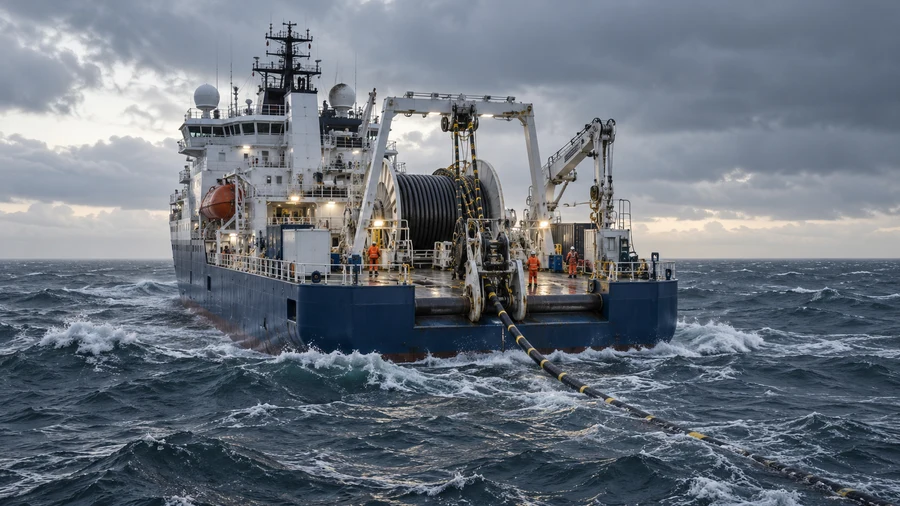
You open a banking app, send a file or start a video call. Everything seems wireless. But when data travels between continents, the connection almost always runs through a cable on the seabed.
According to the European Commission, submarine data cables carry around 99% of intercontinental internet traffic. That is not the same as 99% of all internet traffic: much stays within one country or continent.
These cables form a physical foundation of the digital economy. When they are damaged, recovery can depend on something strikingly tangible: a specialist ship with the right equipment and crew.
That is why Europe's cable security plan also focuses on repair capacity. The Commission proposes a possible reserve fleet and discusses arrangements to make repair vessels available sooner. Proposing such a fleet does not itself prove that an operational European reserve fleet already exists.
A digital economy needs physical repair crews
We talk about cloud technology as if data floats above us. Meanwhile, international digital communication relies on cables, landing stations and equipment that need maintenance.
When a cable breaks, the damage must first be located. Then a suitable vessel, technicians and repair materials are needed.
Resetting a password will not help. Actual work must take place at sea.
The European action plan makes an important distinction. Existing ships can perform routine repairs, but available capacity would be insufficient for simultaneous, large-scale disruptions across different European seas. Specialist workers and equipment can also become bottlenecks.
The problem is therefore not that nobody can repair cables. The risk is that too many parties need the same scarce capacity at once.
One broken cable does not automatically mean an internet blackout
The consequences of a cable break depend on the surrounding network.
Where sufficient alternative routes and capacity exist, traffic can be rerouted. Users may notice little. When several connections fail together or alternatives are limited, keeping services running becomes harder.
Presenting every cable break as the beginning of a total internet outage is therefore misleading.
The economic question is more precise: how many connections can fail before the remaining infrastructure becomes insufficient? And how quickly can damaged capacity return?
That recovery time helps determine how long a network must operate with fewer reserves.
What should a European reserve fleet solve?
The action plan describes several possible ways to recover faster.
The Commission discusses support for additional repair and laying vessels, regional availability agreements and a possible multipurpose reserve fleet. The proposed fleet could repair or lay electricity or data cables in emergencies.
There is a practical distinction between approaches:
| Possible approach | What it could improve | Main limitation |
|---|---|---|
| Arrange vessel access in advance | Greater certainty of access during an incident | Agreements do not automatically create extra capacity |
| Support additional vessel capacity | Enable more simultaneous repairs | Ships require financing, maintenance and crew |
| Keep repair modules available | Equip suitable vessels faster | Not every vessel suits every repair |
| Cooperate regionally | Better coordination of information, equipment and deployment | Priorities must remain clear during a crisis |
The economic logic is that Europe pays for availability in advance, rather than discovering during a crisis what capacity remains free.
This need not mean private operators disappear. The policy direction includes cooperation with existing market participants. Dependence becomes more manageable when availability, equipment and deployment are arranged beforehand.
Concrete funding steps have now been announced
This is not only a story about a future fleet proposal.
On 5 February 2026, the European Commission announced a €20 million call for adaptable repair modules. These are intended to be placed at ports or shipyards to speed up recovery of submarine cable services.
On 23 June 2026, a €40 million call followed for additional capacity to repair submarine communication cables. The Commission also announced €5.8 million for the first two regional cable hubs, in the Baltic and Mediterranean seas.
These are concrete funding announcements. They do not yet prove that all supported equipment has been delivered, hubs are fully operational or repair waiting times have demonstrably fallen.
Those conclusions require implementation results.
Why this is economic resilience
Repair capacity is valuable beyond fixing a cable. Faster recovery can shorten the period in which businesses and public services rely on fewer alternative connections.
That makes a repair vessel part of economic resilience.
For businesses, continuity often matters more than the cable itself. They want to send files, access international systems and keep communicating with customers. The greater the disruption, the more important reliable recovery capacity becomes.
Data and electricity cables deserve separate attention. Both lie at sea, but their technologies and repair requirements differ. Capacity for one type is not automatically fully usable for the other.
More ships alone are not enough
A reserve fleet sounds like a straightforward solution. Yet a ship without available crew, spare parts or suitable equipment has limited value.
Cooperation also requires choices. Who gets priority when several cables are damaged? Who bears the cost? What capacity must remain permanently available?
These policy questions determine whether additional investment actually delivers faster recovery.
A meaningful assessment therefore looks beyond vessel numbers. Mobilisation time, available technicians, repair inventories and the ability to handle simultaneous incidents also matter.
Sometimes the cloud waits for a ship
Europe's cable security plan highlights an overlooked issue: digital independence also requires physical recovery capacity.
Additional cable routes can reduce vulnerability. Rapid repairs restore those reserves after something goes wrong. Both are needed to keep a network resilient.
A possible European reserve fleet fits that logic. Its ultimate value depends on implementation: are suitable vessels, people and materials available at the right time?
Even the most modern digital economy may have to wait for a ship when a cable breaks.
Further reading
Cheap raw materials, costly dependence: why Europe is exploring minimum prices · Geopolitics as a hidden brake on credit: how uncertainty affects business financing