What if you cannot access your money tomorrow?
Updated:
Translated from the original; figures and sources have been preserved. Read the original →
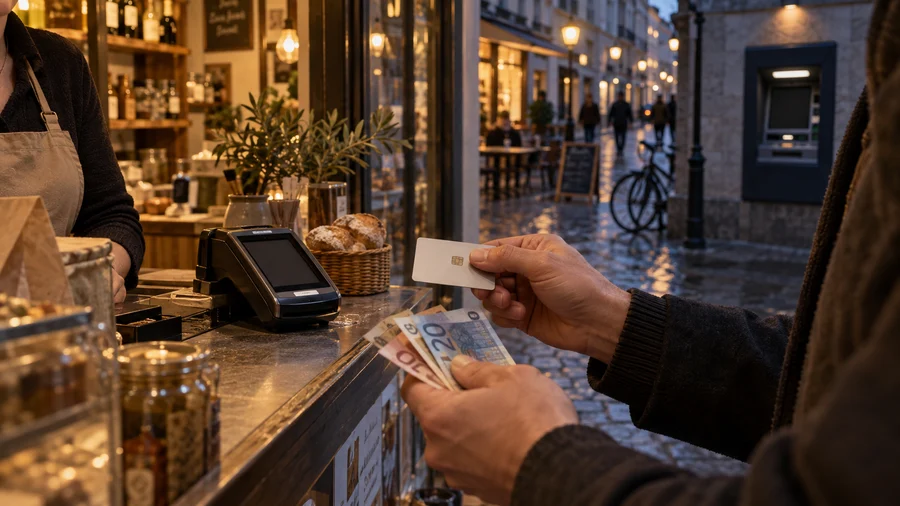
You are at the supermarket buying food for your family. The terminal rejects your card. You open your banking app: no connection. Outside, the cash machine is down too. You have money, but you cannot access it.
This need not mean war or a failed bank. An electricity, internet or payment-system outage can temporarily make everyday money unusable. The question is not your account balance, but which means of payment you can still use today.
That distinction matters more than ever as phone and card payments become more common. What works when digital payments fail? Can bitcoin or the future digital euro solve the problem?
A payment outage is not a bank failure
Suppose the checkout cannot process electronic payments. Your balance may still be safe in your account; only the route to the shop is broken. The fault could lie with the terminal, connection, processor, bank or wider infrastructure. Even a working card is of little use if the shop has no electricity.
A bank failure is different. In the European Union, deposit guarantee schemes generally protect covered deposits up to €100,000 per person per bank, or the local-currency equivalent. This protection addresses a bank’s failure; it does not let you immediately pay at a checkout during a temporary network outage. Source 1
When you say you cannot access your money, first distinguish the problem: is the money itself at risk, or is access temporarily broken?
Why cash suddenly becomes strategic
Cash has a simple feature: a banknote does not first need to travel through a payment network. The European Central Bank therefore describes cash as an important, resilient means of payment in crises. Electronic systems can fail while a physical payment remains possible. Source 1
That does not mean cash works everywhere in every emergency. A shop must be open, goods available, and the retailer able to accept cash and provide change. Small notes and coins are therefore more practical than a single large banknote.
In the Netherlands, De Nederlandsche Bank and the National Forum on the Payment System recommend keeping around €70 per adult and €30 per child in cash for the first 72 hours, alongside multiple payment methods. This is Dutch guidance, not a uniform European rule. The amount also depends on your household and local prices. Source 1
When do your card, phone and second bank account still work?
A second bank or extra card can help if only one bank or card network has problems. It may not help during a regional power cut or widespread internet failure. Phone payments work while the necessary devices and systems function; an extra app on the same phone is not automatically an independent backup.
The aim is different routes of access. DNB advises having multiple payment methods alongside cash, such as a debit card and a phone with a banking app. This spreads dependencies during smaller outages but offers no guarantee during widespread disruption. Source 1
| Payment method | May help when | Limitation during a major outage |
|---|---|---|
| Cash | Card or network payments fail | Shops must be open and accept cash |
| Second bank card | One bank or card service fails | Widespread power or network failures may affect both |
| Mobile payment | You lack a card but digital infrastructure works | Phone, terminal and associated systems must work |
| Bitcoin | Value needs to be sent digitally across borders | Connectivity, acceptance and price stability are uncertain |
| Digital euro | Intended future offline digital payment method | Not yet available to the public |
Does bitcoin rescue you when banks and payment terminals fail?
In certain circumstances, bitcoin provides another route to store or send value. This may matter for cross-border payments or where you retain access to your own wallet. But a bitcoin transaction must ultimately reach the network. Even an offline-signed transaction is only broadcast when connectivity becomes available again. Source 1
Then comes the practical question: who accepts bitcoin for bread, medicine or transport? If you must first sell through an exchange and transfer euros to a bank account, you again depend on infrastructure. The price may also move sharply just when you need a fixed amount.
Bitcoin can therefore supplement ways to transfer value. It is not a dependable substitute for immediately spendable money during a local power or payment outage. For its broader role in conflict, see Bitcoin in wartime.
Will the digital euro allow offline payments?
The ECB is designing the digital euro with online and offline payments. The intended offline mode would allow digital payment without network reception, for example using a phone or card, subject to the final system’s conditions. Source 1
But this is not a solution today. As of 29 September 2026, the digital euro has not been issued for general use. The ECB aims to be ready for a possible first issuance in 2029, dependent on the necessary European legislation and a later issuance decision. An offline design does not solve every conceivable outage either: users need functioning devices, access and the required balance beforehand. Source 1
The digital euro is therefore an interesting response to the vulnerability of digital payments, but not currently a reason to abandon a cash reserve.
What happens if everyone wants to withdraw cash at once?
That creates a second problem. Waiting until an outage to visit a cash machine may mean finding it broken, empty or surrounded by a queue. Setting aside a modest amount in small notes beforehand is different from panic-withdrawing large sums when a crisis begins.
DNB stresses that its 72-hour guidance is intended to cover essential spending for a few days, not to encourage large stockpiles. Source 1
The economic lesson: money needs a route of access
A bank balance, bitcoin in a wallet and a banknote in your hand each represent value differently. Their usefulness changes with circumstances. Network access matters during a bank outage; transferability when crossing a border; what the shop opposite can accept during a local power cut.
That is why the strongest preparation sounds mundane: make sure one broken route does not disable every way you can pay. Some cash, multiple payment methods and a realistic understanding of each are more practical than expecting one technology to solve every scenario.
Next time you see a balance in your banking app, ask: could I still access it if the connection failed tomorrow?
Frequently asked questions
How much cash should I keep at home for an outage?
Dutch guidance suggests around €70 per adult and €30 per child for the first 72 hours, preferably in different denominations. The same amount does not automatically apply elsewhere in Europe; consult local guidance and your essential expenses.
Is my money gone if card payments do not work?
Usually, a failed card payment alone says nothing about your balance or bank’s health. The payment route may be disrupted. Check official information from your bank and payment provider when connectivity returns.
Can I pay with bitcoin during a power cut?
Only if the necessary connection and equipment are available somewhere and the recipient accepts bitcoin. Offline signing alone cannot immediately get a transaction processed by the network.
Does the digital euro exist already?
No. The ECB is preparing a possible digital euro with a planned offline function. General issuance has not yet been decided.
Does deposit protection help during a payment outage?
European deposit protection concerns covered bank deposits when a bank fails. It is not an immediate payment solution for a temporary terminal, network or app outage.
Further reading
Bitcoin at €1 million and the economy · Bitcoin in wartime · European rules for crypto platforms