Bitcoin in wartime: safe haven or dangerous illusion?
Updated:
Translated from the original; figures and sources have been preserved. Read the original →
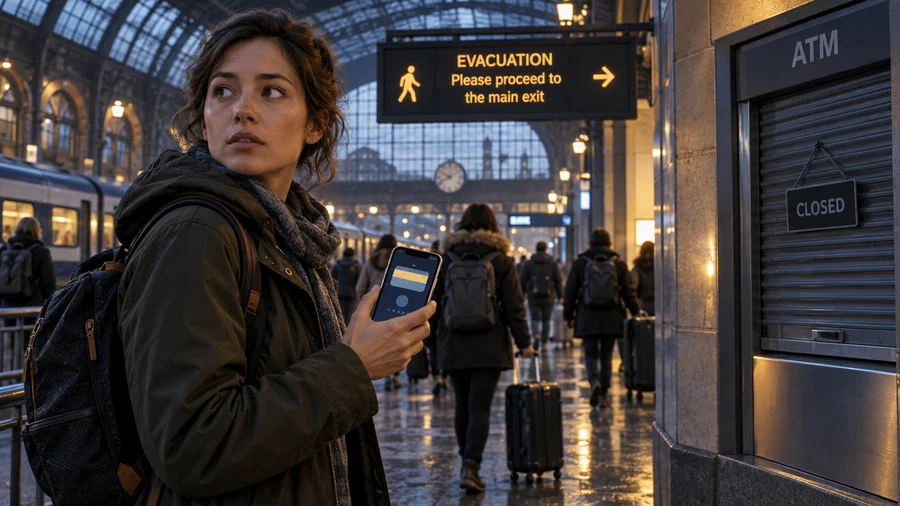
The bank is closed. Your payment card does not work. You need to cross a border and cannot take all your savings with you. In that situation, bitcoin sounds like an escape route: value that need not sit in one suitcase or at one bank.
But ask another question: what use is bitcoin if the power fails, the internet goes down or its price halves before you can pay for shelter?
War exposes the distinction between two claims often confused. Bitcoin can sometimes help move value across borders. That does not automatically make it a safe investment whenever war breaks out.
What war does to money
War can disrupt banks, payment networks and currency exchanges. People may flee while unable to access their accounts, or aid organisations may urgently need funds from abroad. These concrete problems make several tools relevant: cash, bank deposits, payment cards and digital assets.
Bitcoin has a particular feature: people controlling their own wallet access do not depend on one bank branch to retain that access. An actual payment ultimately requires network access to broadcast the transaction. Someone must also accept or exchange the bitcoin. Offline signing is possible, but the signed transaction must subsequently be broadcast online. Source 1
Bitcoin can therefore offer an additional route when a payment channel fails. It cannot replace food, communications, electricity or immediately spendable money.
Ukraine showed what crypto can do
Following Russia’s invasion in 2022, Ukraine’s government received crypto donations from abroad. Blockchain analysis firm Chainalysis estimated that government-published addresses had received almost $70 million in crypto donations by February 2023. This is a historical estimate for identified addresses, not a current total of all aid to Ukraine. Source 1
The example illustrates a practical advantage: a donor across the world can send value digitally without first opening a local bank account for the recipient. Crypto was nevertheless only one channel alongside conventional international payments and other aid. The lesson is not that war makes bitcoin essential, but that an alternative payment channel can be useful in a crisis.
Does bitcoin always rise when war breaks out?
No. Investors may initially sell risky positions and seek liquidity. Subsequent prices depend on interest rates, liquidity, expectations and the nature of the conflict. There is no fixed rule that war means a higher bitcoin price.
The term safe haven also needs precision. A safe haven should retain value or be readily usable during difficult times. Bitcoin’s price can fluctuate sharply, and links between crypto and other financial markets can strengthen during turmoil. An IMF study examined such volatility and spillovers between crypto and traditional financial assets. Source 1
Someone wanting to hold a scarce digital asset for ten years is asking a different question from a family needing to pay rent and transport tomorrow.
Bitcoin versus gold, cash and bank money
| Option | Potential advantage in a crisis | Important limitation |
|---|---|---|
| Cash | Immediately usable where accepted | Difficult to transport safely; availability and acceptance may fall |
| Bank account | Familiar and often practical for everyday payments | Access depends on banks and payment infrastructure |
| Gold | Physical property outside a digital network | Difficult to transport, divide and sell at a good price |
| Bitcoin | Can be moved digitally across borders using your own wallet | Price risk, technical access and the need for acceptance or exchange |
There is no universal winner. The answer depends on the purpose: paying, fleeing, saving or sending money to someone else. The IMF describes gold as an established reserve asset that can attract central banks during geopolitical uncertainty; this does not make gold and bitcoin identical tools for households. Source 1
The hidden weakness: access must work when you need it
A seed phrase or private key can provide access to wealth without transporting physical coins. The same feature creates risk: loss or theft of access can be irreversible. Keeping bitcoin solely on an exchange also makes you dependent on the platform and its access rules. Bitcoin.org therefore stresses wallet security and backups. Source 1
Even with access intact, a war zone may bring power outages, limited internet, high transaction fees, few buyers or shops accepting only local money. A market value on a screen is then not the same as purchasing power on the ground.
What about sanctions? A blockchain is not an invisible banking system
Crypto can also be used by undesirable actors. Transactions without a traditional bank are not necessarily invisible: public blockchain transactions can be analysed and regulated providers must follow applicable rules. FATF highlights both virtual assets’ payment uses and their potential for misuse. Source 1
For economic analysis, the key point is that governments in a major war consider emergency aid, capital flows, money laundering and sanctions enforcement simultaneously. Access to trading platforms may therefore change even if the underlying bitcoin network keeps running.
When can bitcoin genuinely help during wartime?
Bitcoin can be useful as a supplement when someone has reliable wallet access, connectivity and a willing recipient or exchange at the other end. It can also channel cross-border donations. That usefulness says little about next week’s price.
This is the tension at the heart of the story: bitcoin can be useful as a wartime payment channel while falling sharply as an investment. Confusing the two functions can mean relying on price gains at the wrong moment.
The question is therefore not simply whether war is good for bitcoin. A better question is: which wartime problem should bitcoin solve, and will it still work when you need it most?
Frequently asked questions
Is bitcoin a safe haven during war? It is not guaranteed. Its price can fall as investors reduce risk. Practical transferability and price stability are different properties.
Does bitcoin work without the internet? A transaction can be signed offline, but ultimately needs a connection to be broadcast to the network. Without usable connectivity, ordinary immediate payment is not possible.
Why was crypto used during the war in Ukraine? Among other reasons, to receive international donations digitally. This demonstrates a use case, not that crypto replaced conventional financial aid.
Is bitcoin better than gold or cash in a crisis? It depends on the task. Cash is immediately spendable where accepted; bitcoin can be easier to transfer digitally; gold is physical property. Each has clear limitations.
Further reading
Bitcoin at €1 million and the economy · Paying during an outage · European rules for crypto platforms