Why GM Is Redirecting an EV Grant Toward Hybrid SUV Production
The Strategic Newb Editorial Team
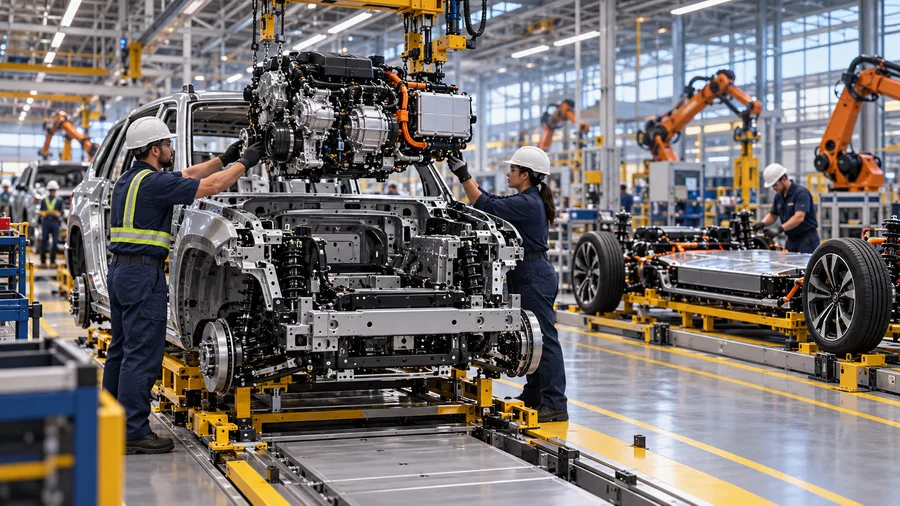
General Motors is preparing one of its major Michigan factories for hybrid vehicle production. The decision is more than another change to the company’s product range. It shows how consumer demand, government policy and manufacturing economics are altering the speed of the transition to fully electric vehicles.
On October 27, 2026, GM confirmed that it will prepare Lansing Delta Township Assembly for future hybrid-electric vehicle production. Reuters reported that the factory is expected to manufacture hybrid versions of the Chevrolet Traverse, Buick Enclave and GMC Acadia. GM has confirmed the investment and the hybrid strategy, but it has not officially confirmed those models or announced a production date.
The company and the United States Department of Energy are also restructuring a previously awarded $500 million manufacturing grant. The funding was originally intended to support electric vehicle production at another plant in the Lansing area. It will now support future hybrid production at Lansing Delta Township.
This shift offers a clear economic message: hybrids are becoming a form of industrial insurance for automakers that invested heavily in fully electric vehicles before customer demand, charging infrastructure and battery economics developed as expected.
What GM has officially confirmed
GM says its planned investment is part of more than $2 billion it expects to direct toward the Lansing region over several years. That total includes a previously announced $1.25 billion investment at Lansing Grand River Assembly.
Lansing Delta Township currently manufactures the Chevrolet Traverse, Buick Enclave and GMC Acadia. The plant produced more than 291,000 vehicles in 2025, its highest annual output. Preparing it for hybrids allows GM to add electrified vehicles without abandoning a factory, workforce and supplier system that already produces popular sport utility vehicles.
Reuters reported that hybrid versions of all three vehicles are planned. However, GM says details about individual models and timing will be released closer to launch. Those distinctions matter: factory preparation is confirmed, while the exact product programme remains partly based on independent reporting.
How hybrid technology works
A conventional hybrid vehicle combines a combustion engine with an electric motor and a relatively small battery. The electric motor can assist the engine during acceleration, power the vehicle at low speeds and recover energy during braking.
Because the engine and motor work together, the vehicle can use less fuel than a comparable petrol-powered model. Unlike a fully electric vehicle, a conventional hybrid does not depend entirely on a large battery or public charging network.
That difference changes the manufacturing economics. A hybrid still needs an engine, transmission and exhaust system, but it also requires electric motors, power electronics, battery-management software and a battery pack. The battery is usually much smaller than the pack in a fully electric vehicle.
Why GM is changing direction
GM previously argued that investing in hybrids could create additional cost and complexity while delaying the transition to fully electric vehicles. The market has changed.
United States hybrid sales have increased as customers seek lower fuel costs without depending on charging infrastructure. At the same time, GM’s share of the US vehicle market fell from 17.4% during the first nine months of 2025 to 16.6% during the comparable period in 2026. Toyota and Honda, which offer many hybrid models, gained market share.
GM dealers have also asked the company to add hybrids. Dealers interact directly with customers and can see when people want better fuel efficiency but are not prepared to purchase a fully electric vehicle.
The result is a strategy that keeps GM involved in electrification while reducing the risk of relying on one technology pathway.
The economic impact on Michigan manufacturing
Preparing Lansing Delta Township for hybrid production could protect jobs and output at one of GM’s most productive US plants. It also allows the company to use established assembly lines, trained workers and supplier relationships.
The investment may support demand for:
- Combustion engines and transmissions.
- Electric motors and power electronics.
- Smaller lithium-ion battery packs.
- Vehicle-control software.
- Factory automation and production equipment.
- Engineering and technical services.
The change could reduce near-term demand for large electric vehicle batteries at GM. It may also slow growth for charging companies if more consumers choose hybrids instead of fully electric vehicles.
However, the decision does not mean GM is abandoning electric vehicles. The company continues to invest in electric vehicle plants, batteries and research. The hybrid programme gives it an additional option while the market develops.
Why redirecting the federal grant matters
The $500 million grant was awarded under a programme designed to convert existing factories for cleaner vehicle production. The original programme already allowed efficient hybrids as well as other electrified vehicles. This is a change in GM’s proposed project and factory allocation, not evidence that hybrids were previously ineligible.
Supporters may argue that hybrids can reduce fuel use across a larger number of vehicles because they need smaller batteries and do not require customers to change their charging behaviour. Critics may question whether directing the funding toward vehicles that still use fossil fuel slows the transition to fully electric models, even though hybrids were eligible under the original programme.
The economic question is whether the revised investment produces more realistic near-term emissions reductions and protects manufacturing employment, or whether it delays the infrastructure and scale needed for fully electric vehicles.
Who could benefit?
GM could benefit by offering products that match current customer demand while using factories and supply chains it already controls. Dealers may gain models that are easier to sell to buyers who remain uncertain about charging or battery range.
Michigan workers and suppliers could benefit from additional investment and a broader range of production. Consumers could receive more fuel-efficient options without accepting the price, charging requirements or driving changes associated with a fully electric vehicle.
Suppliers producing electric motors, inverters and smaller battery systems may also gain. A hybrid uses fewer battery cells than a fully electric vehicle, but a large increase in hybrid production could still create substantial component demand.
Who could lose?
Companies focused exclusively on large electric vehicle batteries could face weaker demand if automakers allocate more production to hybrids. Charging-network operators may see slower utilisation growth.
GM also assumes additional complexity. Producing combustion, hybrid and fully electric vehicles requires multiple engineering teams, component systems and supply chains. That can reduce the cost benefits that come from concentrating on one platform.
Toyota and Honda may face stronger competition, although they possess decades of hybrid engineering and production experience.
The larger strategic lesson
GM’s decision suggests that the vehicle transition will not follow one straight global path. Different regions may adopt hybrids, plug-in hybrids and fully electric vehicles at different speeds, depending on electricity prices, charging infrastructure, government rules and consumer preferences.
For automakers, flexibility may be more valuable than making the fastest possible commitment to one technology. A factory that can support several powertrain options may be better protected against regulatory and demand changes.
The company that wins the vehicle transition may not be the one that predicts a single future correctly. It may be the company that can change production without destroying the value of its factories, workers and supplier network.
What happens next?
GM still needs to disclose the investment amount specifically assigned to Lansing Delta Township, the planned models and the production timetable. Suppliers will also need information about expected volumes before making their own investments.
The strongest evidence will come from factory conversion work, supply contracts and confirmed vehicle launch dates. Until then, the strategy is clear, but its commercial results remain uncertain.
Frequently asked questions
Is GM abandoning electric vehicles?
No. GM continues to invest in electric vehicles. It is adding hybrids to reduce its dependence on a single technology and respond to customer demand.
Which GM SUVs are expected to receive hybrid versions?
Reuters reports that GM plans hybrid versions of the Chevrolet Traverse, Buick Enclave and GMC Acadia. GM has not officially confirmed the individual models.
Has GM received a new $500 million grant?
No. GM and the Department of Energy are restructuring a previously awarded manufacturing-conversion grant and directing it toward future hybrid production.
When will production begin?
GM has not announced a production date.
Is this investment advice?
No. This article explains the economic and industrial implications of GM’s manufacturing decision.
Sources
- General Motors — Lansing Delta Township investment
- Reuters — GM plans hybrid SUVs in strategic electric vehicle pivot
Editorial note
The factory investment and hybrid preparations are confirmed. Specific models and the production schedule have not yet been officially announced. This article contains economic analysis and no personal investment advice.