Why cheap electricity does not automatically mean a low energy bill in Europe
The Strategic Newb Editorial Team
Updated:
Translated from the original; figures and sources have been preserved. Read the original →
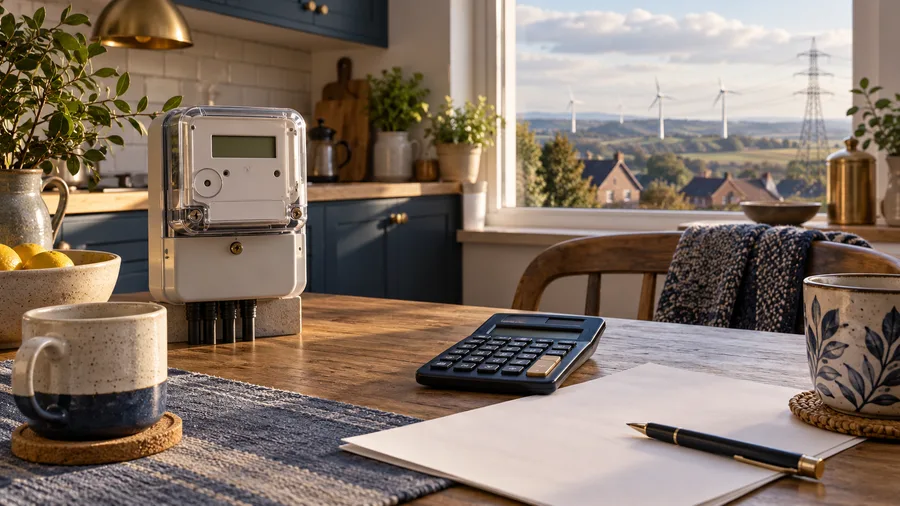
You read that electricity prices are falling. On a sunny afternoon, the market price may even be negative. Yet your energy bill remains high. How can both be true?
Discussions of electricity prices in Europe often mix up different prices: the wholesale market price, the supply rate in your contract and the total bill including network charges and taxes.
The short answer: cheap electricity reduces only part of the bill. Your final costs also depend on your contract, when you consume electricity, fixed charges, network costs and government policy.
An electricity bill has several components
The breakdown differs by country, but four components help explain the bill.
| Item | What are you paying for? | Why does it not immediately track market prices? |
|---|---|---|
| Energy and supply | Purchased electricity, services and commercial costs | Suppliers may buy ahead and hedge price risk |
| Network charges | Transmission, distribution and network availability | Cables and maintenance remain necessary during cheap hours |
| Taxes and levies | National taxes, VAT and other levies | Rates are determined by policy |
| Fixed charges and adjustments | Subscription charges, discounts or support | They do not always depend on each kWh consumed |
A report about low exchange prices is therefore insufficient to predict a household’s savings.
A lower pre-tax price can still mean a higher final price
Eurostat provides a concrete example. The EU average household price rose from €28.79 per 100 kWh in the first half of 2025 to €28.96 in the second half.
The pre-tax price fell slightly. However, higher taxes and levies more than offset that benefit. Their share of the final price rose to 28.9%. These data were published on 5 May 2026 and describe 2025, not a live market price in October 2026. Source: Eurostat
This does not prove that taxes are the main cause everywhere. It does show why the complete price picture matters.
Electricity prices in Europe: differences between EU countries
The following figures come from the same Eurostat publication and show average household prices including taxes in the second half of 2025.
| Country or region | Price per 100 kWh |
|---|---|
| Ireland | €40.42 |
| Germany | €38.69 |
| Belgium | €34.99 |
| EU average | €28.96 |
| Bulgaria | €13.55 |
| Malta | €12.82 |
| Hungary | €10.82 |
The gap is large, but this table does not rank individual contracts. National averages also reflect government measures and market conditions. A low rate does not automatically make electricity affordable for residents: income and consumption matter too. Source: Eurostat
Country comparisons must therefore use the same period, consumption category and tax treatment. Comparing an industrial rate excluding recoverable VAT with a household rate including VAT is misleading.
Why cheap solar and wind do not always set market prices
Wind and solar have low additional production costs: no fuel must be bought for each extra kilowatt-hour. But Europe’s short-term market price is generally set by the last offer needed to meet demand.
If a gas-fired plant is needed, its offer may set the market price. With abundant supply and little demand, prices may become very low or negative. The European Commission describes this as marginal pricing. Source: European Commission
Low production costs do not mean zero total costs. Wind and solar farms must be built, financed and maintained.
The question for your bill is therefore not just how much cheap power is generated. Availability when you consume it and the way your contract charges you matter too.
Why network charges can remain high
The grid must be available when everyone needs electricity at once. Investment and maintenance do not disappear when market prices fall for a few hours.
More electrical applications also change grid use. Smart charging, spreading consumption and using existing capacity better can help. But generating cheap energy and delivering it cheaply are different economic challenges.
ACER’s September 2026 report emphasises efficient network planning and utilisation to protect affordability during electrification. Source: ACER
Your contract determines when lower prices reach you
A fixed contract provides an agreed supply rate. You do not benefit immediately from every price fall, but you are also less directly exposed to each market increase.
With a variable contract, suppliers can adjust rates at agreed times. “Variable” does not automatically mean every market movement is immediately passed through.
A dynamic contract follows the short-term market much more closely. The exact billing interval and surcharges are specified in the contract. Savings depend on your consumption profile and how much use you can shift. Source: European Commission
ACER reports that only 7% of EU households had dynamic contracts in 2025. Most households therefore did not receive cheap hours directly through this pricing model. Source: ACER
Example: energy costs fall 50%, but the bill falls 20%
This is a simplified, fictional example, not a tariff offer or an average European bill.
| Annual costs | Before price reduction | After price reduction |
|---|---|---|
| Energy component | €600 | €300 |
| Other costs combined | €900 | €900 |
| Total | €1,500 | €1,200 |
The energy component halves. Yet the total falls by €300, or 20%. In practice, taxes and other components may change too; here they remain constant to illustrate the mechanism.
Why businesses receive a different bill
Businesses differ greatly in consumption, connection capacity and contracts. A bakery working mainly during the day has a different profile from a continuously operating factory.
Long-term power agreements can provide predictability, but do not necessarily cover all network charges, taxes or shortfalls between contracted production and actual consumption.
Eurostat reported an average of €18.37 per 100 kWh for non-household users in the second half of 2025, 3.5% below the first half of 2025. This is a different user category from households, so it is not a directly comparable discount. Source: Eurostat
How should you compare your own energy bill?
Compare expected total annual costs for the same consumption. Check which amounts are fixed, which are charged per kWh and which discounts are temporary.
Then consider when you consume electricity. Cheap midday power helps little if almost all your use falls in expensive evening hours. Businesses must also consider whether production can shift without extra costs.
The link with gas remains relevant: also read how LNG is changing Europe’s gas dependence.
Frequently asked questions
Does a negative electricity price mean free power?
Not automatically. Your contract must pass through that market price, and taxes, surcharges and network charges may still apply.
Is a dynamic contract always cheaper?
No. The result depends on tariffs, market prices and when you consume electricity. It also increases exposure to expensive periods.
Why does my advance payment not fall immediately?
An advance payment estimates annual costs. It is not a live market price and may lag changes in tariffs or expected consumption.
Sources checked and article updated: 10 October 2026. The country comparison uses EU data for the second half of 2025.