Europe is replacing Russian gas with LNG: how independent are we really?
The Strategic Newb Editorial Team
Updated:
Translated from the original; figures and sources have been preserved. Read the original →
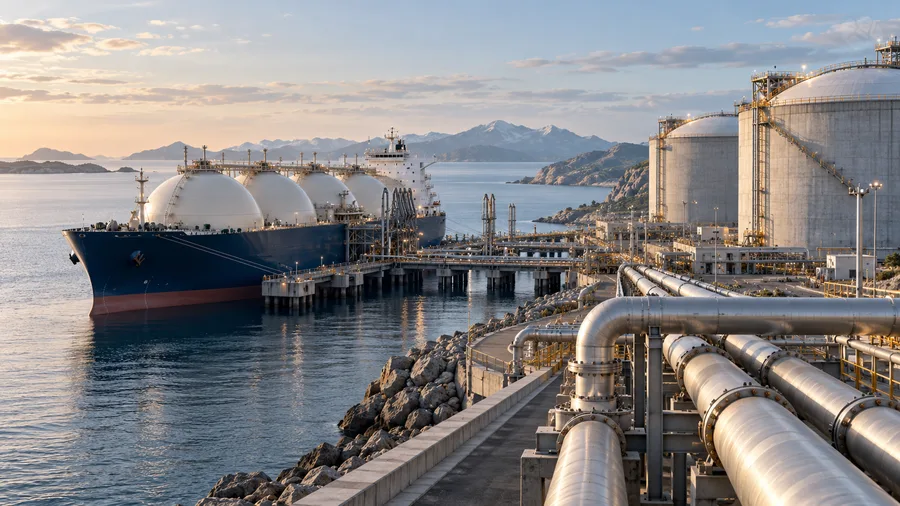
A gas tanker entering a European port may look like proof that Europe has solved its energy problem. Gas arrives by sea from several suppliers, no longer solely through a Russian pipeline. Yet the ship tells only half the story.
The debate about Europe’s LNG dependence rests on a distinction: access to more suppliers is different from independence from foreign energy. Europe has improved its gas-buying options but remains exposed to overseas production, international prices and transport problems.
The short answer: Europe has improved energy security and shifted part of its dependence. LNG offers more choice, but also increases reliance on a global market where other countries compete for the same cargoes.
How much Russian gas has Europe replaced?
According to the Council of the EU, Russia’s share of EU pipeline gas imports fell from about 40% in 2021 to about 6% in 2025. Including LNG, Russia still supplied around 12% of total gas imports in 2025. Norway was the largest overall supplier that year. Source: Council of the EU
“Europe has replaced Russian gas” therefore does not mean “Europe no longer buys Russian gas”. Russian gas can also be liquefied and delivered by ship.
The European phase-out adopted in January 2026 includes transition periods for existing contracts. The ultimate aim is to ban all Russian gas imports by the end of 2027. The shift is a process, not a completed event. Source: Council of the EU
What is LNG, and why does it offer more choice?
LNG means liquefied natural gas. Intense cooling greatly reduces its volume, allowing transport in specialised ships. A European import terminal then turns it back into gas.
A pipeline connects customers to particular producers and transit countries. An LNG terminal can receive cargoes from different regions, enabling a switch when a supplier fails.
But an available berth is not an available gas cargo. The entire chain must work: production, liquefaction, ships, insurance, import terminal and connection to Europe’s gas network.
Europe’s LNG dependence: America’s growing role
ACER, the European agency for cooperation between energy regulators, reports that the US supplied 58% of EU LNG imports in 2025. This represented around a quarter of total EU gas demand. The EU imported 146 billion cubic metres of LNG that year. Source: ACER
These percentages must not be confused. America’s LNG share is much larger than its share of all gas consumed because Europe also uses pipeline gas and domestic production.
For the second quarter of 2026, Eurostat reports a US share of 63.2% of EU LNG imports. This quarterly trade statistic is neither an annual average nor a share of total gas demand. Source: Eurostat
The strategic point is clear: different American exporters provide commercial choice, but still share a national regulatory framework and some geographic risks. Diversification across companies is not the same as diversification across countries.
LNG terminals strengthen supply but do not solve everything
According to the Council of the EU, annual LNG import capacity grew by 76 billion cubic metres between 2021 and 2025 to 242 billion cubic metres. The overview was updated on 8 October 2026. Source: LNG infrastructure in the EU
More capacity allows alternative supplies. But gas must still travel onwards after arrival. A coastal terminal helps an inland business only if pipelines and cross-border connections have sufficient capacity.
Capacity is not production either. Europe can build more receiving capacity than the affordable gas available at a given moment. The number of terminals alone is therefore an incomplete measure of energy security.
Why international shipping affects gas prices
A globally traded fuel links Europe to events elsewhere. If production fails in another region, buyers there may bid more for available LNG cargoes.
Long-term contracts can make deliveries more predictable. The security they provide depends on destination, price and interruption clauses. They do not make transport or production invulnerable.
The IEA’s third-quarter 2026 gas report describes how the Middle East conflict affected LNG supplies and infrastructure. New production elsewhere can partly offset shortages, but restoration delays remain a risk. Source: IEA
This illustrates an important mechanism: even if a European cargo does not pass through an affected strait, prices can rise as other buyers turn to the same alternative suppliers.
What does this mean for households and businesses?
Gas dependence directly affects heating and industrial processes. It can also affect electricity prices when gas plants are needed to meet power demand.
An international price rise does not reach everyone’s bill simultaneously. Procurement arrangements, fixed contracts and taxes determine how quickly changes pass through. Read more in why cheap electricity does not automatically mean a low energy bill.
Businesses also need predictability. A factory can receive enough gas yet lose competitiveness when its price rises sharply. Physical availability and affordability are separate parts of energy security.
When will Europe really become less dependent?
Our analysis: the strongest approach combines multiple suppliers with less need for imported gas. Examples include insulation, more efficient production, power generation without gas, and sufficient network capacity and flexibility.
Electrification must be assessed at system level. Replacing a gas application helps most when the required electricity is reliably available and affordable.
The question is therefore not just how many terminals Europe has. It is also how much gas Europe still must import during cold, expensive or geopolitically unsettled periods.
Frequently asked questions
Is LNG always American gas?
No. LNG is a transport form. It can come from several producing countries, including the US, Algeria, Qatar and Russia.
Does LNG make Europe independent of Russia?
It helps replace Russian supplies. But LNG can itself be Russian, and switching suppliers does not remove dependence on imports.
Do more terminals automatically lower gas prices?
No. They improve receiving capacity and choice. Prices also depend on available production, contracts, global demand and transport.
Has Europe merely shifted its dependence?
“Merely shifted” understates the benefit of alternative routes. But “become independent” overstates it. Europe has more options while new concentrations and global market risks remain.
Sources checked and article updated: 10 October 2026. Europe is discussed mainly using EU data; the EU and the entire European continent are not the same statistical region.