Best self-driving car in Europe in 2026: which can really do the most?
The Strategic Newb
Updated:
Translated from the original; figures and sources have been preserved. Read the original →
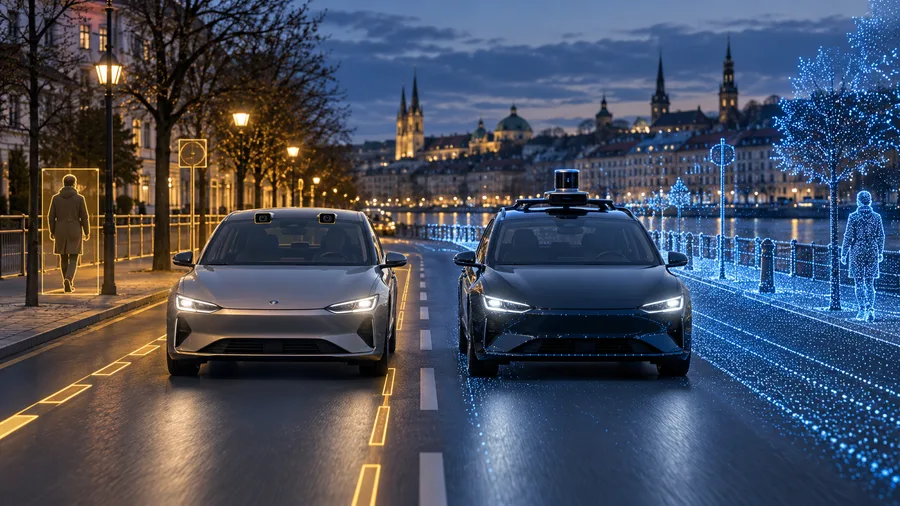
A car that turns by itself, negotiates a roundabout and joins the motorway. It sounds as though the driver is almost unnecessary. Yet the same car can lose some of its capabilities when crossing a European border.
Anyone looking for the best self-driving car in Europe must therefore look beyond the brand. The combination of car, software package and country of use is decisive.
Our editorial choice for the broadest available driving automation is the Tesla Model Y with Tesla Assisted Driving. For hands-free motorway use, the Ford Mustang Mach-E with BlueCruise is our first choice. Both require constant driver supervision. Tesla and Ford explicitly describe this obligation.
Information checked on 22 October 2026. European availability varies by country, specification and software version.
The best self-driving cars in Europe at a glance
This top five considers available assistance features, their operating scope and independent test results. It is an editorial selection, not the result of a single comparative test of all the latest software versions. The Netherlands is a specific availability example; local differences remain decisive.
| Rank | Car | Required system | Main benefit | Limitation |
|---|---|---|---|---|
| 1 | Tesla Model Y | Tesla Assisted Driving | Route guidance covering many different manoeuvres | Only in approved countries and under constant supervision |
| 2 | Ford Mustang Mach-E | BlueCruise | Hands-free assistance on approved motorways | Limited to suitable Blue Zones |
| 3 | BMW i5 | Driving Assistant Professional | Strong tested lane guidance and distance control | No automatic guarantee of hands-free use |
| 4 | Mercedes-Benz C-Class | Driving Assistance Package Plus | Strong assistance and safety backup | Driver remains involved in driving |
| 5 | Kia EV3 | Highway Driving Assist 2 | Lane-change assistance and direct driver monitoring | Hands must remain on the wheel |
The exact packages matter. A car with adaptive cruise control alone does not have the same capabilities as one with the full assistance system.
1 Tesla Model Y offers the broadest combination of driving tasks
Tesla takes first place because, according to current Dutch documentation, its European Assisted Driving system can also handle junctions, roundabouts, turns and motorway entrances and exits. Its scope therefore extends beyond maintaining distance and steering within a lane.
The RDW describes its own research into FSD Supervised, including over 3,000 testing hours and more than 1,000 test runs. This approval matters, but does not prove Tesla is safer than every competitor.
First place concerns the breadth of available functions. The Model 3 is an alternative with the same type of system; this choice does not establish a software advantage for the Model Y over the Model 3.
Take care when travelling: Tesla lists the Netherlands and Belgium among supported countries. The list consulted does not grant general permission across Europe. Activation is blocked in countries without approval. Check the current country list and vehicle requirements before departure.
2 Ford Mustang Mach-E makes hands-free motorway driving tangible
Many drivers do not need a car to navigate a complex urban route. They mainly want less steering work during everyday motorway journeys.
BlueCruise fits that need. In approved Blue Zones, it can steer, maintain distance and control speed while the driver takes their hands off the wheel. A camera monitors gaze and head position. Attention must remain on traffic.
Ford lists BlueCruise on its Dutch Mustang Mach-E page. It is therefore an available product, although specification, activation and route remain decisive.
Why second? BlueCruise offers a clear benefit on suitable motorways, but has a narrower operating scope than Tesla Assisted Driving. Check whether the roads you regularly use are within supported zones.
3 BMW i5 combines strong assistance with independent evidence
The BMW i5 received Very Good in Euro NCAP’s separate 2024 Assisted Driving assessment. Testers highlighted the combination of speed control, steering assistance and driver engagement.
BMW Netherlands also describes lane guidance and distance control with Driving Assistant Professional.
The important purchasing question is which system variant you receive. Driving Assistant Professional should not automatically be equated with the hands-free Highway Assistant offered by BMW on certain models and markets.
Why third? The i5 is a convincing choice for high-quality assistance. Its position reflects documented features and test results, without automatically attributing overseas hands-free features to a Dutch-specification car.
4 Mercedes-Benz C-Class performs strongly on safety backup
The Mercedes-Benz C-Class also received Very Good in Euro NCAP’s 2024 assessment. Its response to an unresponsive driver stood out: in the tested scenario, the car could move to the hard shoulder and stop in a controlled manner.
That is valuable safety backup, but does not guarantee the manoeuvre is possible in all road and traffic conditions.
Why fourth? With the right package, the C-Class offers strong assistance. Tesla handles a broader combination of navigation tasks, while Ford has a clear hands-free offering for suitable motorways.
The Euro NCAP publication on the i5 and C-Class concerns the systems tested in 2024. A changed specification or software version does not automatically inherit that result.
5 Kia EV3 offers a convincing driving-assistance package
The Kia EV3 with Highway Driving Assist 2 received Very Good in 2025. Euro NCAP notes lane-change assistance, a camera detecting fatigue and several forms of distraction, and a controlled stop for an unresponsive driver.
There are limits. The tested software did not adapt speed to approaching bends and junctions. Hands-on-wheel monitoring also remained part of the system.
Why fifth? The EV3 combines useful automation with good driver monitoring. It shows why a less exclusive car can be a serious candidate. The test results apply specifically to the EV3 with HDA 2, not every specification.
Chinese electric cars deserve a European software comparison
XPENG, NIO and Zeekr belong in any serious comparison. However, their capabilities must be assessed using the software European customers actually receive.
XPENG G9 and the difference between XPILOT and VLA
The European XPENG G9 with XPILOT ASSIST received Good from Euro NCAP in 2025. The tested system supported lane changes and adapted speed for bends. However, it did not perform a controlled stop for an unresponsive driver.
That is a concrete reason not to rank it above the best-supported candidates on this test alone. At the same time, the 2025 test does not automatically judge all later updates.
XPENG’s more advanced VLA 2.0 does not yet change this ranking. The manufacturer identifies 2027 as the start of global deliveries. An announcement does not provide an extra driving function today.
NIO and Zeekr offer useful European features
The European NIO EL6 manual describes lane guidance and active lane changes under certain conditions. Zeekr offers the 7X in Europe with driving assistance and automated parking features.
These brands fall outside this five because the European information consulted does not provide a sufficiently strong, comparable basis to rank them higher. That does not mean their current software is demonstrably worse. An independent comparison of the same software generations could change the order.
The biggest mistake when buying a self-driving car
A familiar model name does not tell you which functions you can use. Even official information can differ by market.
For the BMW iX3, for example, international communications describe a European hands-free rollout, while the Dutch product page states on the checking date that the motorway assistant is not yet available. Buyers must therefore check the active function on the specific vehicle.
Ask these questions before buying:
- Which driving-assistance package does this vehicle have?
- Which functions are activated in my country today?
- Where do those functions work on my usual routes?
- Is a subscription or additional activation required?
- Which actions must I continue performing myself?
- Can the dealer demonstrate this on a test drive?
A future update forms part of the car’s future value. The purchase decision must also make sense given what it can do today.
Frequently asked questions about self-driving cars in Europe
Which car does the most driving in this comparison?
The Tesla Model Y with activated Tesla Assisted Driving software is our choice for the broadest combination of driving tasks. This applies only where the feature is available and permitted. Constant supervision is required.
Which car is suitable for hands-free motorway driving?
The Ford Mustang Mach-E with BlueCruise is our first choice for this use. It operates in approved Blue Zones and monitors whether the driver remains attentive.
Are Chinese cars better at self-driving?
That depends on the model, software and market. Chinese demonstrations and software versions do not prove the capabilities of a European specification.
Do five Euro NCAP stars mean a car drives itself well?
No. Euro NCAP publishes Assisted Driving assessments separately from general safety stars. Good crash safety and advanced driving automation are different characteristics.
May you take your attention off the road?
With the assistance systems in this top five, you must remain involved and ready to take over. Hands-free driving does not mean you can watch a film or sleep.
Which car suits your journeys?
Choose the Tesla Model Y if the breadth of available driving functions comes first. Start with the Mustang Mach-E if hands-free motorway comfort is your priority. Include BMW, Mercedes and Kia if good assistance and tested safety backup matter most.
The decisive test drive takes place on your route, using the software you will actually receive.
Read also: LiDAR versus cameras in self-driving cars.