LiDAR vs Cameras: Which Is Better for Self-Driving Cars?
Updated:
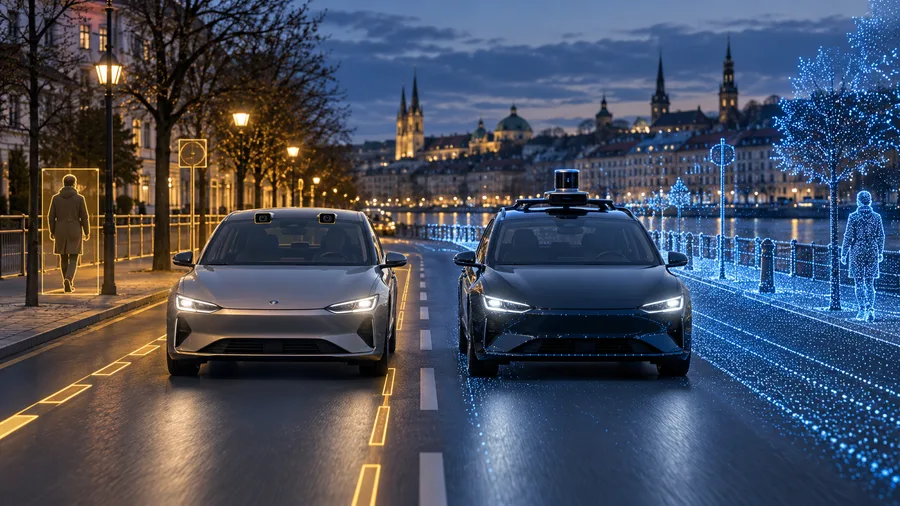
Imagine two self-driving cars approaching the same pedestrian on a dark road.
One car sees the world through cameras and artificial intelligence.
The other fires millions of invisible laser pulses around itself, measuring the environment in three dimensions.
Both vehicles may identify the same pedestrian.
But they are not actually seeing the same world.
This difference sits at the center of one of the biggest technological debates in autonomous driving: LiDAR vs cameras.
Tesla has heavily pursued camera-based computer vision, while companies developing driverless systems such as Waymo use a combination of LiDAR, cameras and other sensors.
So which approach is better?
The answer could determine not only how autonomous vehicles are built, but also how quickly truly driverless cars can scale around the world.
What Is LiDAR?
LiDAR stands for Light Detection and Ranging.
Instead of simply taking pictures, a LiDAR sensor sends laser pulses into its surroundings and measures how long they take to return.
Those measurements allow the system to calculate the distance between the sensor and surrounding objects.
Millions of measurements can then be combined into a three-dimensional representation of the environment.
A LiDAR system can therefore determine the geometry and location of objects around a vehicle with very high precision.
For example, instead of simply recognizing a person standing beside the road, LiDAR can provide detailed information about exactly where that person is positioned in three-dimensional space.
Research published in *Nature Reviews Electrical Engineering* in 2025 described the basic distinction clearly: cameras provide rich contextual information, while LiDAR provides highly useful depth information.
That distinction is crucial for autonomous driving.
How Do Cameras Work in Self-Driving Cars?
Cameras operate differently.
They capture visual information much like human eyes.
They can see road markings, traffic lights, vehicles, pedestrians, signs and countless other details.
Modern artificial-intelligence systems then analyze those images to understand the environment.
The advantage is enormous.
Camera sensors are relatively inexpensive, compact and already produced at massive scale.
The challenge is that a flat camera image does not inherently contain the same direct three-dimensional distance measurements produced by LiDAR.
Instead, AI has to infer depth.
Modern neural networks can do this by analyzing multiple cameras, movement across video frames and patterns learned from huge amounts of driving data.
Tesla is perhaps the most famous supporter of this approach.
Camera-based perception systems can use neural networks for object detection, segmentation and depth estimation. Information from multiple cameras can also be combined into a representation of the road environment.
That leads to a radically different philosophy.
Tesla is effectively betting that better artificial intelligence can compensate for having fewer types of sensors.
Tesla Vision vs LiDAR
Tesla's approach has made the Tesla Vision vs LiDAR debate one of the most important arguments in autonomous driving.
Tesla emphasizes camera-based perception. Hardware and available features vary by vehicle configuration, software and region.
Tesla's current Full Self-Driving system also uses onboard cameras to observe the environment.
Tesla describes onboard cameras providing a 360-degree view, with AI processing the images. This does not remove the requirement for driver supervision.
There is an important distinction, however.
Despite its name, Full Self-Driving (Supervised) is not currently a fully autonomous system. Tesla explicitly states that currently enabled features require active driver supervision and do not make the vehicle autonomous.
Tesla's long-term technological bet is nevertheless clear:
If human beings can drive primarily using vision, sufficiently capable artificial intelligence may eventually be able to do something similar — potentially even better.
Why Does Waymo Use LiDAR?
Waymo takes a different approach.
Instead of asking one type of sensor to understand everything, its autonomous driving system combines different ways of observing the world.
Waymo says its Driver uses an integrated collection of sensors, with LiDAR creating a three-dimensional picture of the surroundings while cameras provide a 360-degree visual view.
Its LiDAR system sends millions of laser pulses outward and measures their reflections, while cameras help identify things such as traffic lights, construction zones and other features of the road environment.
This is an important concept.
A camera may be extremely good at answering:
What am I looking at?
LiDAR is particularly useful for answering:
Where exactly is it?
And radar can contribute another valuable type of information about objects and movement.
Combining them creates what is known as sensor fusion.
What Is Sensor Fusion?
Sensor fusion combines information from several sensors to build a more complete understanding of the environment.
Imagine an autonomous car driving through heavy rain at night.
A camera might struggle with glare, water droplets or reduced contrast.
Another sensor may still provide useful information about surrounding objects.
The goal is not necessarily to determine which individual sensor is perfect.
It is to prevent one sensor's weakness from becoming the entire vehicle's weakness.
This is particularly important because autonomous vehicles have to deal with rare and unpredictable situations known as edge cases.
These might include:
- a pedestrian partially hidden behind a vehicle,
- unusual road construction,
- heavy rain or fog,
- intense low-angle sunlight,
- debris on the road,
- unusual vehicle shapes,
- temporary lane markings,
- or unexpected human behavior.
No sensor technology is perfect in every situation.
That is why redundancy matters.
Mobileye Takes a Third Approach
Interestingly, the industry is not simply divided into Tesla and Waymo.
Mobileye has developed another architecture called **True Redundancy**.
Instead of making every sensor completely dependent on one combined perception system, Mobileye has described an architecture with separate perception channels.
One can operate using cameras, while another uses radar and LiDAR.
The idea is that both systems independently understand the environment before their information is used by the autonomous driving system.
This creates an interesting middle ground.
Cameras remain extremely important.
But additional sensors provide a second way of checking reality.
Advantages of Cameras for Autonomous Driving
Camera-based systems have several major advantages.
1. Cameras Are Relatively Cheap
Automotive cameras can be manufactured at enormous scale.
Reducing expensive sensor hardware could eventually make advanced autonomous technology available in far more vehicles.
2. Cameras Capture Rich Visual Information
LiDAR may know that an object exists at a particular location.
But cameras can more naturally identify visual information such as:
- traffic-light colors,
- signs,
- lane markings,
- hand gestures,
- brake lights,
- road markings,
- and many other contextual clues.
3. AI Vision Is Improving Rapidly
Modern AI can extract considerably more information from video than traditional computer-vision systems could.
Depth, movement, object classification and future trajectories can increasingly be estimated from camera data.
4. Cameras Scale With Data
Millions of camera-equipped vehicles can potentially produce an enormous stream of real-world driving examples.
Those examples can be used to train increasingly powerful AI systems.
This scalability is one of the strongest arguments for camera-first autonomous driving.
Advantages of LiDAR for Autonomous Driving
LiDAR has different strengths.
1. Direct Depth Measurement
Instead of estimating distance purely from images, LiDAR directly measures the distance to surrounding surfaces using reflected laser light.
2. Detailed 3D Geometry
LiDAR creates precise spatial information about vehicles, pedestrians, buildings and other obstacles.
3. It Does Not Depend on Normal Visible-Light Images
Because LiDAR actively sends out laser pulses, it does not perceive the world in exactly the same way as a conventional camera.
That can provide valuable additional information when visual conditions become difficult.
4. Redundancy
Perhaps the most important advantage is not LiDAR itself.
It is having a different sensing method available when another sensor becomes uncertain.
For safety-critical systems, that redundancy can be extremely valuable.
What Are the Weaknesses of LiDAR?
LiDAR is not magic.
The technology also faces challenges.
LiDAR sensors add hardware, integration requirements, computing demands and cost.
Environmental conditions such as rain, fog or airborne particles can also affect optical sensing.
Manufacturers therefore need sophisticated algorithms to separate useful measurements from noise.
This is why the real comparison should not be:
LiDAR works and cameras don't.
Both technologies have strengths and weaknesses.
The important question is whether the additional information from LiDAR justifies the extra hardware and complexity.
What Are the Weaknesses of Camera-Only Driving?
Camera-based systems face a different problem.
Their performance is fundamentally linked to the visual information reaching the camera.
Heavy rain, dirt, glare, darkness, snow or an obstructed lens can reduce image quality.
AI can compensate for some of these limitations.
But in a safety-critical system, the important question is what happens when the AI becomes uncertain.
Humans face the same problem.
When you cannot see clearly through a windshield, your ability to drive safely declines.
An autonomous vehicle therefore needs either extraordinary robustness from its vision system or another source of information to compensate.
LiDAR vs Cameras: Which Is Better?
There is no universal winner yet.
For today's highly automated and driverless systems, using multiple sensor types provides a major engineering advantage: redundancy.
Camera + LiDAR + radar means that the vehicle can observe the same environment in fundamentally different ways.
That helps explain why systems designed for driverless operation can use sophisticated multi-sensor architectures.
But cameras have an equally important advantage:
scale.
If artificial intelligence eventually becomes capable enough to achieve extremely reliable driving primarily from inexpensive cameras, autonomous technology could become dramatically easier and cheaper to deploy across millions of normal vehicles.
That is why this debate matters so much.
Sensor choice could influence deployment costs, but it is only one factor. Software, validation, operating conditions and regulation also determine whether a system can safely scale.
Will LiDAR Eventually Disappear?
Possibly.
But that outcome is far from guaranteed.
AI vision may continue improving, but the pace and safety implications remain uncertain.
At the same time, LiDAR and radar technologies are also improving.
Sensors can become smaller, cheaper and more capable.
The future therefore does not necessarily have to be LiDAR versus cameras.
The strongest autonomous vehicle may simply use all available information when the safety benefits justify it.
There is also another possibility.
As AI becomes more capable, cars could rely primarily on cameras during normal driving while using other sensors as independent safety systems.
In other words, sensors may become less about basic perception and more about verifying what AI believes it sees.
The Real Autonomous Driving Battle Is Bigger Than LiDAR vs Cameras
The most interesting part of this technological battle is not the sensor itself.
It is the philosophy behind it.
One approach says:
Give artificial intelligence enough visual data and intelligence, and it can learn to understand the road.
The other says:
For a machine responsible for human lives, one way of seeing the world may never be enough.
Tesla is helping test the first idea at enormous scale.
Waymo and other autonomous-driving developers are demonstrating the power of highly integrated multi-sensor systems.
And companies such as Mobileye are exploring architectures where different sensor systems can independently verify the environment.
The technology is still evolving.
But one question will ultimately decide the winner:
Can artificial intelligence become reliable enough that autonomous cars need fewer senses than humans — or will the safest machines eventually need more?
Frequently Asked Questions
Is LiDAR better than cameras for self-driving cars?
LiDAR is particularly strong at measuring distance and creating precise three-dimensional information. Cameras provide richer visual information such as colors, road signs and traffic lights. For autonomous driving, the technologies are often complementary rather than direct replacements.
Does Tesla use LiDAR?
Tesla has pursued a vision-focused autonomous-driving strategy and uses camera-based AI extensively.
Does Waymo use LiDAR?
Yes. Waymo's autonomous driving system combines LiDAR with cameras and other sensing technologies.
Can a self-driving car work using only cameras?
Advanced driver-assistance systems can perform substantial driving tasks using cameras and artificial intelligence. However, camera-only approaches must handle difficult visual conditions and uncertainty without relying on another sensing modality.
Why do autonomous cars use multiple sensors?
Different sensors have different strengths and failure modes. Combining cameras, LiDAR and radar can provide complementary information and redundancy.
What is the future of LiDAR and autonomous vehicles?
The future may involve increasingly sophisticated combinations of AI, cameras, radar and LiDAR rather than one technology completely replacing the others.