How much do humanoid robots really cost? A robot without a salary is not necessarily a cheap worker
Translated from the original; figures and sources have been preserved. Read the original →
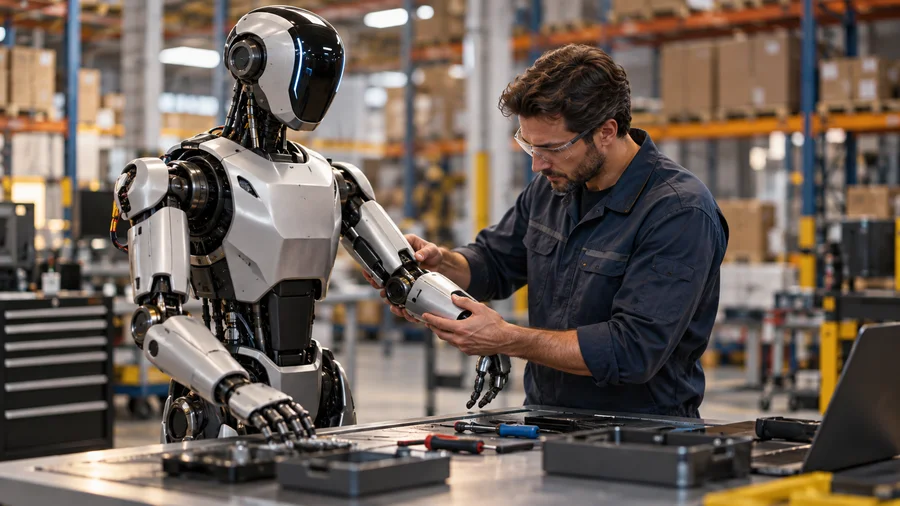
A robot doesn't ask for a raise. He doesn't want any vacation days and doesn't have to go home early to pick up his child.
On paper, that sounds like every employer's dream.
Until he stops in the middle of a service.
One box is just wrong. A gripper does not get enough grip. An employee must come and help. A little later the robot has to charge, while work continues as usual.
That's where the bill begins that you rarely see in a demonstration video.
The costs of humanoid robots go far beyond the purchase price. What counts is how much reliable work a machine delivers for every euro spent.
And that is precisely where it becomes clear which robots can become an economic breakthrough — and which remain especially impressive on camera.
How much does a humanoid robot cost?
There is no universal price for a humanoid robot. A research platform, a demonstration model and a machine that must function daily in a production environment are different products.
Furthermore, a quote may only include the hardware. Software, installation, maintenance and workplace adjustments can be calculated separately.
Even a well-known robot manufacturer cannot determine future costs with certainty. Agility Robotics describes in a document to the American stock exchange watchdog SEC that its assumptions about maintenance, lifespan and service have largely not yet been proven on a commercial scale. Source: SEC document Agility Robotics
This makes a comparison based on the purchase price alone not very useful.
Anyone who wants to use a robot should actually ask two questions:
What does it cost to get it working? And what does it cost to keep him working?
The hidden costs of humanoid robots
Buying a robot is the start of a project. It must then fit within an existing operation.
| Cost item | What to bring |
|---|---|
| Purchase or subscription | Hardware, financing or recurring usage costs |
| Installation and integration | Links with software, machines and work processes |
| Workplace adjustment | Setup, charging points and any safety features |
| Software and support | Licenses, updates and technical help |
| Maintenance and repairs | Labor, parts and replacement of worn components |
| Human guidance | Training, supervision and assistance with exceptions |
| Standstill | Less output and possible disruption of the rest of the process |
Which costs are returned separately depends on the robot, the task and the contract. Some suppliers bundle parts of this bill into one rate.
The biggest surprise does not have to be the power consumption. A machine that requires regular support can also consume a lot of human time.
That hour may not appear on the robot supplier's invoice. The employer will pay for it.
Robot vs. worker: compare the same work
A comparison between a robot and a worker quickly becomes misleading.
On the one hand is the entire employer budget for an employee. On the other hand, only the depreciation of a robot. Subsequently, automation obviously seems advantageous.
But an employee often does more than one clearly defined task.
He moves a box, sees that a package is damaged, warns a colleague and adjusts his approach when a pallet is positioned incorrectly.
A robot that takes over one part of that work does not replace an entire function.
A fair comparison therefore looks at a concrete task:
- How many correct actions are completed per hour?
- How often is help needed?
- What errors arise?
- How much does it cost to repair it?
- How much human capacity is actually freed up?
If a robot saves twenty hours of human labor, but requires fifteen hours of additional guidance, that leaves five hours of direct time savings. That is an illustration, not a measured result of a specific robot.
The machine can also have other advantages, such as taking over heavy work. These also deserve a place in the calculation.
The most important metric: cost per task completed
A robot that costs little per hour, but hardly completes any work, is not a bargain.
The most useful measure is often:
Total cost ÷ number of tasks completed correctly.
A fictional example shows why.
Suppose a robot costs €60,000 annually, including purchase depreciation, support, maintenance and other costs.
| Scenario | Productive hours per year | Tasks per productive hour | Tasks completed correctly | Cost per task |
|---|---|---|---|---|
| A | 3,000 | 60 | 180,000 | €0.33 |
| B | 1,500 | 40 | 60,000 | €1.00 |
These are calculation assumptions, not market prices. The annual costs have been kept the same in both scenarios to make the effect of productivity visible.
The same machine in scenario B costs approximately three times as much per task.
A real comparison must also take into account quality differences, damage, support costs and the consequences of downtime. But the principle remains: a low purchase price means little if the usable output is disappointing.
BMW shows that humanoid robots can do real work
The discussion is now about more than demonstrations.
BMW reported in February 2026 that Figure 02 had moved more than 90,000 parts in ten months during a pilot project in Spartanburg. The robot thus supported the production of more than 30,000 BMW X3s. BMW reported approximately 1,250 operating hours. Source: BMW Group
That is meaningful: a humanoid robot worked on a concrete task in an existing production environment.
But from those figures you cannot deduce how much each action cost or how much human guidance was needed. Operating hours are also different from fully independently productive hours.
BMW also emphasized that production IT, occupational safety, process management and logistics had to be involved early in the deployment. The robot became part of an operational system. Source: BMW Group
That is a more important lesson for companies than just the number of steps he took.
Robots as a Service: does the robot still receive a monthly bill?
Not every customer buys a robot.
With Robots as a Service, often abbreviated to RaaS, a company pays for use and services according to agreed conditions.
GXO and Agility Robotics announced a multi-year agreement in 2024 to use Digit in logistics operations. In the application described, robots moved bins to conveyors and worked with existing automation. Source: GXO
Such a model can lower the purchasing threshold. It may also place support and maintenance responsibilities on the supplier, depending on the contract.
This does not make the costs disappear. They take on a different shape.
A customer still needs to know what the rate covers, what happens during downtime and how much work he receives in return.
Meanwhile, the supplier faces its own challenge: if repairs and support turn out to be more expensive than expected, an attractive customer rate can be at the expense of its margin.
Why a simpler robot is sometimes the better choice
A humanoid robot is attractive because it can potentially work in different places in an environment designed for humans.
That flexibility must deliver value.
When goods always follow the same route, a conveyor belt can be a logical solution. A mobile robot on wheels can suffice for transport over a flat warehouse floor. A fixed robot arm may be suitable for a recurring action in the same place.
These are considerations per application. There is no design that is the cheapest for every company.
The humanoid must demonstrate that its additional capabilities outweigh the additional complexity.
That may be less spectacular than a robot doing a somersault. It is much more interesting for an operational manager.
When will humanoid robots become profitable?
My analysis is that the chance of a convincing business case increases when:
- The task recurs often enough to require intensive use of the machine.
- The robot requires little human assistance.
- The work is heavy, unattractive or difficult to occupy.
- The environment suits his capabilities.
- Maintenance and breakdowns remain predictable.
- The use actually reduces costs or makes extra production possible.
Payback period must also be based on net savings.
An illustrative investment of €150,000 with an annual net benefit of €50,000 has a simple payback period of three years. If that benefit falls to €20,000, the payback period becomes 7.5 years.
Financing, tax, residual value and any changes in costs have not yet been included.
The difference between those outcomes may be something small: how often someone has to walk to the robot to get it started again.
What does this mean for robotics investors?
Two separate questions are important for investors.
Can a customer earn or save money with the robot? And can the manufacturer deliver that robot profitably?
An attractive application for the customer does not guarantee a good margin for the supplier. Conversely, a large order portfolio does not mean that every customer will achieve sufficient returns in the long term.
In its SEC document, Agility lists integration costs, maintenance, service life and customer renewals as uncertainties in its economic assumptions. Source: SEC document Agility Robotics
That is why data about actual deployment, returning customers and services deserve at least as much attention as new demonstrations.
The same applies to actuator suppliers. Reliable joints can help reduce maintenance and downtime. The business value then lies in delivering usable work for longer, not just in selling more parts.
The robot that wins must earn back its bill
Humanoid robots don't have to be able to do everything to become valuable.
One clearly defined task can be sufficient, if the robot performs it safely, consistently and at an attractive cost.
So the question is not just whether a robot can imitate your work.
The question is what is left after installation, maintenance, human assistance and downtime have been paid for.
A robot has no salary. But every minute spent doing nothing useful comes at a price.
Frequently asked questions
How much does a humanoid robot cost?
That depends on the model, the implementation and the contract. For a business comparison, installation, software, maintenance, human guidance and downtime must also be taken into account.
Are humanoid robots cheaper than workers?
That varies per task. Compare total costs for the same amount of correctly completed work. A robot that takes over one task does not automatically replace an entire function.
What determines the payback period of a robot?
The investment and the annual net savings determine the simple payback period. Productivity, maintenance, guidance and actual deployment have a major influence on these savings.
Can humanoid robots already work in factories and warehouses?
There are concrete applications and pilot projects. BMW reported production experience with Figure 02; GXO entered into a commercial agreement for the deployment of Digit. These examples do not yet prove universal profitability. BMW Group · GXO
What is Robots as a Service?
RaaS is a model in which a customer pays for robot use and agreed services. The exact coverage of maintenance, software and support depends on the contract.