Everyone looks at the robot’s brain. Who profits from its muscles?
Translated from the original; figures and sources have been preserved. Read the original →
A humanoid robot lifts a box, walks through a factory and carefully sets the box down.
Social media then talks about his intelligence. Which AI model does he use? How much computing power does it have? Will he soon be able to replace people?
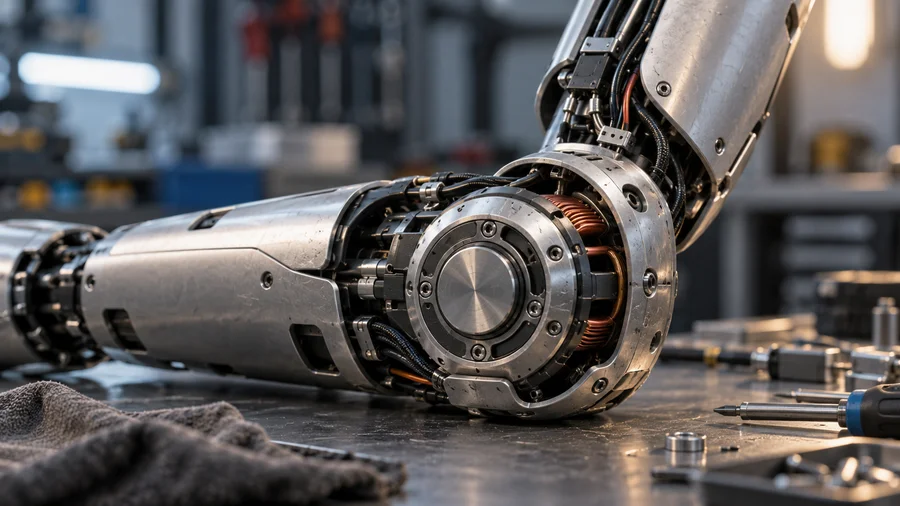
But look at his knee.
There, a small mechanical system must support the robot's weight, help it maintain its balance and continuously respond to movement. Without overheating. Without using an unnecessary amount of power. And ultimately at a price that a factory is willing to pay.
That system is called an actuator.
Robot actuators receive less attention than AI chips, but they are at the center of an important economic issue: how do we turn an impressive robot demonstration into an affordable machine that works every day?
Companies such as Novanta, Timken and Schaeffler want to play a role in this. The opportunity is interesting. The step from technical promise to profitable mass production remains a big one.
What are robot actuators?
An actuator converts energy into movement. In a robot, he can rotate a shoulder, bend a knee or close a grip.
You can think of actuators as the muscles of a robot, although that comparison is only partially valid. A robot joint often contains a combination of an electric motor, a transmission, bearings, sensors and control electronics.
The motor provides movement. The transmission adjusts speed and turning force. Sensors tell the controller where the joint is and, depending on the design, how much force it exerts.
For example, Harmonic Drive sells integrated actuators that combine a motor, precision transmission, brake, encoders and servo electronics. So there is a whole collection of specialist parts behind one movement. Source: Harmonic Drive
That makes the supply chain wider than many videos about “robotics stocks” suggest. Some companies sell complete actuators. Others only supply an essential part.
Why humanoid robots demand so much from their joints
A robot arm in a fixed production cell has a hard enough time. A humanoid robot must also take its own balance, unexpected collisions and the environment in which it moves into account.
Consider a robot that picks up a box from the floor. His legs carry the body. His arms move the load. His joints have to work together to keep him from falling over.
A stronger motor sounds like a simple solution, but it entails extra weight and energy consumption. A sturdy transmission can handle a lot of force, while friction and stiffness can make it more difficult to respond smoothly to contact.
Research into humanoid actuators shows how closely mechanical design, shock resistance and motion control are linked. These problems will not disappear just because the AI model becomes smarter. Research on Series Elastic Actuators MIT Research on Humanoid Design and Control
Ultimately, something very practical counts for an employer: how much useful work does the robot perform before it needs to be charged, cooled down or repaired?
There the actuator immediately takes on economic significance.
Are actuators the next bottleneck of physical AI?
Physical AI is the collective name for AI that acts through machines in the physical world. A robot must translate decisions into real movement.
Actuators can be a bottleneck because many requirements must be solved simultaneously: power, weight, safety, service life, energy consumption and costs.
But there is a difference between a difficult technical challenge and a proven global shortage.
The available sources support that robot joints are an important area of development. They do not prove that every actuator manufacturer will soon have an overfull order book.
The real question is therefore:
Which supplier can make a reliable joint, scale up production and maintain sufficient margin?
Which companies supply actuators for robots?
The market consists of different layers. That distinction is important if you want to understand where the turnover can end up.
| Company | Position in the chain | Concrete robotics link |
|---|---|---|
| Novanta | Motors, sensors and motion control | Technology aimed at, among other things, humanoid applications |
| Timken | Bearings, transmissions and encoders | Portfolio for industrial robots and humanoid motion |
| Schaeffler | Integrated actuators and components | Supply agreement with Humanoid |
| Harmonic Drive Systems | Precision transmissions and actuators | Humanoids included in the growth strategy |
| Nabtesco | Precision gear units | Applications for robot joints |
| Leaderdrive | Transmissions and integrated actuators | Specific humanoid product lines |
| Moog | Actuators and motion control | Proven applications in robotics |
| USA Rare Earth | Magnets and raw material chain | Indirect connection via electric motors |
Novanta: multiple parts of the same joint
Novanta focuses on various components that enable robot movement. The company presents a Motion Stack with servo electronics, frameless motors, encoders and force and torque sensors. Source: Novanta
That's an interesting position. A robot builder must make all those parts work well together. A vendor that makes integration easier can save development time.
Novanta also announced 2026's participation in NVIDIA's Halos AI Systems Inspection Lab in March. That initiative supports the validation and certification of technology for AI systems, including robotics. Source: Novanta investor relations
The collaboration makes Novanta relevant to the ecosystem. However, you cannot derive a large production order from it. Separate commercial proof is required for this.
Timken: Behind the bearing manufacturer is a broader robotics chain
Timken is often associated with bearings. The company has more in-house for robotics.
Cone Drive supplies harmonic or strain wave transmissions. SPINEA makes cycloidal transmissions. CGI supplies compact precision transmissions. In addition, Timken has bearings and encoders.
The company explicitly calls this combination for humanoid movement. Source: Timken
Timken can therefore end up in several places in a robot joint. The question remains for shareholders how large these activities will become within the entire group.
A promising component can be technically important and remain financially modest for the time being.
Schaeffler: from product development to a supply agreement
Schaeffler has one of the more concrete examples in this market.
In January 2026, the German company announced a partnership with the British Humanoid. This includes development and supply of actuators, plus the purchase of humanoid robots for Schaeffler's own production network. Source: Schaeffler
In addition, Hexagon announced in April 2026 an expansion of the collaboration with Schaeffler around its AEON humanoids, following a joint pilot project in 2025. Source: Hexagon
This brings supplier and user close together. Problems that arise on the factory floor can flow back into the design.
A collaboration does not yet indicate how much profit is earned from it. But a supply agreement is a more concrete starting point than just a nice demonstration.
Harmonic Drive and Nabtesco: precision counts
Not every opportunity lies with the manufacturer of a complete joint.
Harmonic Drive Systems specializes in precision transmissions and actuators. The company cites humanoid robots as a growth area in its strategy. Nabtesco describes applications of its precision gearboxes in, among other things, shoulder and hip joints of humanoids. Source: Harmonic Drive Systems · Source: Nabtesco
These suppliers have experience with industrial robotics. That is valuable, but existing market positions are no guarantee for the next generation of robots. Other joint designs may require different parts.
Leaderdrive and SKF: China belongs in this story
An analysis that only mentions US robotics stocks misses part of the supplier market.
Leaderdrive presents specific humanoid components, including compact gears for hands and wrists, integrated rotary actuators and planetary roller screws for linear motion. Source: Leaderdrive
SKF announced an agreement for a joint venture with Leaderdrive in July 2026. According to the announcement, SKF will have a 60% stake. The company will develop and supply precision transmission components for robot joints, with a planned operational start in late 2026. Source: SKF
That is a concrete step towards a joint supplier position. The planned start must of course still be converted into operational production and turnover.
And the companies from viral stock videos?
Moog and USA Rare Earth are relevant names, but for different reasons.
Moog has proven expertise in motion control. It developed integrated hydraulic robot actuators with the Italian research institute IIT. There are also applications of Moog SmartMotors in intralogistics robots from PAL Robotics. Research Moog/IIT · Source: Moog and PAL Robotics
That experience makes Moog interesting. It does not automatically prove that the company will become a major supplier of low-cost electric humanoids.
USA Rare Earth is earlier in the chain. The company is working on permanent magnets and the materials required for them. Such magnets can end up in electric motors, but USA Rare Earth does not build robot joints itself.
The company commissioned phase 1a of its Stillwater magnet plant in March 2026. A production capacity target remains something different than realized sales to robot builders. Source: USA Rare Earth · Second Quarter 2026 Results
Anyone who lumps these companies together is therefore comparing different business models.
Millions of robot joints do not mean guaranteed profits
The appeal of actuators is easy to understand.
Suppose 100,000 robots are built with an average of 30 actuators. Then 3 million actuators are needed. This is a calculation example, not a market forecast; robot designs vary widely.
Yet the most important rule is missing from that sum: what does the supplier earn per actuator?
Higher volumes can go hand in hand with lower sales prices. Robot builders can have multiple suppliers compete against each other or decide to develop parts themselves.
New designs can also change the market. A supplier that is a good fit for today's joint does not necessarily have to be the best choice for tomorrow's joint.
My analysis is therefore that the strongest position arises where technical quality and efficient production come together. A part must function properly and be available at a commercially attractive price.
What should you look for in robotics stocks?
For investing in robotics, a product video is a starting point for research.
The following questions say more:
- Are there any paid production orders?
- Are these prototypes or recurring deliveries?
- How much turnover actually comes from humanoid robots?
- What margins remain if prices fall?
- How much money is needed to expand production?
- Can the customer easily replace the part?
- How much future growth is already in the share price?
An excellent company can become a disappointing investment if purchase expectations are too high. Moreover, a growing market can grow multiple suppliers without one party making exceptional profits.
Who will make money from the robot's muscles?
The best-known name on the robot does not have to be the name on its most important parts.
That makes robot actuators interesting. Novanta, Timken, Schaeffler, Harmonic Drive, Nabtesco and Leaderdrive are working on different parts of the same task: making machines move with sufficient power, precision and reliability.
Which of these will be the biggest commercial winner is still open.
For now, there is a more useful question than “which stock makes me rich?”:
Who can demonstrate that their technology not only makes a robot move, but also allows it to do affordable work?
A robot lifting a box attracts attention. A robot that does that reliably for months can build a market.
Frequently asked questions about robot actuators
What does an actuator do in a robot?
An actuator converts energy into movement. For example, he rotates a robot arm or bends a knee. An integrated actuator can also contain sensors, a transmission and control electronics.
Which companies make actuators for humanoid robots?
Schaeffler, Harmonic Drive and Leaderdrive, among others, offer actuators. Novanta and Timken supply important parts and systems for robot movement. The precise role varies per product and robot design.
Are robot actuators the same as electric motors?
An electric motor can be part of an actuator. A complete actuator often contains additional components that transmit, measure and control the movement.
Is USA Rare Earth a manufacturer of robot actuators?
USA Rare Earth works on magnets and the rare earth chain. The connection to actuators is via materials that can be used in electric motors.
Are actuator companies automatically good robotics stocks?
That depends on their orders, profitability, competitive position and stock valuation. Technical relevance alone is insufficient to determine an attractive investment return.