The new space race: why Europe needs its own satellites
The Strategic Newb Editorial Team
Updated:
Translated from the original; figures and sources have been preserved. Read the original →
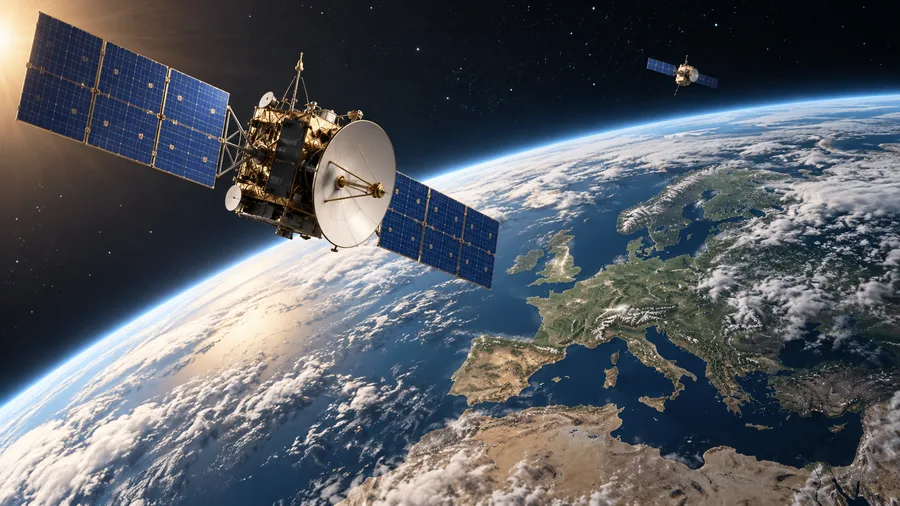
You use navigation, an emergency service shares information during a disaster, and a business assesses flood damage. Space infrastructure can underpin these everyday activities.
European satellites are therefore about more than technological prestige. They help determine whether Europe can navigate independently, observe changes on Earth and communicate when conventional networks fail.
The short answer: foreign services can be valuable, but exclusive reliance on them reduces control over availability, terms and future development. Europe’s own systems provide alternatives and governance control without removing every technical dependency.
Three functions you should not confuse
Galileo, Copernicus and IRIS² are often mentioned together but solve different problems.
| European programme | Main function | What does it provide? |
|---|---|---|
| Galileo | Navigation, positioning and timing | A European source of positioning and timing signals |
| Copernicus | Earth observation | Data on land, sea, atmosphere and changes on Earth |
| IRIS² | Secure satellite communications | Planned additional connections for government and commercial applications |
A navigation satellite does not replace an internet connection. An Earth-observation satellite does not provide broadband to your phone. Europe needs different layers because different economic and social functions depend on them.
Galileo: navigation is economic infrastructure too
Galileo offers free navigation, positioning and timing services for use by smartphones and vehicle navigation. It also has a High Accuracy Service for applications requiring more precise positioning. Source: EUSPA
Timing is less visible. EUSPA says precise time signals matter for telecommunications, electricity grids and financial infrastructure. Source: EUSPA on timing and synchronisation
The strategic benefit is a system under European responsibility. Other navigation systems do not become redundant: combining signals can improve usability.
Galileo also authenticates navigation messages through OSNMA, helping receivers check that a message really comes from the system. This is not a blanket guarantee against disruption: an authentic message can still be unusable if reception is blocked. Source: EUSPA
A flag on a satellite is therefore only the beginning. Reliable receivers, security and alternative time sources remain part of the solution.
Copernicus: observing what happens on Earth independently
Copernicus is the Earth-observation component of Europe’s space programme. It combines satellite information with observations from the ground, air and sea.
Its six services cover land, sea, atmosphere, climate change, emergencies and security. Source: EUSPA on Copernicus
Copernicus Data Space provides free access to a broad range of satellite data and processing capabilities. Source: Copernicus Data Space
This data foundation lowers the barrier for businesses developing applications. It gives public bodies a shared starting point for analysis.
The strategic value is not just owning images. Continuity matters too: data spanning years enable comparisons. If access repeatedly depends on new commercial terms, long-term analysis becomes harder to plan.
This is our economic interpretation: public data infrastructure can support competition between multiple businesses rather than making every user dependent on one exclusive data source.
IRIS²: Europe is building secure communications
IRIS² is intended to provide reliable, secure satellite connections for governments, businesses and citizens. The European Commission lists crisis response, defence, infrastructure and areas with limited terrestrial connectivity among its applications. Source: European Commission
An important update came on 7 August 2026. The Commission and SpaceRISE signed an implementation agreement with a main constellation of 348 satellites: 330 in low Earth orbit and 18 in medium Earth orbit.
Under that schedule, first launches begin in 2029, followed by early secure services. Older reports of 290 satellites describe an earlier design. An implementation agreement does not mean the full system is already operational. Source: Commission, 7 August 2026
Europe is not starting government communications from scratch. EUSPA reports that the GOVSATCOM Hub has been operated since January 2026. This must be distinguished from the future IRIS² constellation. Source: EUSPA
How much control does Europe lose through foreign dependence?
There is no meaningful single percentage. Control involves several questions.
Who decides where a service is available? Who sets priorities during a crisis? Which rules govern the operator? Who can change the terms? And how quickly can a user switch?
A foreign commercial provider may perform exceptionally well. Risk arises when a critical function has no viable alternative. An outage, contract change or political decision can then have consequences a European customer cannot resolve independently.
Our analysis: strategic autonomy is mainly about freedom to act. Europe need not avoid every foreign service, but must remain able to perform essential functions if one relationship fails.
Own satellites do not eliminate every dependency
A satellite network involves more than objects in orbit. It needs launch capacity, ground stations, user equipment, software, components and secure operations.
A weakness in one layer can limit the value of others. For example, a constellation without enough suitable terminals does not yet provide widely usable emergency connectivity.
Economic trade-offs remain. Redundancy costs money. Duplicate capacity is useful if it genuinely covers outages, but less valuable if systems cannot work together.
The best test is practical: how many users can keep operating under realistic crisis conditions, and at what total cost?
Why households and businesses are affected too
Consumers need not buy satellites to benefit. Navigation can support routes, observation data can inform disaster response, and additional communications can support connections where fixed networks fall short.
Businesses need a predictable infrastructure base for investment. They must know which services are available and how long they can rely on them.
The same pattern appears in Europe’s LNG dependence: more suppliers and routes help, but real resilience requires attention to the entire chain.
Frequently asked questions
Is Galileo the same as satellite internet?
No. Galileo provides navigation, positioning and timing information. Internet connectivity is a communications function.
Is Copernicus a European GPS system?
No. Copernicus observes Earth. Galileo is Europe’s satellite navigation system.
Is IRIS² already fully available?
No. The August 2026 implementation agreement schedules first launches in 2029. Full availability must be distinguished from planned early services.
Is IRIS² simply a European Starlink?
That comparison helps explain satellite communications but is incomplete. IRIS² has explicit public-security objectives and its own design; satellite numbers alone say little about suitability for a specific task.
Sources checked and article updated: 10 October 2026. Future launches and services are plans, not completed achievements.