3D printing lost its hype — but robots could send the industry soaring again
The Strategic Newb Editorial Team
Updated:
Translated from the original; figures and sources have been preserved. Read the original →
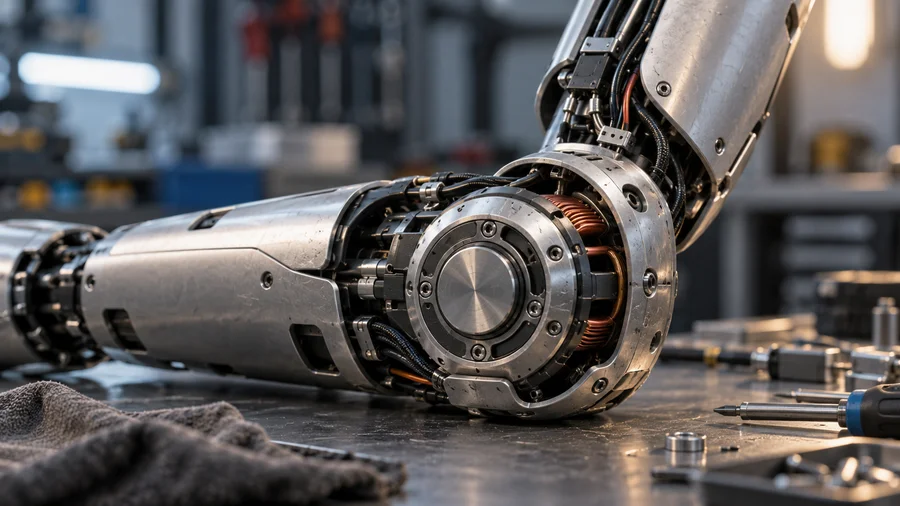
Everyone is watching artificial intelligence.
Nvidia. ChatGPT. Data centres. Humanoid robots. Self-driving cars.
But while billions of euros flow into AI and robotics, a technology once hailed as the next industrial revolution sits in the background:
3D printing.
In the early 2010s, it seemed that almost everyone would eventually have a 3D printer at home. Parts, toys, tools and perhaps even complete products would be printed locally.
That revolution did not arrive as predicted.
Consumers largely lost interest, several listed 3D printing companies fell back from enormous valuations, and artificial intelligence became the technology everyone talked about.
But 3D printing never disappeared.
It simply moved into places consumers rarely see: factories, medical companies, aerospace, defence, engineering and industrial automation.
And that is where a second phase of growth could now begin.
Not through people printing plastic objects at home.
But through robots needing ever more small, lightweight and complex parts.
Perhaps 3D printing was never really meant for consumers
Much of the original excitement around 3D printing centred on decentralisation.
Why ship a product thousands of kilometres when you can print it locally?
Why store spare parts for years when you can keep them digitally?
Why build an entire factory when a printer can produce different products?
The problem was that traditional manufacturing methods often remained much cheaper for mass production.
When a manufacturer needs hundreds of thousands of identical plastic parts, injection moulding can often be more attractive.
The mould is expensive.
But once it exists, parts can be produced extremely cheaply and quickly.
3D printing works the other way around.
It requires very little tooling, but each individual part takes production time.
That makes additive manufacturing particularly interesting when products:
- are complex;
- change regularly;
- are produced in relatively small quantities;
- need to be extremely lightweight;
- need to be customised;
- contain internal channels or structures;
- are difficult to make with conventional machines.
That profile closely resembles the demands of modern robotics.
Why robots could make 3D printing interesting again
From the outside, an industrial robot may look like a single machine.
In reality, it contains a huge number of components.
Motors, gears, sensors, wiring, bearings, housings, couplings, grippers, mounting points, cable guides and structural parts all have to work together.
Many standard components will never be 3D-printed.
Making a standard bearing on a specialised production line still makes much more sense.
The same applies to chips, electric motors, bolts and many gears.
But a robot also contains a long list of parts that are not entirely standard.
Think of:
robot grippers, fingers, sensor brackets, camera housings, cable guides, protective covers, structural brackets, air ducts, customised connectors and specialised end effectors.
For these parts, 3D printing could become much more attractive.
Especially when robot manufacturers constantly modify their designs.
A traditional production line needs stability.
A 3D printer benefits from change.
The perfect example: the robot gripper
One of the clearest applications sits at the end of a robot arm.
The gripper.
A robot picking up boxes needs a different gripper from one assembling electronics.
A food-handling robot has different requirements again.
A warehouse robot handling hundreds of different products may eventually need several specialised grippers.
Such systems normally have to consist of several machined components.
With 3D printing, several functions can sometimes be integrated into one part.
Internal air channels, for example, can be printed directly into a pneumatic gripper.
Mounting points, sensor guides and complex structures can also be part of the same design.
That can reduce the number of components.
But perhaps more importantly:
it can drastically reduce weight.
HP published a case study in which new Multi Jet Fusion 3D-printed grippers were more than 85% lighter than previous designs.
According to the same case study, gripper production time fell by around 30%.
For a robot, that matters far more than it might initially sound.
Every gram at the end of a robot arm counts
Imagine removing one kilogram from the base of an industrial machine.
That can be useful.
But one kilogram at the end of a fast-moving robot arm has a much greater effect on the whole system.
Motors must constantly accelerate that mass.
Slow it down.
Change direction.
And accelerate it again.
A lighter gripper can therefore potentially mean:
lower energy use, faster movements, less strain on joints and the ability to devote more of the payload capacity to the actual product.
That explains why topology optimisation and 3D printing are so interesting to robot manufacturers.
Instead of milling away a solid block of metal, a computer can place material only where it is structurally needed.
The result sometimes looks almost organic.
These are precisely the shapes that traditional manufacturing struggles with, while a 3D printer can produce them relatively easily.
AI could make this process even more powerful
This is where 3D printing begins to connect directly with today's AI revolution.
Artificial intelligence can do more than control robots.
AI can also design robot parts.
Generative design and topology optimisation let computers analyse thousands of possible shapes.
An engineer no longer has to draw exactly what a part should look like.
They can specify constraints:
The part must withstand these forces.
It must weigh no more than this many grams.
These mounting points must remain.
It must be possible to manufacture it from this material.
The computer then searches for an efficient geometry.
Those geometries are often so complex that conventional manufacturing struggles to make them.
That is where 3D printing has an advantage.
MIT research showed how generative AI could develop new geometries for a robot. According to the researchers, the resulting machine jumped about 41% higher than their conventionally designed version and showed a substantial improvement in landing stability.
The interesting point is not just that AI designed a better part.
It is the production chain this could create:
AI → simulation → generative design → digital model → 3D printer → robot component.
That could lead to a fundamentally different form of manufacturing.
Robots may not all need to be exactly alike in future
Traditional mass production follows one principle:
make as many identical products as possible.
But AI can make production more personalised and dynamic.
A warehouse robot in a distribution centre may need different grippers from the same robot working in a car factory.
A humanoid robot in a hospital may use different hands, protective parts and sensor modules from a robot in a warehouse.
So in a world with millions of robots, not every component needs to be made in millions of copies.
Instead, a huge long-tail market could emerge.
Thousands of types of parts.
Produced in tens, hundreds or thousands.
That is precisely where additive manufacturing can become economically attractive.
More than five million industrial robots are already operating
The development of robotics is no longer hypothetical, either.
According to the International Federation of Robotics, approximately five million industrial robots were operating worldwide at the end of 2025.
More than 600,000 new industrial robots were installed in 2025.
The size of the operational stock in 2028 will depend on new installations and the retirement of existing robots.
These figures cover only industrial robots.
Potential growth in:
- humanoid robots;
- warehouse robots;
- autonomous mobile robots;
- agricultural robots;
- defence robots;
- medical robots;
- drones;
- cobots;
comes on top of that.
If robotics really becomes one of the most important hardware markets of the next decade, the market surrounding the robot also grows.
And with it, demand for parts.
Why 3D printing has become an industry behind the scenes
That makes the position of additive manufacturing striking.
The technology is barely central to public debate about technology anymore.
Search for future technology and you get:
AI.
Quantum computing.
Humanoid robots.
Autonomous driving.
Semiconductors.
Yet behind many of these industries, demand for specialised manufacturing is growing.
3D printing may therefore have evolved from a hyped industry into an infrastructure technology.
Less visible.
But potentially much more useful.
That is somewhat like what happened with cloud computing.
Consumers rarely talk about data centres when using Instagram.
But without data centres, the service would not exist.
The same could happen in robotics.
The consumer sees the humanoid robot.
Behind it, however, an entire chain of specialist materials companies, printers, design software, manufacturers and parts suppliers could emerge.
Metal 3D printing could become more important than plastic
When people think of 3D printing, they often still picture a desktop printer laying down layers of plastic.
Industrial additive manufacturing now goes much further.
Metal powders can be used to produce parts from materials including:
aluminium, titanium, stainless steel, tool steel and nickel alloys.
That opens up applications that were previously barely possible.
For example, a metal additive manufacturing supplier reported a topology-optimised robot joint with approximately 20% lower weight than a traditionally cast component, while retaining high mechanical strength.
Metal printing also enables internal structures that are practically impossible with traditional machining.
Lattices.
Hollow structures.
Internal cooling channels.
Integrated cable routes.
That can be particularly valuable in robots, where weight, heat dissipation and space constantly have to be balanced.
But 3D printing will not replace traditional manufacturing
An important qualification is needed here.
A new robotics boom does not automatically mean factories will start printing everything.
3D printing still has weaknesses.
Industrial printers are expensive.
Metal powders are costly.
Printing can be slow.
Surfaces sometimes need finishing.
Critical components require extensive testing and certification.
And when hundreds of thousands of completely identical parts are needed, injection moulding, stamping, forging, casting and CNC manufacturing can remain cheaper.
The future is therefore probably not:
3D printing versus traditional manufacturing.
But:
3D printing alongside traditional manufacturing.
Each manufacturing technology does what it does best.
Mass production for standard components.
Additive manufacturing for complex, lightweight, customised and rapidly changing parts.
The real opportunity lies between prototype and mass production
3D printing is still often seen as a prototyping technology.
That perception is changing.
Industrial printers are increasingly used for actual end products, particularly in small to medium production runs.
That could be especially important in robotics.
A robot manufacturer might develop a new gripper, for example.
Print version 1.
Test it.
Modify the design.
Produce version 2.
Test it again.
And eventually produce hundreds or thousands of parts without first developing an expensive mould.
If the design changes six months later, an entire set of tooling does not have to be rebuilt.
The digital file changes.
Then the printer starts again.
In an industry where hardware may evolve as quickly as software, that flexibility could be enormously valuable.
Spare parts could become a second major market
Another application receives relatively little attention.
Spare parts.
A factory may use a robot for ten or fifteen years.
Meanwhile, manufacturers must keep parts available.
Traditionally, that means physical inventory.
Storage.
Logistics.
And making parts for which perhaps only a few hundred customers remain.
3D printing makes an alternative possible:
digital inventory.
Instead of keeping thousands of parts on shelves, a manufacturer stores certified digital models.
When a part is needed, it is produced locally.
In a world with millions of robots, that could eventually become a major logistics application.
Which businesses could benefit from this development?
If this trend continues, the biggest winner need not be the humanoid robot manufacturer itself.
The value chain is much broader.
Potential beneficiaries include:
Industrial 3D printers Companies developing reliable production printers for plastics and metals.
Materials Specialist polymers, metal powders and composites could become more important as robot components face stricter requirements.
Software Generative design, simulation, topology optimisation and automatic print preparation could become more closely integrated with AI.
3D printing service providers Not every robot manufacturer wants to invest millions in industrial printers. Manufacturing as a service could therefore grow.
Post-processing Many high-quality printed parts still require treatment, polishing, heating or CNC finishing after production.
Digital parts platforms Eventually, a market might even emerge for storing certified robot parts as digital files and producing them locally.
That makes 3D printing more than a single industry.
It could become a manufacturing layer beneath several fast-growing industries.
The robotics revolution could give 3D printing a second chance
3D printing has experienced one of the strangest technology cycles of the past twenty years.
First, it was going to change everything.
Then almost nobody seemed to talk about it anymore.
But perhaps the technology was never the problem.
Perhaps we simply expected the wrong application.
The first wave revolved around consumers printing products at home.
The next wave could revolve around machines making parts for other machines.
And this time, there is a much clearer economic rationale.
Robots need lightweight components.
Robots change quickly.
Robots are adapted to specific tasks.
AI can design increasingly complex parts.
And 3D printers excel when parts need to be complex, customised and produced in relatively small quantities.
That does not mean every future robot will largely come out of a printer.
But if millions of new robots each use dozens of specialised 3D-printed parts, they do not need to.
A technology does not have to build the entire product to become a huge industry.
As the world watches AI and humanoid robots, 3D printing could quietly evolve from yesterday's forgotten hype into one of the manufacturing technologies behind tomorrow's robotics revolution.
Frequently asked questions about 3D printing and robots
Are robots already being made with 3D printers?
Yes. 3D printing is already used for robot grippers, housings, brackets, prototypes, tools and certain structural components. Most of a robot is still made using other manufacturing methods, however.
Why is 3D printing interesting for robotics?
Robot parts often need to be lightweight, strong and compact. Many are also produced in relatively small quantities. This can make the design freedom and low tooling costs of additive manufacturing attractive.
Can metal robot components be 3D-printed?
Yes. Industrial metal printers can produce parts from aluminium, titanium, stainless steel and various high-performance alloys, among other materials. Precision or heavily loaded components often require additional finishing.
Will 3D printing replace CNC and injection moulding?
Probably not. For large quantities of identical parts, traditional processes often remain cheaper. 3D printing is particularly attractive for complex geometries, low to medium volumes and parts that change regularly.
What does AI have to do with 3D printing?
AI and generative design can automatically develop new geometries based on weight, strength and other requirements. Many of these shapes are difficult to manufacture conventionally but well suited to 3D printing.
Could the growth of humanoid robots stimulate 3D printing?
It could, especially if humanoid robots are developed in large numbers while still needing many specialised, lightweight and regularly changing components. The eventual effect depends on costs, production speed, materials and the extent to which robot manufacturers actually integrate additive manufacturing.
Sources and further information
This article draws on data and applications from sources including:
- International Federation of Robotics — World Robotics 2026
- HP — Multi Jet Fusion case study on robot grippers
- MIT — generative AI for robot design
- Research and industry case studies on topology optimisation and metal additive manufacturing
- Industrial applications of SLS, MJF and metal powder-bed fusion in automation and robotics
Disclaimer: future scenarios involving humanoid robots and demand for 3D-printed components remain uncertain. The developments discussed show possibilities and current applications, but do not guarantee widespread adoption of additive manufacturing by all robot manufacturers.