AI and deflation: why your cost of living could still rise
The Strategic Newb Editorial Team
Updated:
Translated from the original; figures and sources have been preserved. Read the original →
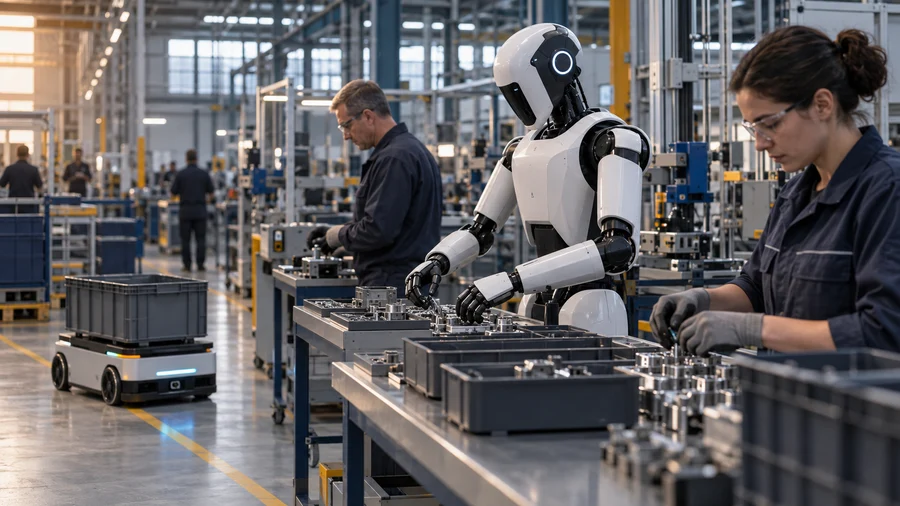
A company automates its customer service. A factory gives robots more work. Production gets cheaper, but you face higher prices and barely get a pay rise. Where are the benefits of that technological progress?
AI and robotics can put pressure on prices because companies produce cheaper. But lower costs do not automatically translate into lower retail prices. If companies keep the savings as extra profit and wages lag behind, employees may actually lose purchasing power.
That is the distributional question behind AI and deflation: who benefits when we can produce more with less human labor?
How AI and robotics can make production cheaper
AI can speed up digital tasks such as processing documents, writing software and answering customer questions. Robots can take over physical tasks, such as assembling parts or sorting packages. The possible outcome is more production with the same amount of labor, or the same production with fewer labor hours.
There are costs too: equipment, software, maintenance, electricity and oversight. Automation only saves money when its benefits outweigh these costs.
If companies can therefore supply cheaper and compete with each other, prices can fall. The European Central Bank describes this link between automation, productivity and price reductions. At the same time, increased demand for cheaper products can create additional work. Job losses are therefore not an automatic outcome for the entire economy.
The difference between deflation and lower inflation
Not every price drop means there is deflation.
| Concept | Meaning | Simple example |
|---|---|---|
| Inflation | The general price level is rising | A shopping basket goes from €100 to €103 |
| Disinflation | The price increase is slowing down | The annual increase decreases from 3% to 1% |
| Deflation | The general price level falls | A comparable shopping basket goes from €100 to €99 |
| Price drop in a sector | Certain products become cheaper | Digital services are falling in price, while total expenditure is rising |
AI can make some services cheaper while housing, energy or other expenses become more expensive. The effect on your monthly budget depends on where your money goes.
What if companies keep the savings as extra profit?
A company does not determine its price solely based on production costs. Demand, competition and customers' willingness to pay also play a role.
A fictional calculation example shows why this is important. The amounts are per product, excluding VAT. The costs include all allocated costs, including automation.
| Per product | Before automation | Afterwards, with a lower price | Afterwards, with a higher price |
|---|---|---|---|
| Costs | €80 | €60 | €60 |
| Sales price | €100 | €90 | €105 |
| Profit | €20 | €30 | €45 |
In the second scenario, both the company and the customer benefit. In the third scenario, profit increases more, while the customer pays more.
Both are possible outcomes. Strong competition can force companies to pass on savings. When customers have few alternatives, a company may have more room to increase margins. It does not follow that every price increase is due to profiteering or AI: other costs can also increase.
Why lagging wages affect your purchasing power
For employees, it is not only the salary on their pay slip that counts, but especially what they can buy with it. That is the difference between nominal and real wages.
If your salary increases by 2% and your expenses become 4% more expensive on average, your purchasing power will decrease by approximately 1.9%. You earn more euros, but you can buy less with them. If your salary falls while prices rise, the loss is even greater.
AI can increase this risk when employers need fewer people for certain tasks. The IMF describes that automation may depress demand for labor, wages and new hires in some professions. Other employees can actually become more productive and earn more. The outcome varies by profession and application.
Can more corporate profits weaken the economy?
An individual company can benefit from lower labor costs. But if many households lose income at the same time, they can spend less. Then companies outside the sectors that automate can also sell less.
A possible scenario is that automation reduces labor costs, profits increase and households subsequently postpone purchases. For companies that depend on that spending, this can put pressure on turnover.
This is not an inevitable downward spiral. Profits can be reinvested, new jobs can be created and lower prices can stimulate demand. Government policies can support incomes. The risk increases when these countervailing forces are insufficient and many households lose purchasing power for a long time.
Moreover, companies cannot raise prices indefinitely. When customers can no longer or do not want to pay more, companies must ultimately respond with different prices, products or production volumes.
Why AI can also cause inflation
The introduction of AI requires investments in chips, data centers, electricity supply and other infrastructure. If demand grows faster than available supply, prices may rise before productivity gains become widely visible.
The ECB discusses these opposing effects in its analysis of AI and the Eurozone. Additional investments and expenditures can cause price pressure; higher productivity can reduce it later. The net effect remains uncertain.
Robotization also takes time. A robot must not only be able to perform a task, but also fit into an existing business process reliably, safely and affordably.
How employees and consumers can benefit
The economic gains from AI can be distributed in different ways. Consumers may benefit from lower prices. Employees may benefit from higher wages, profit sharing or shorter working hours with no loss of pay. Owners may benefit from higher profits.
The latter is not wrong in itself: investors finance equipment and take risks. Social tension arises when the proceeds end up in the hands of a limited group for a long period of time, while others lose income or job security.
Possible policy choices include better competition, agreements on productivity gains, training and support when switching to other work. Taxes and social security also influence how returns and risks are distributed. The IMF mentions retraining and social safety nets as ways to support vulnerable workers during the transition.
No measure guarantees that everyone benefits equally. However, these choices make it clear that the distribution is not determined solely by technology.
What AI and deflation ultimately mean for you
Three questions are important for your prosperity: will your daily expenses be lower, will your income remain stable and will you receive a share of the productivity gains?
If companies produce cheaper while your costs rise and your wages lag behind, you personally hardly benefit from that progress. Even general deflation offers little reassurance if your income falls even faster.
AI can make the economy more productive. Whether this makes your life more affordable also depends on competition, employment and the distribution of the proceeds.
Read our explainers on the real cost of humanoid robots and basic income in the EU in an age of AI and robotics.
Frequently asked questions about AI and deflation
Can AI make everything cheaper?
AI can reduce some costs, but it cannot solve every scarcity. For example, cheaper digital services do not automatically mean cheaper housing. General price drops are therefore not a certainty.
Will wages drop due to robotization?
This is possible for certain tasks or professions when the demand for labor decreases. Other employees can earn more because technology makes their work more valuable. A general wage decline is not certain.
Is deflation always good for consumers?
Lower prices can improve purchasing power as long as income remains stable. Deflation that is associated with unemployment or loss of income can actually be harmful. Existing debts also become heavier compared to declining incomes.
Why don't companies always lower their prices after automation
Because prices also depend on demand and competition. A company can use savings for lower prices, higher profits, new investments or a combination thereof.