If AI takes over work, who will profit from our free time?
The Strategic Newb Editorial Team
Updated:
Translated from the original; figures and sources have been preserved. Read the original →
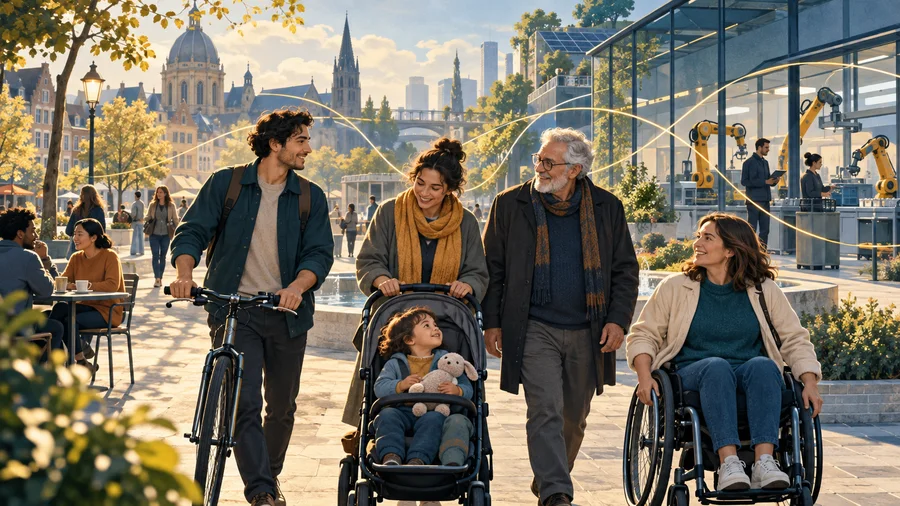
A robot takes over part of your work. Your working week becomes shorter and you have enough income left to live well. What do you do with the hours that become available?
Maybe you go to the gym more often. Maybe you'll finally play that game you never had time for. You join a sports club, follow an online competition or watch your favorite livestreamer in the afternoon.
These personal choices can together have major economic consequences.
If AI and robotization lead to more free time and sufficient purchasing power, sports and gaming can become important growth markets. This also includes amateur competitions, esports, live streaming, coaching and events.
Both industries are already large. The interesting question is how much bigger they can become when free time becomes less scarce.
Sports and gaming are already huge markets
This future does not require completely new needs to arise. People already exercise, play and watch on a large scale.
According to the European Health & Fitness Market Report 2026 from Deloitte and EuropeActive, the European fitness sector had approximately 75.5 million members and 65,700 clubs in 2025. Turnover grew by approximately 9.1 percent that year. This concerns fitness clubs; the broader sports world also includes associations, equipment, competitions and sports trips. Deloitte and EuropeActive
The global games market achieved a turnover of $201.6 billion in 2025, according to Newzoo's updated estimate, also up 9.1 percent from a year earlier. Newzoo
Watching others is also a great activity. Stream Hatchet recorded 36.4 billion watched hours in 2025 within the livestreaming market it tracks: a growth of 6 percent. This figure includes more than just gaming. Stream Hatchet
These figures measure different markets and cannot be directly added together. They do show that the infrastructure for a larger leisure economy already exists.
The future customer does not have to discover sports or gaming. Above all, that customer may have more time to participate.
More free time through AI is a scenario, not an automatic event
Higher productivity can enable a shorter work week. But companies can also use the extra production to grow further, reduce costs or increase profits.
With generative AI, the International Labor Organization emphasizes that job changes are more likely than complete job replacement. This research does not prove that everyone will soon be working less. Moreover, generative AI and physical robotics are different developments. ILO
For the analysis in this article, we therefore assume three changes:
- AI and robots take over enough tasks to save people time.
- This productivity gain actually translates into more free time.
- People retain sufficient disposable income, for example through wages, lower costs, income support or a possible basic income.
The third condition in particular determines how much companies can earn from it.
More free time increases the space for consumption. Purchasing power determines how much of this becomes paid consumption.
Why the sports industry can benefit
Time becomes less of a barrier
A training requires more than the hour you exercise. You have to travel, change clothes and fit the activity in between work, household and other obligations.
When people work less, planning can become easier. A second training per week becomes feasible. A tennis lesson on Tuesday afternoon suddenly fits. A sports weekend does not have to cost fewer vacation days.
This can create opportunities for gyms, associations, trainers and providers of recreational sports.
Part of the growth may also come from existing athletes. Someone doesn't have to become a new customer to book more lessons, rent a court more often or participate in additional events.
Sport can provide more structure and social contact
Paid work gives many people fixed times, goals and contact with others. If work takes on a smaller role in daily life, the need for that structure may continue to exist.
Sports clubs can follow this with fixed training sessions, teams, tournaments and shared goals.
This is a possible behavioral response, not a proven consequence of large-scale automation. But it makes it clear why the opportunity goes beyond selling additional fitness subscriptions.
A club can also become a place where people organize their week and belong.
Competitions can grow on more levels
More available time can create space for amateur competitions, local tournaments and recreational events.
That is why the commercial potential is not just about top sport. Also consider a weekday padel competition, a regional running competition or a football tournament for adults.
Income from participation can be generated from registrations, training, rental, catering and sponsorship. The condition is that there is sufficient local demand, affordable space and organizational capacity.
The growth opportunity may be just as good for the recreational athlete as for the professional athlete.
Why gaming can also grow
Gaming can take up extra free time in different ways: playing longer, trying more games, organizing competitions together or watching others play.
A distinction must be made between more playing time and more turnover.
Anyone who spends an extra hundred hours in a game that has already been purchased does not automatically spend extra money. Free games can also get a lot of attention without every player paying.
Sales growth only occurs when additional involvement leads to, for example, new purchases, subscriptions, expansions, advertisements or paid events.
Gaming can take on a greater social role
In the future scenario of more free time, people can more easily plan regular play times together.
A group of friends can start a weekly competition. An online team can train more often. Players can undertake longer joint adventures.
This means gaming can play a greater role as a meeting place and shared hobby. That opens up potential opportunities for community management, tournament organization and services that help groups play together.
The value is not only in the game itself, but also in the people you meet there.
More players don't automatically make esports more profitable
More free time can broaden the base for competitive gaming: more participants, more amateur teams and possibly more viewers.
Yet a publisher, a professional team and a tournament organizer make money in different ways. A popular competition can attract a large audience and at the same time have high costs.
Therefore, it is too simplistic to say that a larger gaming market will automatically make every esports organization richer.
A more credible growth path lies at multiple levels: local events, accessible online competitions, coaching and major professional tournaments. Each of these needs its own revenue model.
Live streaming can benefit players and viewers
A gamer can play, watch a match and then follow a live stream. As a result, one interest can lead to different forms of time use.
If people have more free hours, livestreamers can reach audiences at more times. Smaller communities around specific games, languages or interests can also benefit from this.
Possible sources of income include advertisements, subscriptions, sponsorships and voluntary contributions. But here too, extra viewing time is no guarantee for proportionately higher income.
Advertisers must have a budget available. Viewers must be willing to pay. Platforms also determine some of the conditions under which creators earn.
More free time also means more competition between makers
The same development that increases the audience can increase the number of streamers.
When more people have time to broadcast, more channels compete for attention. AI can also simplify certain production tasks, such as preparing subtitles or editing clips.
This creates an important tension: the total market can grow while it remains difficult for an individual maker to build an audience.
More viewers make attention more valuable. More creators make that attention harder to win.
Sports versus gaming: what are the differences?
The comparison below describes possible effects within the scenario of more free time and sufficient purchasing power.
| Item | Sports | Gaming and live streaming |
|---|---|---|
| Effect of extra time | More frequent training, more lessons and competitions | Play longer, more competitions and viewing time |
| Possible income | Memberships, coaching, rentals and events | Games, subscriptions, advertisements and events |
| Main limitation | Space, facilities, guidance and affordability | Attention, competition and willingness to pay |
| Social opportunity | Teams, associations and local meetings | Online groups, teams and maker communities |
| Growth without much extra turnover | Walking, training at home, using the same subscription more often | Play for free, play existing games and watch free streams |
Gaming can expand digital participation across national borders relatively quickly. Physical sport often requires extra courts, fields, halls or trainers.
On the other hand, sport can offer local encounters and physical experiences for which people may consciously make room in their budget.
Both industries can grow, but the growth does not have to come from the same companies or revenue models.
Basic income can make a difference — depending on what's left
A possible basic income can provide financial security. However, for paid leisure activities, what counts is how much money people have left after housing, energy, food and other necessary expenses have been paid.
An income that only covers basic needs creates little room for expensive equipment, sports trips or multiple subscriptions.
Therefore, three outcomes are conceivable:
| Scenario | Possible effect |
|---|---|
| More free time and more disposable income | Ample opportunities for paid sports, gaming and events |
| More free time and approximately the same purchasing power | Increased participation, with selective additional expenditure |
| More free time and less purchasing power | More interest in free and cheap activities; pressure on expensive providers |
The difference between those scenarios is big. A sector can gain more users while the average expenditure per user decreases.
The biggest opportunity: giving people something to look forward to
Sports and gaming have a shared strength within this scenario: they can provide goals.
Win a match. Improve a personal record. Play a competition with friends. Experience an event together.
If paid work takes up less time, such activities can become more meaningful. The commercial opportunity then lies with providers who help people participate, make progress and stay in touch.
These could be large platforms, but also a local trainer, a sports club or an organizer of small gaming tournaments.
The economic question then becomes: who makes the extra free hours attractive enough to spend time and money on it?
Frequently asked questions about AI, sports and gaming
Does AI automatically provide more free time?
No. That depends on how productivity gains are distributed. Shorter working hours are one possible outcome, in addition to more production or lower costs.
Can gaming grow if people work less?
Yes, more available time can increase participation and viewing time. Turnover only grows when that extra attention also results in paid purchases, subscriptions or advertising revenue.
Can the sports industry benefit from a basic income?
This is possible when people have enough money left over for sports. Affordable facilities, accessibility and guidance also remain important.
Does this make livestreaming an easy profession?
That does not follow from this scenario. A larger audience can go hand in hand with more competition between creators. Personality, quality and an involved community remain possible differentiators.
Can sports and gaming grow at the same time?
Yes. People can divide their extra time between exercise, playing and watching. At the same time, both industries compete with other activities, such as travel, family, culture and volunteering.
What would you do with ten extra free hours per week: exercise, play games or both?
Sources
- Deloitte and EuropeActive — European Health & Fitness Market Report 2026, published April 15, 2026; figures for 2025.
- Newzoo — Global games revenue cracked $200 billion in 2025, published June 18, 2026; updated estimate for 2025.
- Stream Hatchet — 2025 Yearly Live Streaming Trends Report, reporting year 2025.
- ILO — Generative AI and Jobs: A Refined Global Index of Occupational Exposure, 2025 survey.
Editorial research date: October 21, 2026. The future impacts on sports and gaming are scenario analysis by the author, not a growth forecast from these reports.